Monday, 25 January 2016

Positive Action for Change in Mental Health Services - Part 1


In November last year I attended this one day conference organised by PCCS Books in Nottingham. Two of the keynote speakers – Lucy Johnstone and Sami Timimi – had previously travelled to Powys to speak at a conference organised by our team in March 2014 - Finding Meaning in Psychosis: Early Intervention Services. This conference had highlighted the debate that challenges the validity of ‘mental illness’ diagnosis and raised questions about whether the idea of ‘mental illness’ is useful in driving innovation. However, due to leave I had been unable to attend. So, I was really keen to make the trip across country now to find out more about implementing innovative approaches to mental health distress. And the conference promised not just two but several inspirational speakers.


PCCS Books is an independent mental health publisher dedicated to the demedicalisation of distress, and person-centred, recovery-focused mental health services. The name developed out of a training organisation called ‘Person-Centred Couselling Services’, and at the conference (I think they organise one every couple of years) Director Heather Allan welcomed everyone and set the scene for the day:

“The case for demedicalising mental health services is well rehearsed. The research has been done, the conferences have been held and the intellectual argument all but won. Yet on a day-to-day basis, services continue to operate within the medicalised status quo. One of the aims of this conference will be to look at how we can implement realistic, practical changes in our mental health practice, education and lives, in order to continue the progression from rhetoric to reality.”

Due to limited space I can only touch briefly on the speakers’ presentations with a focus on their practical suggestions for bringing about change in working practice. (Full presentations are available here however).

Lucy Johnstone – Challenging, compromising or colluding? Some thoughts on trying to bring about change in mental health systems

Lucy made regular reference to her own personal situation working as a Consultant Clinical Psychologist at the Royal Glamorgan Hospital for Cwm Taf University Health Board in South Wales. This is the most socially deprived area in the whole of Wales, where 13% of the population are in contact with mental health services. It was a very medicalised service when Lucy arrived.


Lucy has since introduced an approach called “team formulation”. Regular meetings take place involving services in contact with an individual experiencing distress, within Community Mental Health teams, Assertive Outreach teams, rehab services and inpatient wards, to develop an in-depth understanding of that person’s particular difficulties. Staff will then work together to tailor any support to the needs of the individual rather than applying a one-size-fits-all approach. Using a case study of a 17 year old girl hearing hostile voices, Lucy contrasted the medical approach, which resulted in a diagnosis of psychosis/schizophrenia, to the way team formulation drew out the young woman’s story of abuse and bullying over a period of years. The latter approach acknowledges that responses such as hearing voices are survival strategies – “a normal reaction to abnormal circumstances.” 

In Cwm Taf team formulation has spread organically and not aroused much resistance. Lucy explained that her colleagues may not always agree with her approach but they take her stance on board, and some people are shifting away from using diagnostic approaches. The team formulation approach had led to “a change in thinking” and become “part of the culture as a word and a concept.”

“Instead of giving a diagnosis, we need to listen to people’s stories.”


Peter Beresford – From mental health to mad studies: making involvement real


Peter Beresford was introduced as the first “out” mental health service user to become a professor (Professor of Social Policy at Brunel University in London in fact). He spoke knowledgeably about the political background to current mental health service provision, noting politics’ powerful alliance with traditional psychiatry at the expense of those living with mental distress. He believes that “lived experience” is devalued by government, and rather than trying to influence politicians we would be better advised to take the initiative ourselves. Peter’s recommendations included:
  • Resisting forced employment and impoverishment.
  • Holding on to good participative practice.
  • Listening to service users.
  • Encouraging service user input in professional training, which has a real impact on service culture.
  • Focusing on changing the future for mental health and service users by innovating, by developing our ideas for change and our practice.
Peter also spoke about the value of Mad Studies, and referenced the recent conference Making Sense of Mad Studies which my colleague Anne attended in early October.

“We have to be courageous and rigorous and stop hoping that powerful big voluntary organisations will speak for us.”

Look out for Part 2 of this conference report next week, when I feature the talks of keynote speakers Sami Timimi and Pete Sanders. You can also find out more about the Soteria Network and the British Association for Person-Centred Approach, along with other organisations who attended. Thanks for reading, and let us know your thoughts on these ideas and approaches in the comments box below.

Monday, 18 January 2016

Meet Mandy Pearce - Reablement Worker at Mid Powys Mind


In 2015 Mandy Pearce started as Mid Powys Mind’s new Reablement Worker, funded by the Lloyds Bank Foundation, in a new three year project to help support people in transition from hospital. 

Working originally with patients from Felindre Ward in Bronllys Hospital, South Powys (a ward offering acute inpatient mental health services) the Reablement Service offers much needed support to people coming home after a medium to long term hospital stay.

We caught up with Mandy recently at her Llandrindod base to find out more about the project has evolved since she started last summer.


What does reablement mean exactly?

The reablement approach is well known in physical health. It is newer in mental health. It is short intensive support, usually offered to people in their own homes, after a stay in hospital and during a period of ongoing recovery back in the community.

I have access to patients’ Care Plans, liaise with their Care Co-ordinators and also attend their discharge meetings. Once they have left hospital I then visit them and provide support depending on their needs. This can be very varied depending on individual situations. Two of my first clients had been long-term patients on the ward – one for 12 months. There was a lot of work to be done. People become quite institutionalised and it can be quite scary returning to the community. Even going to the corner shop can be hard.

Some people, meanwhile, are only in hospital for a couple of weeks and then quickly get back on track with their lives once they leave.

How does reablement make people’s lives better?

It provides additional support that hasn’t been there before. It’s about looking at people’s needs. Isolation is a key word really. The hospital reflects that sense of isolation back to the patients. They have been unwell at home for quite a long period, perhaps staying indoors, maybe even in bed. Then they go into hospital and are still quite isolated.

Originally I thought the role would involve carrying out practical tasks such as looking after a pet or going shopping. But people want to talk. That’s often their main need. We have to be flexible in our approach and try and meet people’s needs.

Who is eligible to receive the service?

When I started it was just available to ex-patients of Felindre Ward who are from the Radnorshire area of Powys. However, my remit has now been extended and I work very closely with the Crisis Resolution Home Treatment Team which is based at Bronllys Hospital. Staff in this team support people to remain at home, and when people are discharged from their care they can be signposted to me for further support.

How was the need for your post identified?

Colleagues at Mid Powys Mind originally identified a need through speaking to staff at Felindre Ward and the Crisis Home Treatment Team. They then worked on a funding bid and were pleased to receive an award from the Lloyds Bank Foundation to fund a 3 year project.

Key to my role is my link with Mid Powys Mind. Mind offers a comprehensive service with many different facets, and I can help people understand the service and access the right area. People might just sign up for counselling or go to the art group once a week. It’s whatever works for them. More often than not it puts routine back in to their lives plus it gives them the opportunity to spend time with others who understand.

I can also signpost people to Tim Skelcher, our 1:1 Recovery Worker. 


You mentioned isolation, what are some other typical difficulties that people face upon leaving hospital?

Yes, isolation is a key factor as well as low confidence and, of course, stigma. Living in rural areas is not only a contributing factor to isolation but can make someone feel that all the locals have an idea of what has been going on for them and although things are improving around awareness there still is a certain amount of stigma surrounding mental health issues.

Returning home from hospital can be daunting for patients as it can be a reminder of how unwell they were before their admittance to hospital. Properties have been left and the environment can be reflective of how unwell someone was. So, practical help in sorting and organising can be really helpful. There can also be a backlog of mail that needs attending to. This can be stressful depending on what it is.

How long does your support last?


I work with people for up to eight weeks following their discharge. However, if I feel they need further support I can request an additional four weeks. It can take a long time to get there sometimes.

I visit Felindre Ward regularly so that people know who I am and generally have a chat with the patients. There is not enough talking going on. Interpersonal skills are so important to people’s recovery. When I start working with a patient I often find that they just want to have a good chat.

How do people stay safe, well and independent once the reablement support has finished?


Some clients may already be in receipt of additional support via the Community Mental Health Team and other care organisations. However, as part of my post it is important to try to engage people with the service of Mid Powys Mind and introduce/support them to access possibly outreach groups and many other activities that Mind has to offer.

Tell us how your work fits in with that of other voluntary sector groups


At Mind we have been working hard to create better working relationships with partner organisations that can offer a specialist service to cater for a client’s specific needs. For example - drug and alcohol support, housing and tenancy. Also, doing something meaningful with their time when further along on their recovery journey can play a very valuable role, so volunteering themselves could be an option.

What are some of the hardest things about working on this project?

I suppose one of the hardest things about this job is that time is limited. During my time with a client I can develop a good working relationship and in order to do this there is a certain amount of trust and understanding realised. It is hard when our time comes to an end for them and all clients so far have said they wished it could have been for longer.

The nice things about working on the project?

The nice part of this post is, of course, seeing clients develop and their confidence build and an ability to push their boundaries and try new things.


Any other recent developments at Mid Powys Mind you can update us on?

We are developing a youth peer support group (18 – 25 year olds) which meets weekly on Tuesdays, 1 – 3pm, in the Training Room at the Resource Centre. It is great to be able to put young people in touch with their peer group and signpost them to other services that can be useful to them. We’re planning to work again with Owen Griffkin later in the Spring with more Havin’ A Laugh workshops. And a professional animator will be coming in to bring people from different generations together and interpret their stories using animation, so we’re very much looking forward to that. 


Many thanks to Mandy for telling us about the Reablement Service at Mid Powys Mind. You can contact Mandy by emailing re-able@midpowysmind.org.uk or ringing 01597 824411.

Monday, 4 January 2016

Top mental health vloggers & videos

Happy New Year! Traditionally we start the New Year by recommending some of our favourite blogs. In the past we have covered mental health and also dementia. This year we’re looking at videos and vlogging.

“A vlog (or video blog) is a blog that contains video content. The small, but growing, segment of the blogosphere devoted to vlogs is sometimes referred to as the vlogosphere.”

There are a surprising number of people vlogging about mental health. Many of these are young people around the world who have grasped the opportunity that the video site YouTube provides to talk about their personal experiences online. Many report that they find it therapeutic to do this, and hope that their experiences will also help and support others who are struggling with mental health issues.

A high proportion of these vloggers regard their distress as an illness and their experiences are very much phrased around the medical model relating to mental health. There are, however, some videos which take the social model view, and others where the boundaries are blurred. You can read more about the debate around the medicalisation of mental health on this blog, suffice to say most (though not all) of the recommended vlogs and videos here tend towards the view that mental distress is, as campaigner, writer and speaker Jacqui Dillon states, “a normal response to abnormal stress”, as opposed to an illness. 

And so whilst we’re on the topic of Jacqui, we may as well start the list by highlighting a video of her on our very own PAVO YouTube channel. This was made at the 2013 Powys “Shaping Services” conference.


The channel Crazywise is run by photographer and film maker Phil Borges and features videos questioning how 'Western culture defines and treats severe mental disorders'. Phil is also working on a feature length documentary 'challenging the current mental health system in crisis'. Many of the Crazywise films are interviews with "experts" talking about their experiences in the field, including British psychiatrist Russell Razzaque who has a background in mindfulness meditation and is currently leading a clinical trial into Peer-Supported Open Dialogue
.


Rai Waddingham hears voices and sees visions. She is an 'independent trainer specialising in innovative ways of supporting people who struggle with extreme states (including ‘psychosis’, ‘dissociation’ and post traumatic reactions).' This video from her channel 
focuses on her experiences of hearing voices.


.
Laura Delano, an American who also features on the Crazywise channel, has her own independent channel where she vlogs regularly about her own experiences of psychiatry and the psychiatric system. She describes herself as an ‘ex-"Bipolar" patient, (and) discusses life after psychiatric labels and psychotropic drugs’.


Another Laura, Laura Nuttall, vlogs about her experiences in psychiatric hospital with real insight given to the actual experience of being on a mental health ward in the UK.


LikeKristen is a young American vlogger with a very watchable style. Her videos include all kinds of mental health topics, ranging from experiences of self harm, to stigma and practical suggestions to help recovery. Here is a link to her journaling video. 


Fixers is a UK organisation featured previously on our blog. Sarah Harmon, who lives in Powys, talked for Fixers about her experience of mental health issues and the work she does in schools to help combat stigma. Fixers is a project of the Public Service Broadcasting Trust, and uses short film and other media to enable young people have their voices heard and help make positive change. Check out the Fixers website to watch videos relating to mental health and young people in Wales.


Kati Morton is an American therapist who provides information about “conditions” and “treatments” that are very easy to follow. As the National Health Service in the UK uses much of the same terminology it can be helpful to watch these if you want to find out more about treatments such as Cognitive Behavioural Therapy (CBT) that are available to people here too.


And finally, the Spiritual Crisis Network has some excellent videos on its website, including a 5 minute animated film called "Compassion for Voices: a tale of courage and hope", produced by King’s College, London.


We hope you enjoy watching some of these videos and vlogs, and would love to hear about others that you recommend. Let us know in the comments box below.

All the best for 2016 from the mental health team at PAVO – Angharad, Anne, Glynis, Jane and Jackie.

Wednesday, 16 December 2015

Havin' a Comedy Christmas 2015


"Tis the season to be jolly....." 

Yes, it's that time of year again. It's unbelievable how quickly it turns up each December.  In 2014 we posted Top 10 Tips to Survive Christmas, as we recognise that the festive season is not everyone's favourite period.

For Christmas 2015 our team have been inspired by local comedian Owen Griffkin's new comedy workshops to think how laughter has kept us going over Christmases past.

Each of the team has come up with a book, or film, or memory that has made them laugh in Christmases gone by whilst wondering whether to embrace the holly (ouch) and mince pies with family, friends or even complete strangers, or just run and hide.

"Fa la la la la, la la la la...."


Angharad

Many things remind me of Christmas and the laughs I’ve had, such as watching classic 1990 Christmas film ‘Home Alone’ with Macaulay Culkin. But the highlight of any recent Christmas was watching my dog, Bella (a fluffy white bichon frise) open my mum’s Christmas presents for her. As the centre of our little family, she is without a doubt put on the highest pedestal, treated like a human and the focus of me and my mum’s lives. I’ve had the blessing of owning Bella since my last year in primary school, which makes Bella around 14 years old (an old lady!) yet she still has the personality of a puppy and hasn’t lost any of her diva like qualities yet. She is spoiled, and rightly so!


Last Christmas, the buzz and excitement of smelling her Christmas dinner and her presents under the tree were too much to bear, and she began like a puppy, tearing the corners of the wrapping paper off. We normally get her to help open a small section of our presents, but last year, she came into her own! Without any warning she took centre stage and started unwrapping presents in the middle of the living room, swinging the paper around with her mouth as best she could, determined to find out what was inside! After some playful growling, swinging wrapping paper and presents and holding them down with her paws, she had unbelievably managed to open two well wrapped presents! This memory always makes me laugh at how loving and funny animals can be, who enjoy Christmas as much as anyone else! It also made me and my mum hysterically laugh, along with us clapping and cheering her along!

‘Animals are such agreeable friends - they ask no questions; they pass no criticisms.’ George Eliot


Anne

When Jackie suggested this topic for a blog, my heart sank slightly. Call me Scrooge but Christmas isn’t one of my favourite times of year. 

But then I remembered my favourite scene from "The Wrong Trousers", an Aardman Animations film starring Wallace & Gromit that was first shown on Boxing Day in 1993, and will be forever associated with Christmas for me. It’s the train set chase scene where Gromit is attempting to stop criminal penguin Feathers McGraw escaping after a diamond heist. When Gromit grabs the box marked spare track and frenetically starts to lay track to keep the toy train on the rails, I was in hysterics. It’s well worth watching the clip on YouTube. I defy anyone not to smile whilst watching it.


Jackie

Way, way back in 1982 I ripped open a Christmas present whilst on holiday in Dorset. It was a copy of the now legendary Adrian Mole book by Sue Townsend - “The Secret Diary of Adrian Mole aged 13 ¾”. I started reading, was hooked after two pages, and didn’t stop until I’d finished a few hours later. The Christmas pudding was long since cold, the mince pies just crumbs swimming in spilled alcohol, and my elbows had turned black and blue from lying still for so long. It was the funniest book I’d read in ages by a classic writer of comedy fiction. Who hasn’t heard of Adrian Mole?

Sue Townsend went on to write a total of 8 books about Adrian Mole, taking him from angst-ridden teenager in the Thatcherite years of the 1980s to the brink of middle age in the The Prostrate Years and Gordon Brown’s New Labour era of the late noughties. I haven’t read the later volumes - so there is more laughter to look forward to yet.

Here are a few of my favourite quotes from the original classic:

“I must say that I take my hat off to Sainsbury's, they seem to attract a better class of person. I saw a vicar choosing toilet paper; he chose a four-roll pack of purple three-ply. He must have money to burn! He could have bought some shiny white and given the difference to the poor. What a hypocrite!”

“It is the first day of spring. The council have chopped all the elms down in Elm Tree Avenue.” 


“I have never seen a dead body or a female nipple. This is what comes from living in a cul-de-sac.”


Jane

Some years ago my mother came for Christmas. She was (she died this year) a very difficult person and there was always a fair amount of tension with her around. During Christmas Eve she snapped at one of my teenage children for not doing, in her eyes, sufficient washing up. A general shouting match ensued with my mother shouting at said child and ripping up the Christmas present she was going to give to this offspring - who obviously shouted back that no-one had wanted Granny to come anyway and me shouting at my mother in defence of my children. 

Meanwhile my husband was at his work’s Christmas booze-up - which was legendary. My daughter rang the most likely pub, found him and summoned him back. Eventually he wove his way home and into this maelstrom, lay on the floor and declared “I love you all!”. I can’t actually remember what happened next - but I found a mention of this in some notes after my mother moved out of her house into a nursing home - she had written “Christmas with Jane and children, least said”. For us this is now a traditional family Christmas story, and I guess it goes to show that Christmas can be difficult and tense and also, at least in retrospective, hilarious too.


Support over Christmas

Wellness and Recovery Learning Centres around Powys are open at some point over Christmas and the New Year and would welcome your visit. Click here to find their contact details and links to their own websites.You can link to national helplines here.

If you need help urgently find information here.


Have a Happy Comedy Christmas and we look forward to hearing from you in 2016!

Tuesday, 8 December 2015

Making Sense of Mad Studies

by Anne Woods 
Participation Officer, PAVO mental health team

Illustration by Grietje Keller
I recently attended a two day conference at Durham University entitled Making Sense of Mad Studies organised by the North East Mad Studies Forum. Before attending, I wasn’t too sure about what to expect. Mad Studies wasn’t something that I had come across before and I felt slightly uneasy about using the word mad in this context, a theme that came up in the conference and on Twitter. 

The term Mad Studies has been credited to Richard Ingram, one of the speakers, who was inspired by the creation of Deaf Studies as an academic discipline distinct from Disability Studies and wondered whether the same could happen for madness. In his presentation he said that finding method in the madness was not as important as preserving the madness in the method! In other words, Mad Studies is a way of looking at the world that uses and benefits from a different perspective to life and need not only apply to academic research on mental health. The consensus from the conference seemed to be that Mad Studies was something done by people who identify themselves as mad and not something done to or about them.

Richard Ingram
A fuller definition is provided in the book, "Mad Matters" (2013) edited by Brenda LeFrancois (another conference speaker), Menzies and Reaume.

“An umbrella term that is used to embrace the body of knowledge that has emerged from psychiatric survivors, Mad-identified people, antipsychiatry academics and activists, critical psychiatrists, and radical therapists. This body of knowledge is wide-ranging and includes scholarship that is critical of the mental health system as well as radical and Mad activist scholarship. This field of study is informed by and generated by the perspectives of psychiatric survivors and Mad-identified researchers and academics.” 

Brenda LeFrancois
The conference included a wide range of speakers from different backgrounds: academics, some of whom identify as ‘mad’, early career researchers, activists, artists, people with lived experience of various types, sometimes presenters falling into several categories. Presenters shared some intimate and honest accounts of their own life experiences within the psychiatric system and how that had informed their work.

The agenda was jam-packed but some highlights for me included hearing about Mad Studies reading groups in Amsterdam from Grietje Keller. The groups give a space for reading and discussing critical texts that challenge the dominant medical psychiatric model and are mostly attended by people who have been users of mental health services. The groups are popular and give attendees a different perspective on their experiences.

There was discussion around ‘doing’ (teaching/ learning about) Mad Studies with a presentation from participants and tutors of a course at Queen Margaret University in Edinburgh for people with lived experience of mental ill health, and tutors of a course for approved mental health professionals (AMHPs) describing how important it is for professionals to be trained by people with experience of being on the receiving end. Dr Dina Poursanidou talked about the challenges that this throws up, including managing the emotional toll of using traumatic personal experiences as an education tool, something of particular relevance to PAVO’s mental health team in the participation work that we do. 

Brigit McWade from Lancaster University on Recovery
This theme was also picked up later by an action group called ‘Recovery in the Bin’. They have adopted 18 key principles, one of which is, “we refuse to tell our ‘stories’, in order to be validated … We believe being made to feel like you have to tell your ‘story’ to justify your experience is a form of disempowerment, under the guise of empowerment.” This is an issue that I am well aware of from personal experience. As a team, I think we recognise this and carefully balance our desire to use powerful personal stories to facilitate change against the emotional toll on the individual and their right to control how much and when they disclose.

The Recovery in the Bin presentation gave food for thought on the concept of recovery and the group’s contention that it has been appropriated by mainstream mental health services and is less focussed on what’s best for each individual and is more concerned with what’s best for a capitalist society, ie: getting people into employment and off benefits as quickly as possible. The group talk about the validity of remaining ‘unrecovered’ by this measure, finding ways to live with distress that does not necessarily neatly fit into a recovery star model, also recognising that some life experiences have to be tolerated rather than recovered from.

"You told me I'm my own worst enemy. So I got a restraining order against myself!"
The conference had a breadth of views and opinions and there were some challenging discussions, about racism in psychiatry and academia for example, as well as humorous moments such as why art made by service users can actually be good art. It introduced me to several views and topics that I hadn’t come into contact with before and had a good mix of people sharing their personal experience and academic theory. It will be interesting to see how the discipline develops and whether, in future, universities will have departments of Mad Studies and full-time degree courses or whether it becomes a movement developed by grass roots activists – or both!


You can find more Mad Studies resources on a website run by Brigit McWade.

Tuesday, 1 December 2015

Re-Live Theatre @ Dementia Supportive Communities event


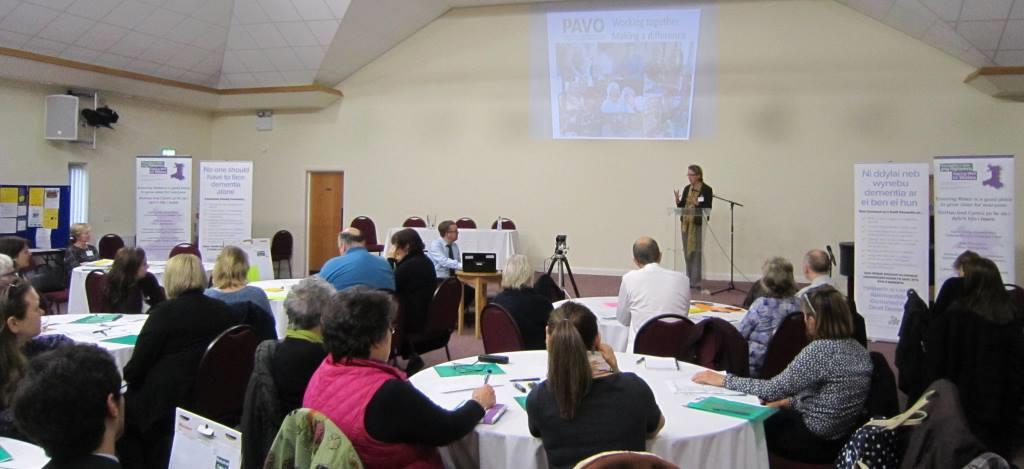
Last Thursday I attended a Dementia Supportive Communities network event in Brecon organised by Ageing Well in Wales and Brecon and Hay Dementia Supportive Community with support from Alzheimer's Society, Powys Association of Voluntary Organisations, Powys County Council and Powys teaching Health Board. The event was extremely well-attended, with representatives from the statutory, voluntary and private sectors.

The aim of the event was "to build and develop Dementia Supportive Communities across Powys by:
  • Sharing examples of practical ways to support people with a dementia.
  • Identifying best practice and sources of information.
  • Exploring ways of working together in the future."
It was an absolutely packed day, and all I can do here is focus on some highlights, whilst giving links to further information where appropriate.

The day was introduced by Gweneira Raw-Rees (below left), the Project Lead for Ageing Well in Wales, which has the challenging remit of "ensuring Wales is a good place to grow old for everyone". Gweneira explained that one of AWW's roles is to share good practice through events. "The formula is simple. To try to inspire people to take action."  

Our facilitator for the day was Trish Richardson (below right) of Brecon and Hay Dementia Supportive Community. Trish explained the concept behind dementia friendly communities (interchangeable with dementia supportive communities), emphasising that "it is about enabling people with dementia, working with them as opposed to doing for them."


First up, and certainly the highlight of the day for me, was a performance from Re-Live Theatre Company, working alongside people with dementia. The company is passionate about the role creativity plays in removing stigma, and aims to put the real stories and experiences of people with dementia out there. The short performance was made by two members of the company alongside real people (not actors) sharing their real experiences. These included features around the importance of singing for some, and the humiliation of being bid for as a 68 year old male in "not too bad condition.... not too challenging... no immediate family... if you know what I mean...." Number NL2810 was then sold to the highest bidder for £500 - securing his place at an Elderly Infirm Unit.

And Jill Grey read her powerful poem with support from other members of the group.


They meet in the appointed room.
Laptops, briefcases, suits.
Meet bi-monthly,
Promptly, religiously,
Unless, of course, it's cancelled
And nothing happens.

They bring their minutes
Their memos
Their own agendas,
Protect their kingdoms
Cover their backsides
And nothing happens.


They have a bright idea.
It's brilliant, workable
Inexpensive.
Then it's - 'Maternity Leave',
Or - 'Change of Post'
And nothing happens.

'Care in the Community' means
'Keep them at home'.
Poorly trained care-workers; different each day
With eyes on the clock, pens on the paperwork
And minimum pay.
Promises of improvement
But nothing happens.


A brand new ward! An Assessment Ward!
Retitled - 'Assessment and Continuing Care'.
Queues grow deeper, waiting lists longer.
Does it really matter?
The outcomes are the same.
So nothing happens.

They close a ward; its soul has flown.
A dementia ward now filled with ghosts.
In general wards they cannot sleep.
"Those damned dementia patients!
Why can't they just shut up!"
But nothing happens.

Tories blame the Socialists.
Socialists the Tories.
Lib Dem, UKIP, Plaid add their two-penneth too.
Oh where is the one who can wield Excaliber or hold aloft good Merlin's Wand?
A bold magician who would override us all
And make it happen!

L-R: Gloria Jones Powell (Chair, PAVO Board), Joy Garfitt (Head of Adult Social Care, PCC),
Rhiannon Jones (Executive Director of Nursing, PtHB)
How to follow that? Well, that was the task of the next three speakers. They all made comprehensive presentations from their individual organisations' perspectives about work being done to encourage dementia supportive activities across Powys. All three acknowledged that there is still a lot to be done, but the ambition is clearly there. Again, I can only give a flavour here due to lack of space, but there is a link to the presentations at the end of the post.

Rhiannon Jones, Executive Director of Nursing, Powys teaching Health Board
Rhiannon clarified that dementia currently falls into the mental health strategy for Powys - Hearts & Minds. Her role as Chair of the steering group overseeing the Joint Dementia Action Plan is to work more with people in contact with services, and the community, to get it right.

Joy Garfitt, Head of Adult Social Care, Powys County Council
Joy spoke of the journey currently being travelled to make the council a person-centred organisation. "It is about support, not necessarily services. It is not about fitting people into a box." She explained that from April 2016 the new Social Services & Wellbeing (Wales) Act will change everything.

Gloria Jones Powell, Chair of Trustees, Powys Association of Voluntary Organisations
After introducing the audience to PAVO's general role in supporting the Third Sector, Gloria highlighted three very relevant services - Powys Befrienders and the Third Sector Brokers are hosted by PAVO, whilst the new role for Powys of a Dementia Supportive Communities Coordinator is managed by Alzheimer's Society.


In one of the breaks I managed to catch up briefly with Karen Rodenburg (above), who has recently taken on this role. Karen is based in Newtown and covers Montgomeryshire & Radnorshire. Her colleague in South Powys is Ian Thomas, who is based in Talgarth.


A couple of really interesting workshops later ("Experiencing dementia - how does it feel?" with Re-Live Theatre Company, and "Setting up voluntary and community-led dementia friendly initiatives" with Brecon & Hay Dementia Supportive Community) and it was time to hear PtHB's Dementia Lead - Harold Proctor - speak.

After a little bit of history relating to person-centred care, Harold described how practically we can help people with dementia who are in a hospital environment. He touched on everything from the Butterfly Scheme, to colour and tonal contrast in the physical environment, with references to liaison nurses, specialised training, digital technology and dementia pathways along the way.


Rachael Beech, PAVO's Powys Befrienders' Coordinator, was the final keynote speaker of the day. Her topic: Establishing a Powys Dementia Network. She put into words what I had been thinking increasingly throughout the day - there is a lot going on around dementia in Powys. How do we pull it all together? Care homes. Memory clinics. Singing groups. Hospitals. Memory cafes. Carers' respite. Neighbours' support.... Who is doing what, where and when? PAVO has already started work on a mapping and gapping project, and now proposes initiating a dementia alliance, forum or network - Rachael asked people to suggest names. She also posed the questions - who would be invited? How often would it meet? Would a virtual network be an option?

The new network could be facilitated by PAVO, and would be aimed at people using services and their carers in the first instance. The idea is to launch it next April after further dementia events have been held and information gathered. What do you think? Would you find a dementia network useful? Have you got a good idea for a name? Let us know in the comments section below.

All told everyone seemed to find this dementia networking event extremely valuable. A similar event is planned in North Powys for the New Year. Watch this space for further updates. Here's hoping they manage to book Re-Live Theatre Company for another inspiring session.
_________

Dementia Supportive Community Coordinators in Powys
Montgomeryshire & Radnorshire: 
Karen Rodenburg, email: karen.rodenburg@alzheimers.org.uk
South Powys: 
Ian Thomas, email: ian.thomas@alzheimers.org.uk

Presentations from the day can be found on the Powys Mental Health website 
under the Powys Mental Health dementia blog section.

Jill Grey has written a book which is available online - 
After the Rehearsal - Living with Dementia, a Carer's Story