Showing posts with label person-centred. Show all posts

Monday, 3 December 2018

Connected Generation project

Connected Generation project staff meet the Community Connectors

Zandra Pitt is the Project Officer for this new lottery-funded project - Connected Generation -  in which five organisations work together with people over 50 in Powys.

I met with her recently to find out more about how Age Cymru Powys, Citizens Advice Powys, Credu, Disability Powys and the Royal Voluntary Service are supporting people to build on their strengths and enjoy a greater sense of wellbeing.


How did your involvement start?

I have worked in a variety of roles over the years, in England and Wales, including women’s aid and homelessness charities, a children’s legal centre and various community advice services. I studied law as an older student.

I was the Advice Manager at Cardiff University Student Advice Service for nearly seven years and saw a major increase in mental health problems whilst I was there.

Where did your interest in the project stem from?

The fact that it involves five partner organisations, each bringing their own scope of what they can offer, attracted me. That, and the person-centred approach of the project, really interests me. The project will raise a lot of the challenges that people over 50 have but also the opportunities that are available to them.

Tell us more about the project and your role

The Connected Generation project is funded by the Big Lottery Fund People & Places programme for three years. Of the five partners, Credu (formerly Powys Carers) is the lead organisation. As Project Manager I am based with Credu, along with two Outreach Workers. Then we have two Outreach Workers with Age Cymru Powys, another two with Disability Powys, one Adviser with Citizens Advice Powys, and the Community Development Worker and assistant with the Royal Voluntary Service.

The project is committed to working with people with the aim(s) that they will:

  • Feel more connected to other people and less socially isolated. 
  • Feel more able to shape the services that impact on their lives and feel more listened to, valued and respected in their relationships with services that matter to them. 
  • Feel that information, advice and support is more coherent and enable them to make informed choices. 
My role involved pulling the project together initially. I look after the reporting and monitoring, and raise awareness working with all the partners,

Which organisations do what?

When people are referred to the project the Outreach Workers from the relevant organisation (Credu, Age Cymru Powys or Disability Powys) will aim to build trust and rapport and have a conversation about what matters to them most over time. The outcome is around what that person wants. The workers may have to pull in others rather than signposting or referring on. We operate an “any door” approach. There is no central hub. Rather than turn people away the individual partners will make internal referrals so that people are not put back on the merry-go-round, constantly trying to find the right route in for support.

If reducing isolation is an outcome, then we would look at who or what that person wants to be connected to appropriately.

The staff have received training in “Circles of Support” and “Effective Collaborative Communication”. It is about listening and having the conversation at what matters to someone at a given time.

The client may want to pursue other interests. For example, Credu runs carers’ groups, whilst Age Cymru Powys holds regular crafts and social groups.

We meet regularly with Clair Powell, the Senior Officer Community Connectors at Powys Association of Voluntary Organisations. The Connectors refer clients in to the partner organisations for support.

Citizens Advice Powys has a caseworker dedicated to the project and can be pulled in by the outreach workers. She provides advice on a range of issues including benefits, debt, and housing.

The volunteer support element is led by the partner, the Royal Voluntary Service, whose community development worker recruits and trains volunteers to become companions.
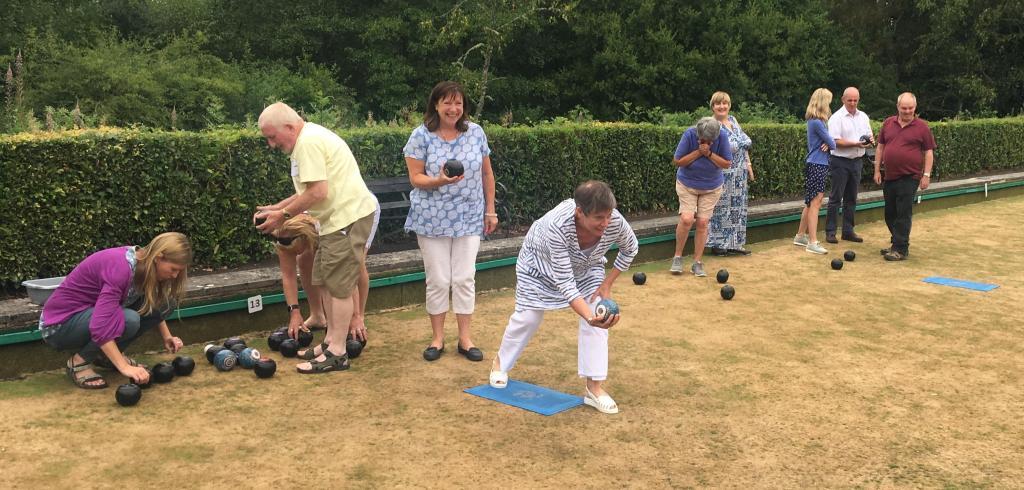
Connected Generation get together

Who is the project for?


People in Powys who are 50 + who need support. We aim to create long-term self help and support to build personal resilience for the future. If they require more specialist support, say round their mental health, we will pull in another organisation/service.

What kind of difficult life challenges do older people experience in Powys?

There are many examples. Some of the most common include:

  • The cared for and the carer. 
  • Coping with illnesses. 
  • A need for information and advice in order to move forward. 
  • Wanting to carry on meeting up with friends once a week when there are rural transport and/or mobility issues. 
  • Maintaining own home. 
  • Physical and/or mental health issues (including clinical depression/bipolar disorder/dementia). 
  • Feeling lonely and isolated. 

How does it support people struggling with their mental health?

We will provide support but may also look at pre-existing networks to refer to other specialist support such as Ponthafren Association or the nearest Mind centre as appropriate.

How does the project make a practical difference?

"Many thanks for your kind help and the information you have provided, really useful. I’m going to call Llanidloes Home Support in my lunchtime and I am working from home tomorrow, so if she could visit then that would be great, I’ll stay in touch."

"Carer phoned outreach worker a few weeks later and expressed his thanks again for all the help, his stepson’s anxiety levels were much lower and this makes his caring role more manageable."

"Just speaking to the outreach worker and getting the information he needed, M felt that he had lifted a big weight from his shoulders."

"By this time they were both overwhelmed that someone had stepped in and offered them information and support – ‘No one’s ever done anything like this for us before'."

"Somehow we have been listened to and heard and helped."

"Thanks for the visit. It is time for me to reassess my work / life / caring balance, so your contact couldn't have come at a better time."


How is the project influencing policy and practice at a national level?

We want to influence local government, the health board, National Government and hear the voices of older people to make changes to policy and improve services. It is about enabling the individual and collective voices to be heard in the right place.

Some of the groups come together with other stakeholders to inform and give evidence to various inquiries and consultations.

We’re aiming to work in a coproductive way. I attend the Older People’s Partnership Board along with Gail Hamer, the Chief Officer at Age Cymru Powys. The project started in January 2018 and we are already reviewing how it goes and learning all the time.

At the same time the five partners are all continuing to feed into their national networks.

What is the most challenging part of your role?

As I am new to the area – getting to know it better, as I’ve not worked in Powys before. Developing essential networks and understanding the scope of the organisations and other services. Ensuring that we keep true to the people centred approach.

Tell us about some of the most rewarding work you have done on the project so far

Meeting an incredible group of committed people. Myself, I’m a step away from working with individuals, but I’m very aware of the work they do in the team. They are very supportive to people who have powerful stories to tell.

When you’re not working how do you enjoy spending your time?

I like art, socialising with family and friends, and walking. I recently completed a three-day course on stained glass, which was really good. 


Many thanks to Zandra for telling us all about this exciting new project. To find out more about the Connected Generation project contact Zandra Pitt by emailing zandra@credu.com or ring 07971 637 447.


Thursday, 5 May 2016

Dementia Supportive Communities event - the North

Karen Rodenburg, Dementia Friendly Communities Coordinator, North Powys
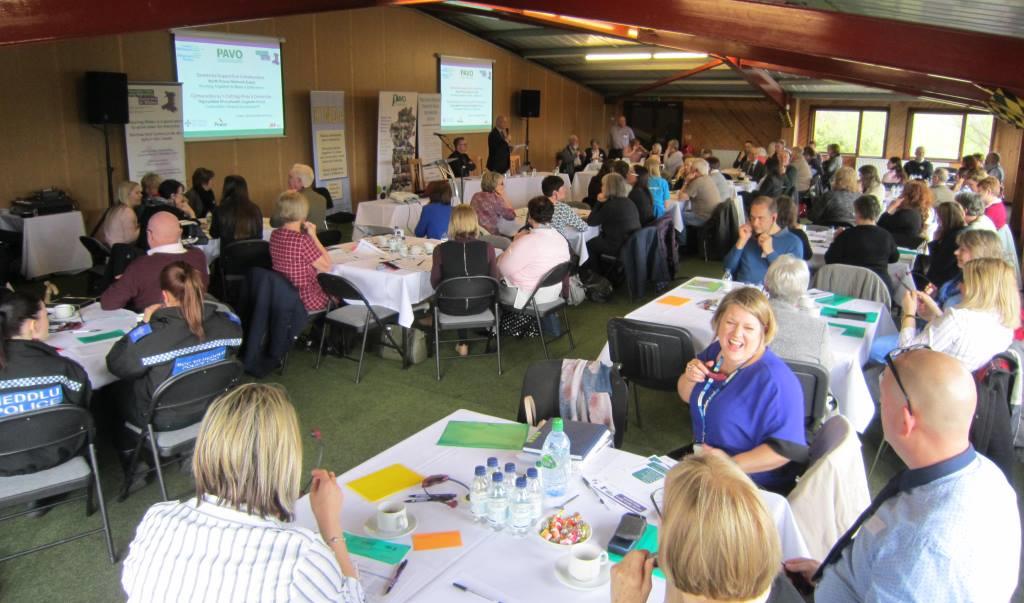
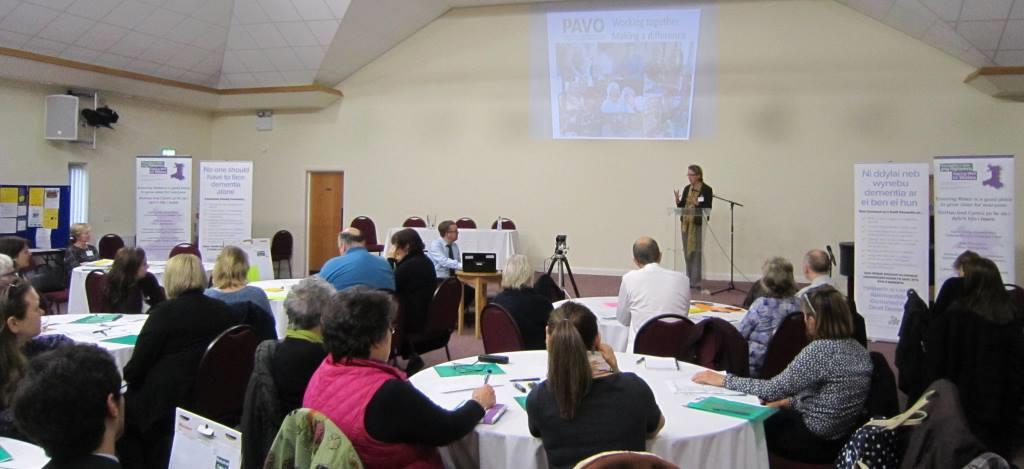
In November last year I attended an excellent Dementia Supportive Communities event in Brecon, South Powys. Last week it was the turn of the North. Thanks to the hard work of Ageing Well in Wales, Alzheimer’s Society, and Powys Association of Voluntary Organisations we had the opportunity to find out more about some truly inspiring initiatives already taking place. And by the end of the day people were asking not just – what has been done already, but what can we, what can I do, to make my bit of Powys a more dementia supportive (or friendly) community? The seed has been sown!

Read on to find out how the day - “Working Together to Make a Difference” - unfolded.


Carl Cooper, Chief Executive Officer at PAVO, set the context for the day, explaining that the new Social Services and Wellbeing (Wales) Act requires us to work with people and communities to address matters that are important to them, and dementia is very much part of that agenda as it touches the lives of so many people. Whilst much is already happening, Carl asked if the voluntary sector could work alongside the public and private sectors in a more effective and efficient way.

Steve Huxton of Ageing Well in Wales, and Carl Cooper, CEO at PAVO
Next up was Councillor Dawn Bailey, the Powys County Council Dementia Champion. Partnership working was also one of Dawn’s key messages. After touching on the history of the Dementia Supportive Community, and the need to treat everyone as an individual with specific needs, she outlined the council’s plans. These include moving to a creative approach, providing more community based services, and ensuring these are the best services possible given the reduced resources available. Dawn said that this will require culture change, both within staff and general populations, where everyone gets involved. What we need is a grassroots approach from the bottom up. The council’s aim for Powys to become a DFC will be formalized in the Dementia Mission statement soon to be adopted.

Councillor Dawn Bailey, PCC Dementia Champion
Steve Huxton, Network Coordinator of Ageing Well in Wales, followed by telling us that 45,000 people in Wales live with dementia and under half have received a formal diagnosis. People of all ages will be affected, directly or indirectly, through the experience of family and friends. He went on to outline what we mean by a Dementia Supportive Community:
  • It listens to people’s needs. 
  • It is patient and understanding. 
  • It engages with businesses and local organisations. 
  • It makes changes with people, rather than providing services for them. 
The concept has benefits to all of us, not just people with dementia, and has blossomed into a social movement throughout Wales.


Karen Rodenburg, Dementia Friendly Communities Coordinator in North Powys,
had literally just started when I attended the event in the South. Since then she has been extremely busy helping to set up DSCs across the North.

Karen explained that through this initiative we can help people to live well in their own homes and play an active role in their communities. Her presentation included local updates, case studies around partnership working, and outlined the mechanics of how to go about taking those first small steps to setting up a DSC in the first place. The roadmap (above) provides a snapshot of some of the key actions a community can then take to “empower people with dementia to have high aspirations, confidence and know they can contribute.”


Heather Wenban, Project Development Officer in Dementia Care at Powys Teaching Health Board then spoke on “Creating dementia friendly hospitals.” She touched on everything from the Butterfly Scheme, to colour and tonal contrast in the physical environment, with references to liaison nurses, specialised training, digital technology and dementia pathways along the way.


Dr Shirley Evans, Senior Research Fellow at the Association for Dementia Studies at the University of Worcester, described a research project on dementia friendly meeting places. The initiative, developed by the University of Amsterdam, brought health, social care and voluntary organisations together to create a community based club in an ordinary life setting. The pilot was so successful that it is now being replicated throughout several European countries, with Droitwich Spa hosting the first club in the UK. A second, more rural example, has just opened in Leominster. It will be particularly interesting to observe how this develops as it could more readily be applied to a Powys setting.


Rhiannon Davies, Co-chair of Brecon Dementia Friendly Community, followed, talking us through the history, starting in 2012, of the first DSC in Wales. The inspirational work that is being carried out in Brecon is now a model to other communities across Wales, as we found out during Dementia Awareness Week 2015. Rhiannon said that the most important thing that they had learnt in Brecon was the importance of action. No matter how inspired or committed people are, it is “how you walk the talk that counts”. She added that BDFC is open to sharing resources and experiences in supporting other DSCs to develop and grow.

Julia Llewellyn Roberts from KINDA with Carla Rosenthal (PAVO Participation Officer, mental health team)
There followed updates from some of the more recently developed DSCs in Powys. Each had its own quite individual origins and story depending particularly on who had initiated that all important “action” that Rhiannon had spoken about.

Julia Llewellyn Roberts – KINDA (Knighton Initiative for Dementia Action)

Julia had been inspired after hearing that Liverpool planned to become a DSC and in 2014 pulled together some key local organisations from which the steering group grew. KINDA now has alliances with the Royal Voluntary Service, Community Support, Men’s Sheds, primary schools and the Carer’s Trust
.


Nic Williams – LOUDA (Llandrindod Opens up to Dementia Awareness)

Nic, who is a Wellbeing Coordinator at Mid Powys Mind, was inspired at one of Rhiannon’s Dementia Friend sessions. She is currently fundraising whilst promoting the concept to cafes and hotels in the town, and has already involved the town council and Vanessa Garwood of Alzheimer’s Society.


Robert Robinson – Dementia Friendly Welshpool

As the Town Council Clerk in Welshpool, Robert was originally approached by Karen Rodenburg to consider how the town might become dementia friendly. In the short-term the new steering group is being chaired by the town council, which also provides support including secretariat, banking account, insurance, a website and use of a building. Karen has provided dementia friendly sessions for all the councilors and many of the staff too.


Councillor Kath Roberts-Jones & Councillor Stephen Hayes, PCC Portfolio Holder Health & Social Care
Workshops followed the presentations, and on our tables we all looked at how we could work to make our own communities more dementia friendly, taking into account potential barriers whilst suggesting areas of help and support. What impressed upon me was the sheer number of links we had just on our table of five people, into the third, statutory and private sectors, and also each of us into our own communities. We all agreed that as a first step it was important that we find out about becoming a Dementia Friend, and encourage colleagues, family and friends to do the same.

Freda Lacey, Senior Officer Health & Social Care at PAVO, also asked us to consider the potential value of a Powys-wide Dementia Forum or Network. There followed a lively discussion about the purpose, membership and location of such a network. No decisions have yet been made, but the feedback has been gathered, and Carl explained that in partnership with Powys County Council, Powys Teaching Health Board and other agencies all the comments will be taken on board. So, watch this space for further updates!

What do you think? Would you like to see a Powys-wide Dementia Network? And how would it work best for you? Are you setting up a Dementia Supportive Community in your area? Let us know in the comments box below.


A dementia sensory box - for stimulating conversation and reminiscing

Small changes help make a dementia friendly community – 
an Alzheimer’s Society video we watched during the day.

The event was supported by Powys Teaching Health Board, 
Powys County Council and the Joseph Rowntree Foundation.

Monday, 21 March 2016

Thrive at Mid Powys Mind


This week our guest post is by Mary Williams 
the Development Manager at Mid Powys Mind.


Mid Powys Mind is very excited to have trained in THRIVE, which is a non-medical course looking at recovery not just from mental health problems, but from any difficult period in life. It was developed by Marion Aslan of Elemental Wellbeing.

THRIVE stands for Time, Healing, Resilience, Interdependence, Vivacity and Emancipation. 


The course uses a huge range of tools from various sources (person centred planning, counselling, psychology etc) to help people move forward, recover and thrive again. 

The course also doubles up as a staff training tool, to enable staff to use THRIVE principles and tools within their work.

THRIVE covers


Time
Safe ways to take a balanced look at our lives so far, the important factors that can affect us over time including turning points, telling your story, timelines and tools to help people move forward.

Healing
Ways in which people survive and heal from difficult experiences and important factors that help and hinder this process. 

Resilience
Looking at tools to help you build your resilience and manage difficult emotions.

Interdependence
There is sometimes too much emphasis within services placed on people acquiring independent living skills without exploring and acknowledging the need for social skills and connections. This module looks at the importance of that, what those relationships could look like and where you might find them.

Vivacity
Going beyond ‘getting through the day’ to really enjoying life - thriving.

Emancipation
What it might be like to be free from mental health services and the trauma of difficult life experiences?

All the staff and two of our volunteers attended ten very intensive days of training in October last year. Below are some extracts from the evaluations:

“I really love the material and ethos of THRIVE – it is similar to the way I have tried to work – it certainly has the same values base – which is the key thing, I think, in all of this.”

“…come out the other side with so much more insight and understanding to be able to understand the experiences that I had gone through and the trials that lay ahead of me.”

“I feel so much more stronger and capable to take whatever comes and do it with the strength that I have always had but didn’t recognise.”


“More challenging than other recovery centred courses. More reflective, and ultimately more optimistic.”

“I think this is going to be really useful.”


We are all using some of the training and tools in our work and as you can tell from the evaluations, we all got a lot from it personally too. 

We have been busy developing our own THRIVE course for members and have just started delivery of that. We have plans to deliver another course in June and later in the year.


You can find out more about Mid Powys Mind on the charity's website. Mary Williams can be contacted by tel: 01597 824411 or emailing: health@midpowysmind.org.uk

The next Mid Powys Mind THRIVE 4 week course starts on 6 June 2016. 1 - 4pm at The Resource Centre, Mid Powys Mind, Llandrindod Wells.

Monday, 25 January 2016

Positive Action for Change in Mental Health Services - Part 1


In November last year I attended this one day conference organised by PCCS Books in Nottingham. Two of the keynote speakers – Lucy Johnstone and Sami Timimi – had previously travelled to Powys to speak at a conference organised by our team in March 2014 - Finding Meaning in Psychosis: Early Intervention Services. This conference had highlighted the debate that challenges the validity of ‘mental illness’ diagnosis and raised questions about whether the idea of ‘mental illness’ is useful in driving innovation. However, due to leave I had been unable to attend. So, I was really keen to make the trip across country now to find out more about implementing innovative approaches to mental health distress. And the conference promised not just two but several inspirational speakers.


PCCS Books is an independent mental health publisher dedicated to the demedicalisation of distress, and person-centred, recovery-focused mental health services. The name developed out of a training organisation called ‘Person-Centred Couselling Services’, and at the conference (I think they organise one every couple of years) Director Heather Allan welcomed everyone and set the scene for the day:

“The case for demedicalising mental health services is well rehearsed. The research has been done, the conferences have been held and the intellectual argument all but won. Yet on a day-to-day basis, services continue to operate within the medicalised status quo. One of the aims of this conference will be to look at how we can implement realistic, practical changes in our mental health practice, education and lives, in order to continue the progression from rhetoric to reality.”

Due to limited space I can only touch briefly on the speakers’ presentations with a focus on their practical suggestions for bringing about change in working practice. (Full presentations are available here however).

Lucy Johnstone – Challenging, compromising or colluding? Some thoughts on trying to bring about change in mental health systems

Lucy made regular reference to her own personal situation working as a Consultant Clinical Psychologist at the Royal Glamorgan Hospital for Cwm Taf University Health Board in South Wales. This is the most socially deprived area in the whole of Wales, where 13% of the population are in contact with mental health services. It was a very medicalised service when Lucy arrived.


Lucy has since introduced an approach called “team formulation”. Regular meetings take place involving services in contact with an individual experiencing distress, within Community Mental Health teams, Assertive Outreach teams, rehab services and inpatient wards, to develop an in-depth understanding of that person’s particular difficulties. Staff will then work together to tailor any support to the needs of the individual rather than applying a one-size-fits-all approach. Using a case study of a 17 year old girl hearing hostile voices, Lucy contrasted the medical approach, which resulted in a diagnosis of psychosis/schizophrenia, to the way team formulation drew out the young woman’s story of abuse and bullying over a period of years. The latter approach acknowledges that responses such as hearing voices are survival strategies – “a normal reaction to abnormal circumstances.” 

In Cwm Taf team formulation has spread organically and not aroused much resistance. Lucy explained that her colleagues may not always agree with her approach but they take her stance on board, and some people are shifting away from using diagnostic approaches. The team formulation approach had led to “a change in thinking” and become “part of the culture as a word and a concept.”

“Instead of giving a diagnosis, we need to listen to people’s stories.”


Peter Beresford – From mental health to mad studies: making involvement real


Peter Beresford was introduced as the first “out” mental health service user to become a professor (Professor of Social Policy at Brunel University in London in fact). He spoke knowledgeably about the political background to current mental health service provision, noting politics’ powerful alliance with traditional psychiatry at the expense of those living with mental distress. He believes that “lived experience” is devalued by government, and rather than trying to influence politicians we would be better advised to take the initiative ourselves. Peter’s recommendations included:
  • Resisting forced employment and impoverishment.
  • Holding on to good participative practice.
  • Listening to service users.
  • Encouraging service user input in professional training, which has a real impact on service culture.
  • Focusing on changing the future for mental health and service users by innovating, by developing our ideas for change and our practice.
Peter also spoke about the value of Mad Studies, and referenced the recent conference Making Sense of Mad Studies which my colleague Anne attended in early October.

“We have to be courageous and rigorous and stop hoping that powerful big voluntary organisations will speak for us.”

Look out for Part 2 of this conference report next week, when I feature the talks of keynote speakers Sami Timimi and Pete Sanders. You can also find out more about the Soteria Network and the British Association for Person-Centred Approach, along with other organisations who attended. Thanks for reading, and let us know your thoughts on these ideas and approaches in the comments box below.

Tuesday, 1 December 2015

Re-Live Theatre @ Dementia Supportive Communities event


Last Thursday I attended a Dementia Supportive Communities network event in Brecon organised by Ageing Well in Wales and Brecon and Hay Dementia Supportive Community with support from Alzheimer's Society, Powys Association of Voluntary Organisations, Powys County Council and Powys teaching Health Board. The event was extremely well-attended, with representatives from the statutory, voluntary and private sectors.

The aim of the event was "to build and develop Dementia Supportive Communities across Powys by:
  • Sharing examples of practical ways to support people with a dementia.
  • Identifying best practice and sources of information.
  • Exploring ways of working together in the future."
It was an absolutely packed day, and all I can do here is focus on some highlights, whilst giving links to further information where appropriate.

The day was introduced by Gweneira Raw-Rees (below left), the Project Lead for Ageing Well in Wales, which has the challenging remit of "ensuring Wales is a good place to grow old for everyone". Gweneira explained that one of AWW's roles is to share good practice through events. "The formula is simple. To try to inspire people to take action."  

Our facilitator for the day was Trish Richardson (below right) of Brecon and Hay Dementia Supportive Community. Trish explained the concept behind dementia friendly communities (interchangeable with dementia supportive communities), emphasising that "it is about enabling people with dementia, working with them as opposed to doing for them."


First up, and certainly the highlight of the day for me, was a performance from Re-Live Theatre Company, working alongside people with dementia. The company is passionate about the role creativity plays in removing stigma, and aims to put the real stories and experiences of people with dementia out there. The short performance was made by two members of the company alongside real people (not actors) sharing their real experiences. These included features around the importance of singing for some, and the humiliation of being bid for as a 68 year old male in "not too bad condition.... not too challenging... no immediate family... if you know what I mean...." Number NL2810 was then sold to the highest bidder for £500 - securing his place at an Elderly Infirm Unit.

And Jill Grey read her powerful poem with support from other members of the group.


They meet in the appointed room.
Laptops, briefcases, suits.
Meet bi-monthly,
Promptly, religiously,
Unless, of course, it's cancelled
And nothing happens.

They bring their minutes
Their memos
Their own agendas,
Protect their kingdoms
Cover their backsides
And nothing happens.


They have a bright idea.
It's brilliant, workable
Inexpensive.
Then it's - 'Maternity Leave',
Or - 'Change of Post'
And nothing happens.

'Care in the Community' means
'Keep them at home'.
Poorly trained care-workers; different each day
With eyes on the clock, pens on the paperwork
And minimum pay.
Promises of improvement
But nothing happens.


A brand new ward! An Assessment Ward!
Retitled - 'Assessment and Continuing Care'.
Queues grow deeper, waiting lists longer.
Does it really matter?
The outcomes are the same.
So nothing happens.

They close a ward; its soul has flown.
A dementia ward now filled with ghosts.
In general wards they cannot sleep.
"Those damned dementia patients!
Why can't they just shut up!"
But nothing happens.

Tories blame the Socialists.
Socialists the Tories.
Lib Dem, UKIP, Plaid add their two-penneth too.
Oh where is the one who can wield Excaliber or hold aloft good Merlin's Wand?
A bold magician who would override us all
And make it happen!

L-R: Gloria Jones Powell (Chair, PAVO Board), Joy Garfitt (Head of Adult Social Care, PCC),
Rhiannon Jones (Executive Director of Nursing, PtHB)
How to follow that? Well, that was the task of the next three speakers. They all made comprehensive presentations from their individual organisations' perspectives about work being done to encourage dementia supportive activities across Powys. All three acknowledged that there is still a lot to be done, but the ambition is clearly there. Again, I can only give a flavour here due to lack of space, but there is a link to the presentations at the end of the post.

Rhiannon Jones, Executive Director of Nursing, Powys teaching Health Board
Rhiannon clarified that dementia currently falls into the mental health strategy for Powys - Hearts & Minds. Her role as Chair of the steering group overseeing the Joint Dementia Action Plan is to work more with people in contact with services, and the community, to get it right.

Joy Garfitt, Head of Adult Social Care, Powys County Council
Joy spoke of the journey currently being travelled to make the council a person-centred organisation. "It is about support, not necessarily services. It is not about fitting people into a box." She explained that from April 2016 the new Social Services & Wellbeing (Wales) Act will change everything.

Gloria Jones Powell, Chair of Trustees, Powys Association of Voluntary Organisations
After introducing the audience to PAVO's general role in supporting the Third Sector, Gloria highlighted three very relevant services - Powys Befrienders and the Third Sector Brokers are hosted by PAVO, whilst the new role for Powys of a Dementia Supportive Communities Coordinator is managed by Alzheimer's Society.


In one of the breaks I managed to catch up briefly with Karen Rodenburg (above), who has recently taken on this role. Karen is based in Newtown and covers Montgomeryshire & Radnorshire. Her colleague in South Powys is Ian Thomas, who is based in Talgarth.


A couple of really interesting workshops later ("Experiencing dementia - how does it feel?" with Re-Live Theatre Company, and "Setting up voluntary and community-led dementia friendly initiatives" with Brecon & Hay Dementia Supportive Community) and it was time to hear PtHB's Dementia Lead - Harold Proctor - speak.

After a little bit of history relating to person-centred care, Harold described how practically we can help people with dementia who are in a hospital environment. He touched on everything from the Butterfly Scheme, to colour and tonal contrast in the physical environment, with references to liaison nurses, specialised training, digital technology and dementia pathways along the way.


Rachael Beech, PAVO's Powys Befrienders' Coordinator, was the final keynote speaker of the day. Her topic: Establishing a Powys Dementia Network. She put into words what I had been thinking increasingly throughout the day - there is a lot going on around dementia in Powys. How do we pull it all together? Care homes. Memory clinics. Singing groups. Hospitals. Memory cafes. Carers' respite. Neighbours' support.... Who is doing what, where and when? PAVO has already started work on a mapping and gapping project, and now proposes initiating a dementia alliance, forum or network - Rachael asked people to suggest names. She also posed the questions - who would be invited? How often would it meet? Would a virtual network be an option?

The new network could be facilitated by PAVO, and would be aimed at people using services and their carers in the first instance. The idea is to launch it next April after further dementia events have been held and information gathered. What do you think? Would you find a dementia network useful? Have you got a good idea for a name? Let us know in the comments section below.

All told everyone seemed to find this dementia networking event extremely valuable. A similar event is planned in North Powys for the New Year. Watch this space for further updates. Here's hoping they manage to book Re-Live Theatre Company for another inspiring session.
_________

Dementia Supportive Community Coordinators in Powys
Montgomeryshire & Radnorshire: 
Karen Rodenburg, email: karen.rodenburg@alzheimers.org.uk
South Powys: 
Ian Thomas, email: ian.thomas@alzheimers.org.uk

Presentations from the day can be found on the Powys Mental Health website 
under the Powys Mental Health dementia blog section.

Jill Grey has written a book which is available online - 
After the Rehearsal - Living with Dementia, a Carer's Story

Thursday, 12 November 2015

Dual diagnosis - changing times

Dual diagnosis - co-occurrence of a mental health problem with a substance misuse problem.

This week’s post is from our guest author Kate van den Ende. 

Kate is one of three representatives on the National Mental Health Forum in Powys. There are ten such networks across Wales, feeding in to the National Partnership Board – where those using services, carers, professional groups, the statutory and voluntary sector and government departments across Wales meet three times a year to oversee the delivery and implementation of "Together for Mental Health – A Strategy for Mental Health and Wellbeing in Wales".


The bad news

If you live with a mental health problem, you are more likely than the rest of the population to have to manage a problem with substance misuse as well......and vice versa.

The most commonly used 'substance' is alcohol, but, in the world of addiction, the understanding is that, at different times, we use different 'substances' to support us, to self-medicate - a horrible term used by professionals! So alcohol can be interchanged with food, drugs, relationships and/or gambling as the 'substance of choice' at different stages of our lives, depending on which is available or which fills the need at that time.

The double whammy of co-occurrence used to be considered a rarity but, as any of us could have told the professionals, statistics show that it is more like the norm..... and if you have a severe and enduring mental illness like schizophrenia or bipolar disorder, your chances of having to cope with both is considerably increased again.

Assuming that co-occurrence was a rarity meant that the two sides to the problem tended to be treated separately, as if they were symptoms of two completely different, unrelated conditions. People were shunted between the separate services and, surprise, surprise, they fell through the gaps!

Our experience was just that.

An appointment would be made to see the mental health team or psychiatrist. Nervousness and self doubt resulted in large quantities of vodka. The professionals refused to see a drunk patient. An appointment was made to see the drug and alcohol service. Nervousness and self doubt resulted in large quantities of vodka and a failure to attend the appointment. This in turn fed into the 'I'm rubbish, just see how rubbish I am....I can't get help even when it's offered.' Vodka again, with pills this time. A&E admission and a couple of days to check liver function before discharge either directly home to exhausted and lost carers or mental health ward, with or without Section. Medication, escapes to buy vodka, discharge to the even more exhausted and despairing carers.

An appointment would then be made to see the mental health team....vodka.....no change in mental distress......appointment with drugs and alcohol service....vodka......further reason to beat herself up.....vodka and pills.....A&E.....Section.....revolving doors, escalation of the problems.....further desperation for carers....

And so we went on, for 18 months, with the reliance on vodka and the self harming reaching ever higher, dangerous levels. Neither service looking beyond their particular remit. Nobody was looking at the whole distressed person, with all her complexity of problems.

The good news 


Changes are being made to the way help and treatment are offered to people battling with co-occurrence. Indeed, changes are being required by the Welsh Government. If you talk to service providers in Powys, they will tell you that they have already started on a new, joined-up approach. Drug and Alcohol services are provided in Powys by Kaleidoscope and CAIS. They have started to work out ways of joining forces with the local mental health services, to deliver 'seamless' provision.

But the new legislation demands far far more. Seamless delivery is just a start.

It includes:

"It must not be left to the service user to navigate between substance misuse, mental health and other related support services themselves." They and their family will have a nominated, responsible key worker to help them find their way.

There must be "absolute clarity on which agency is leading and coordinating care."

An integrated approach, with clear treatment protocols and care pathways will provide "holistic, person-centred care."

To deliver these improved services, the Welsh Government recognises that:

Professionals on both sides will need considerable training "to overcome institutional and cultural assumptions."

So, from December this year, when Powys teaching Health Board resumes complete control over, and responsibility for, the commissioning and delivery of services to those in mental distress in this area, they have been offered a fine example of the kind of services we want, whether or not we have a co-occurring substance misuse problem.

Integrated, holistic, person-centred and individually tailored to our needs, delivered by teams of well trained professionals who work together and who listen!

That’s the kind of support we need to recover control over our lives.