Showing posts with label Mid Powys Mind. Show all posts

Monday, 16 December 2019

Remembering Jill Dibling

Jill Dibling in 2017 with her artwork
Derek Turner writes:

It was with a deep sense of sadness that I learnt recently that Jill had been diagnosed with terminal cancer. Three days ago, I learnt that she had passed away. My sense of sadness deepened with the fact that I would be unable to celebrate Jill’s life at The Pales Meeting House in Llandegley on Saturday 14th December 2019. It was typical of Jill that she did not want visitors, she would manage her illness, and her final days, in her own way with the support of ‘her girls’.

Jill was a pioneer in modern thinking about mental health. She not only had her own lived experience but she had ‘lived expertise’ as well. By lived expertise I mean that she learnt valuable skills from her own overcoming of the challenges she faced. It was her ability to use this expertise to the benefit of other people that makes her stand out. 


Jill helped in the founding of Mid Powys Mind and later became Chair. She was equally involved in Powys Mental Health Alliance. It was in this later participation that I had most to do with Jill. The Alliance was run entirely by people with lived experience but it was Jill who was behind the radical approach to service provision that drew on her own expertise. Jill had a quiet tenacity that more often than not won the day when others might be sceptical about what could be achieved by people who were so often dismissed as mere ‘service users’.

Jill (right) with Pat Atkinson of Powys Mental Health Alliance in 2009
It would however be wrong to remember Jill just in terms of mental health services. She was a committed artist whose work has been described as experimental. She passionately believed in the benefits for some people in the creative value of art in mental health and wellbeing. Jill would sing with the Peace Choir at the Pales Meeting House, but, if asked, Jill would probably see her role as a mother to her girls as her most important contribution.

There was a positive energy from Jill that gave us all hope. She will be missed in by all those who knew her, and her contribution to mental health services in Llandrindod, Powys and Wales, should not be forgotten.

Jill (far right) at the launch of the Powys "Yellow Book" of mental health information in 2000


Freda Lacey writes:

Jill was always someone who was open to developing and growing her knowledge. She was very involved in the lottery-funded DIY Futures project and was a firm proponent of the abilities of people to be very much co-creators of their own mental health care and treating people as experts in their own care.

I knew Jill in the capacity of my working with her in Participation, her patience and care of working with others and her openness to listening to other people’s views and her encouragement of people speaking up and asking for what they wanted. She was always supportive of me and I felt her deep care… She’d always have time for a coffee and would, in my early days, offer me guidance or knowledge of a situation or history/story that was invariably really important and valuable to know.

Jill with colleagues from Powys Mental Health Alliance in 2010
Jill undertook some Open University courses that I supported her on and certainly our discussions about her essays and her dedicated focus on learning inspired me, she was always wanting to improve her knowledge and continue to grow and learn.

Jill was a skilled professional volunteer contributing outstanding knowledge and guidance to mental health services in Powys, particularly her support of individuals coming together as peers. She was recently awarded a life achievement award by Mid Powys Mind which was very well deserved. 

I will miss her, her quiet support and the way she would invite sharing. I will miss her steadfastness and extraordinary lived experience, her gentleness and yet her solid convictions on what was right and what was needed. Her loss in respect of mental health services in Mid Powys will be keenly felt.

Letting go – a poem by Jill Dibling 
Jill at the grand opening of the Wellness & Recovery Learning
Centre on Felindre Ward, Bronllys Hospital, in 2014.

The creeper went west
With the wind from virginia.
The tall trees went south
With the wind from the north.
The gardens went wild as
The weeds became stronger -
They thrived and they seeded
And then they took hold
Of the lawns and the beds
Where the roses were growing.

Then all became clear as
Their strength was revealed.
The moss covered stones and
The fungi grew bold
On the wood of the roof and
The door and the sills.
The pools formed and swirled and
Spawned life of their own.

Then at last we let go of
The home that had bound us.
The breath of the earth and
The light could surround us
And free us to enter
That world that had found us.


Derek Turner worked for many years as a Mental Health Development Worker at Powys Association of Voluntary Organisations.

Freda Lacey is the Mental Health Partnership Manager, Powys Teaching Health Board, and previously the Senior Officer Health & Wellbeing at PAVO.

Tuesday, 14 May 2019

Youth group - Mid Powys Mind


Lorna Jones runs the youth group at Mid Powys Mind, ably assisted by volunteer Abby Simms. The group is aimed at 16 – 25 year olds, and gives them a safe and supportive place to meet and talk about what’s bothering them. I recently met up with three of the young people who attend regularly to find out more about the group.

We’ve been going to the group since June last year which is when the very first meeting took place. We just do little bits of activities every week and it’s nice to get out. It’s in the Wellbeing Centre in Llandrindod and 5 to 7 of us are attending at the moment.

We’ve done pottery, art, games, we get to go on walks (that’s my favourite), and do Zentangle-mindfulness doodling. We do loads of different stuff, whatever we fancy, if we want to do something we just say. We plan quite far ahead and we’re all involved in structuring what we do. Some of us live further away so it’s not possible to get up every week, so we write down the dates that will be best for us.

Lorna Jones, Youth Worker Mid Powys Mind
It’s just nice to come somewhere and have a bit of a chat. It’s a safe place to go so if there is something on your mind, even if you don’t talk, Abby and Lorna talk it out of you. They pull it like a string! They pick up on your mood and always know when something is wrong. They’re very good, they’ve worked out who each of us are and what makes us tick and what doesn’t.

As it’s quite a friendly group we’ve all got to know each other really well so we’ve learned what to say and what not to say - what triggers other people. It’s good to be able to go somewhere and know that, hang on a minute, I’m not the only one who actually has to deal with something like this. I’ve gone and then learned that three people have actually had to do a very similar thing to what I’ve had to do. We’re all pretty close. We’re all treated the same way. Nobody is treated differently. Everyone has the same respect for each other.

Everyone’s problem is just as important as everyone else’s.

We didn’t know any of the others. It was new to all of us. It was a bit scary at the start but Lorna and Abby were really good at introducing everyone to each other. I think people have come out of their shells. When I came I didn’t really want to talk, I was very quiet, but now I don’t stop and others were very quiet too, wouldn’t say boo to a goose. We were all private and Lorna and Abby have brought our thoughts out of us. They make a relaxing, calming atmosphere.

Abby Simms, Mid Powys Mind volunteer, at a pot painting session
I’m quite a moody person and Lorna and Abby help us out with emotional and practical things. 

It’s good to get out of the house and away from everything else. To have a break. New people can just show up to the group. It’s a place we don’t have to go to have counselling, but we can go somewhere and just say “I feel crap today”. Even if you say “I don’t want to be here right now”. Okay, yes, alarm bells go off in their heads but they actually sit and listen to you. They make time to listen to you. Whereas in normal life we have busy parents who don’t have the time to do it, it’s good to have a place just for you which is your safe place.

In the past if we needed extra help Lorna signposted us to a different service, or if we were nervous Lorna contacted them for us. When I first came to the group, I was a bit of a mess and really struggled and Lorna put me in touch with Claire who works for Mid Powys Mind as a Recovery and Support Worker. I would not be here today if I hadn’t come to this group and met Lorna and Abby. I’ve learned to trust again, it’s taken a long time to get to where we are today, the good thing is you can have a joke with them. Some people have down days but the atmosphere isn’t down, there’s always something going on. 


Say there’s a new member and they don’t want to walk in with all of us in the room, if you speak to Lorna beforehand she will meet you outside first. It’s little things like that, and she prewarns us as well, some of us are quite nervous about meeting new people, they say you have to be nice! Those little things make a big difference.

Confidentiality is a huge thing and we all respect that. Though we have broken some rules…. Only phones! But we are teenagers!

There are activities planned for the next few weeks. We have Monopoly, another walk, we’ve walked around the Lake before, we get a newsletter with a list of options. It’s 2 hours every week. It’s open to anyone in the Mid and North Powys area aged 16-25 to come along.


Many thanks to the young people for telling me all about the Youth group at Mid Powys Mind. If you want to find out more about the group then contact Lorna by emailing youth@midpowysmind.org.uk or ringing 01597 824411. There is also a Youth group Facebook page.

Wednesday, 24 April 2019

Side by Side Cymru project – Mid Powys Mind

Launch of the Mid Powys Mind Side by Side project
A couple of weeks ago I attended the evening launch of Mid Powys Mind’s latest project – Side by Side Cymru. The project has received support from Mind Cymru and the Welsh Government. 

We learnt more about the initiative from various members of Mind staff who spoke on the night. They were joined by Kirsty Morgan, Assembly Minister for Brecon & Radnorshire in the Welsh Government. 

Mary Griffiths, Development Manager, Mid Powys Mind 


Mid Powys Mind is very excited and proud to be part of Side by Side Cymru. We are one of four hubs in Wales led by Mind Cymru. The MPM hub covers Mid and North Powys, and supports peer support. Peer support has always been an integral part of the services MPM offers. The connection to someone who is interested in similar things to you, or someone who has been through similar experiences, is a connection of equals and really invaluable. It is insightful and totally authentic. 

The support of peers can help people recover and to form friendships – so important for mental health and wellbeing in an increasingly isolating world. People who have used our services have told us time and again how they have benefited from the support of others who have really walked in their shoes. That is why MPM jumped at the chance to be involved in this project. Not just to support people who have their struggle with mental health in common, but all peers no matter what their shared interests or shared histories.

Powys is the most sparsely populated county in mainland UK and as a result of this we are often lacking in access to statutory services. This has been a huge driver in creating a large and active voluntary sector from sports clubs, to Young Farmers to Women’s Institutes, to village halls and U3A to name but a few. Powys has a lot of really good peer support going on already. MPM has seen the value of peer support and we believe if there is anything we can do to help it thrive even more we should be doing it.

Rachel Wyatt, Senior Project Officer, Mind Cymru


Peer support is about people using their own experiences to help other people and it’s great to hear there is so much diversity. It can happen in a group, on a 1:1 basis and also online as well but for this project we will be focusing on peer support that takes place face to face in a group situation. It’s about people taking a lead and taking control. So it’s a different model from more traditional health and wellbeing models because it is people in control and taking the lead very much on an equal basis. Through peer support we can feel valued, more connected to others, and more able to take control of our lives. 

Side by Side fits really well with Mind’s national strategy – Building on Change – the aim is for 100,000 people to access peer support opportunities across England and Wales by 2021. The project is very much based on previous work done in England that we are bringing into Wales. It was the biggest research project carried out on peer support in the UK as a whole. Over £3 million was invested, to understand some of the values that underpin peer support and to work out what people need. 

One of the important findings which is relevant to our work here in Wales is that peer support is often within groups and people who take responsibility and control in the groups and publicise the work they are doing – these doers really need a little bit of extra support themselves. So these are the people we will be targeting as part of this project.

Something else that also came out was the development of a toolkit for peer support which is freely available on the Mind website. It gives practical help, advice and some interactive activities in terms of things you can do practically in your groups to support each other.

Our aim with Side by Side Cymru is to improve the wellbeing of people experiencing mental health problems by improving the availability and quality of peer support available in the community. MPM is one of 4 local Minds working with Mind Cymru to deliver this project. Newport Mind, Merthyr & the Valleys Mind and Aberystwyth Mind are working across their areas of Wales.

We will be running a range of events and shared learning training workshops for people to cover different topics identified locally as being really important in relation to small community groups. Small grants are also available to start and develop groups.

The target audiences are people who are already delivering peer support within a group. We’d also like to hear from people not currently delivering peer support but are interested in doing so. There will be some specific targeted work involving people who are Welsh speakers, rural communities (farmers and the farming community), Black, Asian and minority Ethnic (BAME) communities and a male audience as well.

There is an independent evaluation as part of this project. We intuitively know there is something really helpful about peer support but trying to prove it is quite difficult. There has not been much research around peer support, so this is a really good opportunity to do some here in Wales.

One of the things that will be measured is people’s confidence – will it be improved by what is being delivered in Mid Wales, and if it has a knock-on effect for community groups in Powys. Does peer support improve people’s wellbeing, connections and hope for the future?

Lorna Jones, Side by Side Cymru Officer, Mid Powys Mind

I met with a lady the other day who said – we don’t do anything. We only meet and have coffee. So I said I would come along and take a look. So I went, and there were between 15 and 25 people having coffee in a village hall with two ladies thinking they were doing nothing amazing. To me they were doing everything amazing. They were giving up their time. Nobody was paying them any money. And the people having coffee were very isolated in a very rural village. What people do voluntarily is unrecognised. This project is a way of recognising this. 

What has really blown me away is that one of the first questions people ask is “what is the training I can have to help my group / club?” The stigma of mental health is much less than it used to be and people are willing to admit that if we meet that’s good for our mental health. This is as much about preventing poor mental health as us coming in later to support that mental health. We all have mental health.

It can be a rugby club… a dementia group… a carers' group… or a Parkinson’s group… all the Young Farmers' Clubs in Radnorshire have signed up. You can also set up new groups in your community -  there are grants to support the group to continue. We cannot go in to the workplace. However, if a social group is set up outside the workplace where people can meet that is fine.

My vision is to set up a community of support within support, so in each group there is always someone who can help someone. Some organisations are offering use of their venue free of charge. That’s huge. A big cost of running your group is the cost of a venue.

People are so willing to help. But we need to network that information. Over the next 15 months we will make those connections in the community so that we can all support and help each other.

If you have decided that your group would like to apply or have some support you can register your interest online and apply for a grant if you want one. There is a list of eligible items. Cash is not available or funding to pay members of staff. Items will be given out at quarterly network events. Attendance at these is not compulsory, but if you invest your thoughts and ideas at an event we can build on this.

I work in the Wellbeing Centre in Llandrindod. I can also come out to your group and talk to you. The training will incorporate the tool kit but also confidentiality, safeguarding, boundaries, self-care and basic mental health awareness. We will signpost people to further training as required.

Kirsty Morgan, Assembly Minister, Welsh Government

There is often a place for prescription drugs and medicine to support people but there are other options that should and could be made available to individuals to help them recover and maintain their mental health and wellbeing. This project is part of the attempt by Welsh Government to support alternative approaches to mental wellbeing by looking at different ways in which we can support people recover and maintain good mental wellbeing.

Kirsty Morgan AM speaks at the Side by Side project launch in Llandrindod Wells
I know that after a really stressful day at work I can rely on the fellow mums and dads and the kids at the Young Farmers’ Club to raise me up and help me forget about all that stress and strain. I know that there is nothing better for my mental health than forgetting about what has happened during the day and spend the evening painting sets, sewing costumes and making cups of tea and coffee for amazing young people that live in our community. That makes me feel like a human being. That makes me feel normal and well to be in that group.

I know how valuable these organisations, and being part of something, can help you significantly. If we can help more groups become even more adept and more sustainable and better at providing that network of support that can only be a good thing. There is a fantastic network of volunteers who are doing amazing things day in day out.

I am absolutely convinced that providing an evidence base to what’s happening here will be really important in informing public policy in this area moving forward.

For further information about the Side by Side Cymru project contact Lorna Jones at Mid Powys Mind by ringing 01597 824411 or emailing hub@midpowysmind.org.uk or check out the Side by Side Cymru Facebook page.

Thursday, 17 January 2019

Rural stress – working together to support the agri sector in Powys

PAVO brings together people representing agricultural and mental health sector organisations across Powys
“It’s okay to not be perfect. It’s okay to make mistakes. It’s okay to do something that you hadn’t done, because if we don’t do those things, we never grow.”  The DPJ Foundation

On Tuesday I attended a packed first meeting of what looks like a new PAVO network. It was organised by my Engagement colleague Sue Newham, and facilitated by Freda Lacey (Senior Officer Health & Wellbeing PAVO) to look at how organisations can better work together to address the worsening issue of mental health distress and stigma in the agricultural community in Powys.

Men in particular, but also women working in this sector, such as farmers and vets, are vulnerable to high levels of stress due to many factors beyond their control including the weather, isolation, animal disease, farm succession, and, even as I write, who knows what future Brexit holds….?

In our team we had been conscious of the issues for some time, alerted by our colleagues in the health board that this community was not so readily accessing mental health services as other people in Powys. However, after recognising some of the barriers in reaching out to this community ourselves (as detailed in Farming and mental health: the challenge) we realised that it was essential to collaborate closely with other key groups for us to make any kind of impact.

The BIG issue we identified at Tuesday’s meeting

Men working in the agri sector in Powys are still reluctant to ask for help when they need it. There could be hundreds of support services available, but if help is never sought it will make absolutely no difference to that person. The real challenge is encouraging men that “it’s OK to say” – as recognised by a Farmers’ Union of Wales event at the Royal Welsh Show in 2017.

Share the load

Emma Picton Jones lost her husband Daniel when he chose to end his life in 2016 after struggling with mental health issues. She subsequently set up The DPJ Foundation to support the agri sector in Pembrokeshire, and attended Tuesday’s meeting with her fellow trustee Sophie Adams. 

After a successful first year providing free counselling sessions and training for the sector in south-west Wales, the charity is now extending into Powys. 18 volunteers staff the telephone / text helpline. New Powys counsellors have been recruited who can provide the first counselling session within a week at a mutually convenient location in Welsh or English.

If you, or someone you know, would like to talk to someone confidentially then call 0800 587 4262 or text 07860 048 799. The helpline service is available 24/7. 

Man to man

Tracy Lewis, a farmer who also works for Mid Powys Mind in Radnorshire, told us about a new initiative the organisation is piloting to encourage men to talk to and support each other. It is aimed at all men, but she is visiting markets in the area and encouraging farmers to “take the Pledge with a friend”. 

As part of the Pledge the men agree that if they are struggling they will tell their friend that they need help, particularly if they are feeling suicidal, and contact support services. Friends also pledge to listen to each other without judgment, to ask directly if they think they may be suicidal, and support each other to seek appropriate help.

Tracy Lewis of Mid Powys Mind with Owen Griffkin, Participation Officer Mental Health - PAVO

Numerous other organisations attended on the day, bringing massive expertise and experience into this new network. They included Age Cymru Powys, Brecon & District Mind, Care & Repair Powys, Dementia Matters in Powys, the Farming Community Network, the Farmers’ Union of Wales, the National Union of Farmers, Ponthafren Association, Powys Teaching Health Board, and the local Young Farmers’ Clubs. Two PAVO trustees with extensive experience in the field - Trish Buchan and Ian Charlesworth, joined them.

Many of these organisations already provide support services for people in the agricultural sector struggling with stress or low mood. The challenge now is to work collaboratively to provide the best possible support to those that need it.

Some of the challenges & proposed approaches

These points / questions were raised during the meeting:
  • Do we focus on normalising mental health issues with young people now in college so that in twenty years they will be better equipped to deal with what life throws at them, or, support those in their 40s and 50s who are struggling now? Or both? 
  • It is no one person’s job to help support people working in the agri sector. We need to tap into the whole community – we all have contact with farmers. (I do. My cat goes on holiday to a cattery – a diversification scheme - on a farm). 
  • Mental Health First Aid training, tailored specifically for the agri sector, is key. Vets, feed merchants, market staff, farmers’ union staff, the list goes on… The DPJ Foundation provides this training and raises awareness about how to spot the first signs of mental health struggles and what support is available. 
  • Powys Teaching Health Board is looking at a more integrated approach, so that people can seek support about both their physical and mental health issues at the same time. In Pembrokeshire The DPJ Foundation will be trialling a mobile unit which will go to markets, shows and even farms. A blood pressure check, a bit of an all-round physical MOT, and a chat. 
  • Ambassadors in the community who can speak about their own experiences can be very powerful in sowing the seed – that “it’s OK to say” and support is available. The DPJ Foundation invested a huge amount of time giving talks in the early days and people would ring for help – some several months later. 
  • Clarity around what support third parties can give (families, friends and neighbours) is needed. So often it is down to the individual to make that first contact (or not) which leaves others feeling helpless and hopeless. 
  • Sustainability is also key: 20 years ago following the Foot & Mouth crisis a number of initiatives were set up such as the Rural Stress Helpline, but ultimately they ended as funding ceased. We need to try, together, to embed support within the community not just in short-term services. 
This post is just a brief summary of a much wider and deeper discussion about the current situation and fuller notes will be available to anyone interested in joining this network. You can find out more by contacting Sue Newham, tel: 01597 822191 or email mentalhealth@pavo.org.uk

The next meeting of this network (which has yet to have a name!) will be in May after the lambing season.

The Mid Powys Mind Pledge sign-up 
For me the key message I took away from this valuable session was that we all, as Powys people, need to work on raising awareness, and normalising asking for help, amongst the agricultural community.

“It’s OK to say”. 

We would be very interested to know your thoughts – please comment below or contact us in the Health & Wellbeing team at Powys Association of Voluntary Organisations.

Thursday, 25 January 2018

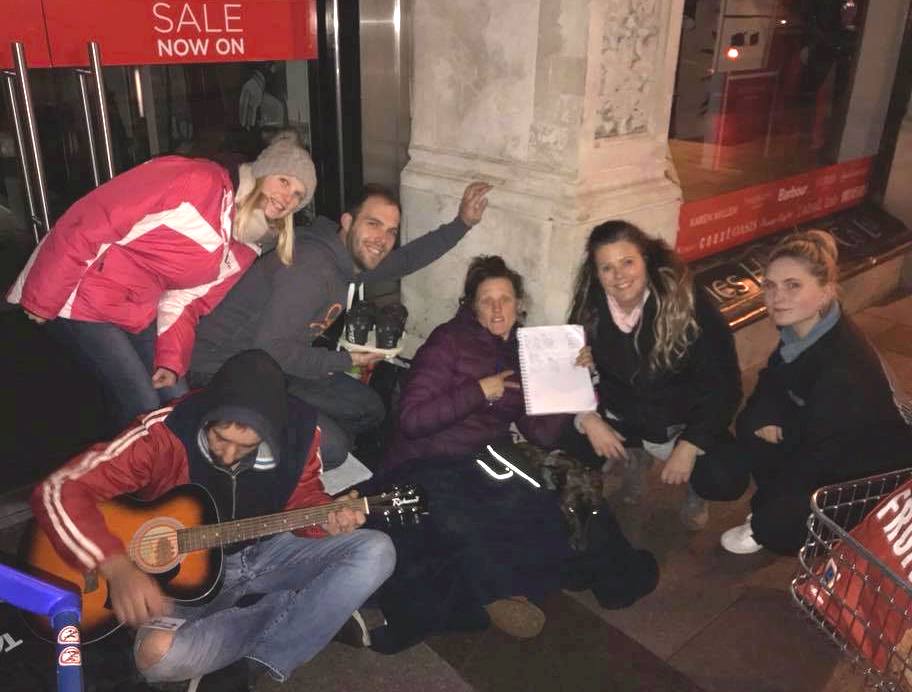
Helping our Homeless

Nicky Pugh, Ashley Morris and Sarah Mason
I recently came across this relatively new group in Llandrindod Wells on Facebook. Prior to that I had not realised that there was support for homeless people in Powys, and realised I knew very little about the subject. Homelessness is suddenly very much in the news – particularly in Windsor because of an imminent Royal wedding – but what of the situation in Powys?

Reading on further on the group’s Facebook page I discovered that much fundraising work had taken place locally in the lead up to Christmas 2017. As a result Helping our Homeless had “supported homeless in Swansea, Cardiff and in our local vicinity, most recently supporting local homeless with clothing, essential items of food and toiletries and footwear.”

Keen to find out more, I messaged the group on Facebook, and one of the group’s founders, Sarah Mason, quickly got in touch. She told me how she, Ashley and Kayleigh Morris, Lee Jarvis and Nicky Pugh came together to take action to help homeless people.


Tell us how the group Helping our Homeless came about and why?

Last year I saw a post on Facebook from Ashley, who was going to do a calendar where every day he placed an item in a box to give to the homeless at the end of the time. I messaged Ashley and his wife to offer some donations as she had been collecting items over the past couple of years and donated these. Ashley and Kayleigh accepted my donation, and this led to us talking about possibly going bigger.

During the year I met Lee Jarvis in a local supermarket and we spoke about homelessness and raising money. Lee agreed this was a good way forward and came on board. Another friend, Nicky, joined us soon later.

After September, I contacted all the interested parties and we met in a local pub where we put together a plan of what we would like to achieve. To be honest we have never looked back.

What is the main purpose of the group?

We want to provide practical and emotional support to homeless people and their animal companions. At the same time we hope to raise awareness of homelessness with the general population.

Who is eligible for support from Helping our Homeless?

Anyone who is street homeless in Wales (but not exclusively), and their animal companions.

We also work with agencies and individuals to reduce poverty and prevent homelessness. In particular we are keen to support Shelters across Wales and in surrounding areas.


How many homeless people are there in Powys roughly and how are where are they living?

A lot of homeless people in Powys are not accounted for on the rough sleeping count as unlike the street homeless in the cities, we don’t always see them here. In a large rural county people could be sleeping rough in barns or farm outbuildings, or in woodland, and remain hidden much of the time.

(The National Rough Sleeping Count, produced by the Welsh Government, is “an annual report which includes information on the estimated number of persons sleeping rough over a two week period and the number of persons observed sleeping rough.”)

Why are people homeless in Powys or elsewhere?

There is no one reason why people become homeless. All kinds of factors can lead to homelessness, including health issues, unemployment, and family breakdown. Many homeless people have previously been employed and in a position to pay for their housing, but something suddenly changes and their lives are turned upside down.

Some of the key factors leading to homelessness include: benefit changes, a rise in the cost of living, the loss of employment and a lack of new job opportunities. Also a person’s mental health may deteriorate, they may have drug and alcohol or other addictions, or a completely unexpected change in their circumstances could lead to homelessness.

It is said that most people are just two pay cheques away from poverty and three from homelessness.


What support does Helping our Homeless provide to people?

We provide essentials, care, and face-to-face interaction, whether in Powys or further afield.

On the practical side, we find that the essential items homeless people really do need are food, care packs, toiletries, clothing and some form of shelter for their time on the streets. Tents and sleeping bags are very popular! We will also provide first aid provisions.

We talk to people. We empathise. We guide people to other agencies that can offer support. We spend time engaging and trying to make day-to-day life easier for those on the streets.

Most importantly, we offer face-to-face confidential support without judgment. We are a face that cares.

In other parts of the UK we will work directly with local shelters and help promote the invaluable work they do.

As a group we provide online support to each other.

How does being homeless impact on a person’s mental health?

Hugely. Many homeless people are struggling with low self-esteem. Their confidence and morale have completely dipped. Some people have such low self-worth, and are so lonely, that they resort to self harming, including substance misuse. In worse case scenarios, some people have suicidal thoughts.

Physical health can also deteriorate rapidly when people are sleeping rough. If they are not eating regularly they can experience malnutrition, and, inevitably, they tolerate a deterioration in their personal hygiene.

If people don’t receive the support they need, what can happen to them?

Health can deteriorate rapidly, with the result that homeless people have a lower life expectancy.

They are also far more likely to commit crime. Due to their circumstances they may lack self control, and they may become addicted to drugs and alcohol.

Homeless people are still entitled to claim benefits using the Simple Payment card. However, in reality not everyone receives all the benefits that they are entitled to.

I know you want to grow your group – what are your main aims?


We would really like to register Helping our Homeless formally as a charity – we are working with PAVO development workers to progress this. The next step would be to expand the group, so we will raise awareness of our activities as much as we can with the aim of recruiting more volunteers. Bigger, more permanent premises, with sufficient storage space would be an added bonus!


If people are interested in volunteering for the group, what roles are available (alternatively, what skills do you need)?

Roles that we currently have available include:
  • Collecting donations.
  • Sorting the donations that come to us.
  • Advertising.
  • Distributing.
  • Fundraising.
  • Promoting the cause.
Do get in touch if you are interested! Contact details below.

Which other organisations do you work closely with, either locally in Powys, or in the rest of the UK, to provide support to people?

Quite a few, mainly in Wales. In Swansea these include Unity Group Wales, the Unum Project and Zac’s Place. In Llandrindod Wells – Mid Powys Mind, the local food bank, and the Herb Garden Community Café.

We also engage with lots of online shelters and organisations.

What are the main challenges of the role?

The big one - not being able to commit as much time as we would like. And feeling so far away as we are remotely based.

On a very practical level, we currently lack long-term storage, and vehicles – we would love a van.

We also have to deal with our own mental challenges as we carry out the work.


Tell us about some of the most rewarding work you have done at Helping our Homeless so far.

Our top 8 most rewarding aspects so far:
  1. Provided shelter to many rough sleepers.
  2. Food and drinks.
  3. Medical aid.
  4. Support and advice.
  5. Support to other shelters.
  6. Time with the street homeless.
  7. Making our street homeless feel wanted.
  8. Learning about the street homeless and building relationships.
When you are not volunteering how do you enjoy spending your time?

We all work full time, so we juggle working with volunteering. Some of our hobbies include bowls, football, pool, art and craft work. And we spend time with our families of course!


Many thanks to Sarah and the rest of the team at Helping our Homeless for telling us more about their work in Mid and South Wales in particular.

If you want to find out more or get involved you can contact Sarah by ringing 07775 851 718 or send a message on the Helping our Homeless Facebook page.

On the BBC website this week two articles feature Homelessness:


Thursday, 17 August 2017

Mums Matter


Mums Matter is a new project being run at two of the Mind centres in Powys – Brecon & District, and Mid Powys Mind in Llandrindod Wells. As the name suggests, the aim is to provide emotional support for new Mums “to manage the everyday, nurture themselves and dispel the many myths of motherhood.”

The project facilitators, Deborah Wilkie in Brecon (left below), and Tracy Lewis in Llandrindod (right below), told me more.


Tell us why you think there is a need for this project in Powys

Deborah: Whilst promoting this programme mums who have had their babies have stated “they wished this sort of course was available to them after they had given birth to their children." They also said “there was no additional support to help mums apart from their GP or health visitor to help them go through such a huge life-changing experience. They felt alone and that they were the only ones suffering and could not fully be honest in how they were struggling with their feelings of anxiety and worries, and feeling very low and isolated”.

Tracy: Powys has the worst access to services and facilities of all 22 principal areas of Wales. There are 30% of households living in poverty in rural Wales. Because of this women can become isolated after childbirth. The stresses of becoming a new mum and all the different advice and opinions can lead mothers to become anxious and worried.

Has Mind rolled out Mums Matter elsewhere in Wales and if so how has it been received?


Deborah: This is the first time this type of support and programme has been rolled out in Wales and we are delighted that Powys has this great opportunity and is leading the way in Wales.

Tracy: This project has been designed by mums with postnatal anxiety and depression who live in deprived and rural areas. The pilot was held in Cardiff and was received very well. Mid Powys Mind is very happy to be rolling this programme out for mums in Mid Powys.

What about motherhood can be different in a largely rural county?


Deborah: Powys is the biggest rural county in Wales covering 2000 square miles with many small country villages and small towns so accessing essential health and social care services for mothers and families can prove to be very difficult especially if they have no transport. The local transport can be infrequent or not at all, leaving a lot of mums and dads trying to cope and do their best for their babies and children. Motherhood can be lonely in these small villages and towns as the population can be very small. They may be the only young family in the area and accessing baby/toddler groups will mean travelling to another area.

Tracy: There are a lack of effective support networks in Powys as its geographic and social isolation is an ongoing problem, mums sometimes don’t feel they can ask for help as it looks like they are a failure in small communities. Many women can struggle to hold on to their identity once becoming a mother.

Tell us about some of the myths around motherhood, and how women can feel in the early days


Deborah: Social media, magazines and TV can portray life is perfect whilst pregnant and after giving birth and concentrates on images of the ideal ‘perfect’ mum. Even when a mum has a quick snapshot of a mum pushing a pram in the street and that mum can seem like they have “got it together” and look like a ‘perfect’ mum in the mind of the viewer, it may not be the case. This programme gives evidence and demonstrates that that’s not the reality and we discuss what motherhood is really like for them. Learning being a ‘good-enough’ mum is essentially a healthy way of bringing up children as it instills realistic expectations in children and teaches them to cope with uncertainties in our realistic world.

Tracy: There are many myths in motherhood and these can lead to self-stigmatising behaviour and negative perceptions of one's self-worth. This can affect any mother of any age and any walk of life.

When women hit a certain age they can feel the pressure to have a baby without being mentally prepared. When you have your baby a mother does not always have the immediate rush of love that you are told you will have as this can be slow to build and can come over time.

There are harmful myths surrounding working mums that they are neglectful and guilty mothers which can add to the pressure and create anxious feelings.

Mums Matter aims to show these women that they are not alone with these feelings, and provide them with the tools they need to overcome these pressures.

How do new mums find out about the project and join in? And when is your next course?


Deborah:  I am running another programme in September 2017 in Brecon during the school term. It's an 8 week course (2 hrs a week) for mums and I provide a crèche for your baby (if you require it) in the same building of the course. If you like to find out more don't hesitate to contact me for a chat….. call or message/text Deborah on 07487 239 150 email deborah@breconmind.org.uk Or ask your health visitor or GP to refer you.

Tracy: The next Mums Matter programme I am running is on the 12 September in Knighton Leisure Centre, 1 till 3 every Tuesday for 6 weeks. There is a crèche available which is run by qualified members of staff. If you would like to book onto this programme please contact me on 07960 271 696 message or text, or you can email me on mums@midpowysmind.org.uk


What kind of support can the sessions provide? 

Deborah:  Being a mum is a very busy role and can be overwhelming and the need to look after yourself is important so we spend time looking at that in a friendly group of mums sharing similar experiences. We explore what it’s really like being a mum and all the feelings of anxieties and worries that go with the role. We look at many coping tools to manage the everyday, looking after yourself and feelings such as negative thoughts and guilt. The aim is to help mums feel much better and more confident in themselves and trusting their own skills and decisions in their role as a mother.

The programme also offers a confidential supporter session for partners and significant others who supports mum, raising their awareness to postnatal depression and anxiety and exploring ways they can support the mum.


Tracy: The sessions will introduce mums to tools such as breathing techniques, meditation and ideas that will help with wellbeing as well as providing an opportunity and space for mums to come together and talk about their experience and feelings. Those in the group, with the help of the Mums Matter Facilitator, will be able to support each other with the changes that becoming a mum demands, and they will realise they are not alone.

There is also a supporters' session for family and friends to attend if they wish.

If appropriate and timely support isn’t provided to new mums what could happen? 


Deborah: I see this programme acting as a prevention as well as an intervention of support to help mums feel stronger in their own well-being. This programme has already prevented some mums going onto anti-depressants and their postnatal depression escalating. I am coming across mums who are still suffering from anxiety and depression some years on from when they first started suffering with these symptoms after giving birth to their child. This programme may have prevented these symptoms escalating into a longer-term health problem so timely intervention is of the utmost importance to mums in their postnatal period. Also, fathers can suffer with postnatal depression too. This programme raises mental health awareness and knowledge also to fathers and carers and other family members.

Tracy: If mums don’t get the support in which they need then depression can take hold and mothers can withdraw completely from all social activities and services that they may need and all relationships will suffer.

If it became clear a mum was experiencing severe postnatal depression what would happen? 


Deborah: I would in discussion and permission from the mum share this information with her GP and health visitor and encourage a referral onto the Community Mental Health Team where there is a specialised perinatal team. I would also refer onto any other services which meets any other identified needs.

Tracy: I would refer that mother back to her health visitor and doctor and help her to seek the professional help that is needed and discuss any other pathways that would help her with her recovery.

Does Mind support continue once the 6/8 week course is complete? Alternatively, what support networks can you recommend to mums? 


Deborah: The mums are encouraged in the 7th & 8th week; which is more of a social meet up with their babies to discuss how they are going to continue supporting each other. My mums from the first programme formed a very strong trusting bond and have a message group chat and plan to set up their own baby/toddler group in September for mums who are experiencing very similar experiences so they can share the realities of being a mum in a supportive, ’good-enough’ environment.

I also refer on to other services for continued support if needed such as counselling, Action for Children amongst others. They also have an information pack. I am also still there for mums to contact me post-programme for any further additional information and sign posting if needed.


Tracy: After 6 weeks there is another meeting in 3 months for the mums to come together with myself to see how everyone has been getting on. There is also a questionnaire to fill out to see which tools the mums have been using and if they are still in contact with each other. Mid Powys Mind also offers counselling, arts and crafts, training and a volunteer programme with information about the Mid Powys Mind services. There are also lists of playgroups, parent and toddler groups and other agencies which the mums may need in their packs.

Tell us what a “Mums Matter Powys” looks like to you personally 


Deborah: I am so thrilled that Brecon Mind has had this opportunity to deliver this programme and I feel privileged to be part of it and I get the opportunity to work with so many wonderful mums. The mums I have worked with so far are amazing and inspirational. I hope this 2 year project can demonstrate to funders and the local government that this is an essential part of the perinatal service provision in Powys for mums and their families.

Tracy: Mums Matter is a programme running in different areas in Powys to help mums who are feeling low and anxious and need some support and tools to help with their mental health at this moment. Mums can talk openly and honestly about how they are feeling without being judged and will feel excepted and not alone.

What are the main challenges of the role? 


Deborah: I hope the word gets about across all the services in Powys that play a part in supporting mums in their prenatal and postnatal period of their lives. I have done my best promoting and advertising and attending service team meetings to-date but there is still lots to do on that.  Also, I would like to see an increase in the referrrals from GPs, I hope they can see and get to know of the benefits. I do get some self-referrals but I think it’s also important individuals know they can refer themselves and contact me direct for a friendly chat to find out more about the programme.

Tracy: Finding available rooms and crèche space and also letting mums know the programme is running and how it can really help.

Tell us about some of the most rewarding work you have done at Mind so far


Deborah: The biggest reward I had was hearing and seeing the progress and achievements of the mums who attended the first programme in believing in themselves as a mum; they were even using the ‘I am’ statement. They left a lot stronger individuals and even accomplished drinking a ‘hot cup a tea’ daily which I was very proud of. Their feedback is the most rewarding and they did it themselves I was just there!

Tracy: Running my first group and seeing the mums bond and support each other whilst learning to grow in confidence was very rewarding.

When you are not working for Mind, how do you enjoy spending your time?


Deborah: I’m a mum of 2 grown up children and a grandmother of 3 gorgeous little ones so my days of running around teenagers have been replaced by choosing when I want to run around after my grandchildren. This has left me with some spare time to indulge in walking coastal paths and cycling. I love our wet and windy land and try and spend most of my time out in it. My husband and I share a passion for classic cars and go on many classic rallies with our restored classic car. My vocation is practicing Reiki in my other spare spare spare time! I love my cats and peace and quiet when I get it, that might mean me just hiding in a corner somewhere for a while.

Tracy: I am a farmer’s wife so I enjoy getting outside and helping my husband and 3 boys on the farm. I also enjoy playing netball and badminton and having a glass of wine with my friends. 


Feedback from some mums who have attended Mums Matter: 

  • Amazing idea and support for those who are worried, feeling down or suffering with post-natal depression. There is no need to suffer in silence, there are others too. It was the best thing I ever did. 
  • I feel more confident in myself and around people. 
  • I could moan and share my feelings without judgment and in a safe place. 
  • The creche gave me time to myself to focus on the course… I feel so much better! 
  • I never left my baby before, was nervous but he enjoyed it and I enjoyed my space and new-found friendship with lovely mums, felt less alone & more myself. 
  • I loved how the course gets you to look at being a realistic mum and not have to stress about being a perfect mum all the time. It’s okay to be a ‘good-enough’ mum! 
  • I’ve decided not to take anti-depressants as this course has made me feel so much stronger, confident and happier… I now walk my dog regularly, relax with colouring and drink HOT tea!! 
  • The course helped me put things into perspective, the past & the present. Things make more sense now. My heart melts now when I see my kids and that’s not happened in a long time.

Tuesday, 27 June 2017

In memory of Kelvin Mills: trustee, volunteer and life affirmer

Powys Patients' Council team 2014: L - R Freda Lacey, Rhydian Parry, Penny Price (Ward Manager), John Lilley, Kelvin Mills
by guest author, Freda Lacey
PAVO Senior Officer, Health & Social Care

I wrote recently about “Dying Matters” and in May, one of the long standing volunteers of the PAVO Mental Health team, Powys Mental Health Alliance (PMHA) and Mid Powys Mind - Kelvin Mills - died.

When I facilitated Powys Patients’ Council several years ago now, which goes into Bronllys Hospital Mental Health Inpatient Unit, I was privileged to work with three volunteers. Kelvin was one of the liveliest volunteers who dedicated his time to speaking with patients and rallying them around to come in and visit us to talk about how they were doing and/or speaking up about any issues, compliments, concerns they had whilst being an inpatient on the mental health ward.

It is no secret that Kelvin used to be a patient, both at Bronllys for some time but also at “Mid Wales Hospital”. He was known, far and wide, by staff and other people in contact with services, volunteers and members of the public. Everyone seemed to know Kelvin. I don’t think he ever met a stranger. If he didn’t know you, he’d know all about you within minutes, and you’d know about him! He would have treated you to a story or two, shared some history, told a joke (quite often “politically incorrect”) and laugh hilariously so you had no choice but to laugh with him. He was incredibly generous and very funny, sometimes without meaning to be.


Kelvin at a PMHA trustee meeting in 2010 with fellow trustee Jill Dibling
I remember fondly some of the PMHA Trustee meetings, when trying to have a serious conversation about some order of business, Kelvin would break out the crisps from his rucksack (which he was never without) and start to share them out, not caring a whit about whether it was the right time for a break. Kelvin could get quite passionate about rights and would tell you straight if he thought something wasn’t right. He wasn’t shy about saying what needed to happen - he expected people to step up to the plate and do what was necessary.

Kelvin's Poems & Jokes page in the PMHA newsletter

He was a nostalgic and used to quite often tell stories of his time in Mid Wales Hospital and the fun and community they had. He spoke about his catering experience and I know from attending his funeral, and hearing some more about his life, that he was a very good cook. I believe he used to volunteer/cook with Mid Powys Mind on occasion.

Before going into Bronllys Hospital for our meetings with patients, we’d always have lunch, the volunteers and I, and have a bit of a briefing about issues we’d picked up from the last meeting and actions that had taken place. Kelvin was known to the staff at “The Honey Café” where he would chat away to them as if they were his friends. He would order the same thing always, a cheese sandwich, a cup of coffee and an apple or berry tart with vanilla ice cream, all to come at the same time. He is the only person I knew who could stand whilst having a cup of coffee in one hand, a cigarette in another and fall asleep - an incredible feat of balance.

Despite Kelvin’s physical ailments, he would always be ready to come to Patients’ Council and looked forward to his outings. He was always telling me about ways of saving the public purse and would speak quite often about the amount of money being spent on services and whether it was really value for money. He made me reflect on how things were and are now.

I think Kelvin always sought for ways to belong, to local community. He was incredibly attached to Llandrindod Wells Football Club and used to go to games with his Dad. He was dedicated to helping the club in many ways. He was also a bit of a rock and roller, liked wearing leather jackets, jeans and loved Elvis Presley and was seriously attached to watching Westerns.

Gravel Baptist Chapel
People I’ve spoken to remember Kelvin very fondly. One of the Senior Managers at Bronllys mentioned a Christmas on the ward she’d never forget, especially given what Kelvin had bought for all the nurses!

We will miss Kelvin. We will miss his laughter, his humour, his stories and his abilities to break down the barriers of what is expected and the unusual. He took risks without knowing he showed us how to push the boundaries. He didn’t do what was usual and yet he was so very familiar. He wasn’t silent and sometimes his stories meant you got lost or side tracked. I learned to be patient with him as he sometimes wouldn’t take no for an answer. He demanded respect and well, he deserved it. His life, whilst too short, packed a punch, I’ll never forget him.

There is a saying at the end of the novel, “Middlemarch” which I feel appropriate to end with (and have taken some liberties of changing some words).... "His full nature spent itself in deeds which left no great name on the Earth, but the effect of his being on those around him was uncapturable. For the growing good of the World is partly dependant on unhistoric acts, and on all those people who live faithfully their hidden lives and rest in unvisited tombs.”


Kelvin lies at rest in Gravel Baptist Church’s graveyard, overlooking the peaceful countryside near Llangunllo. I’d like to think he won’t rest in an unvisited tomb…

RIP Kelvin Mills: died 6 May 2017, aged 59 years.