Showing posts with label BBC. Show all posts

Thursday, 25 January 2018

Helping our Homeless

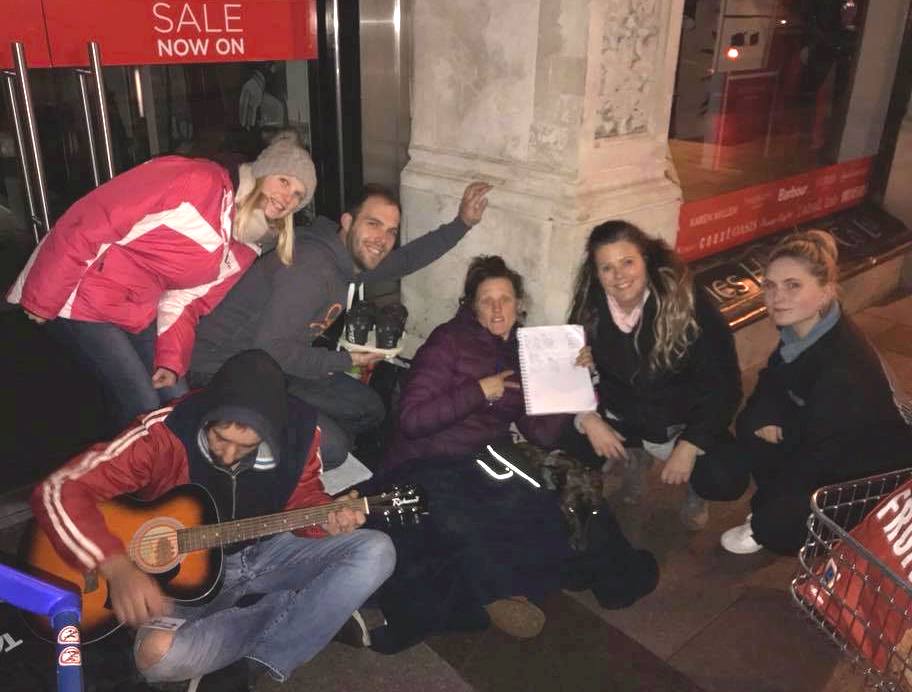
Nicky Pugh, Ashley Morris and Sarah Mason
I recently came across this relatively new group in Llandrindod Wells on Facebook. Prior to that I had not realised that there was support for homeless people in Powys, and realised I knew very little about the subject. Homelessness is suddenly very much in the news – particularly in Windsor because of an imminent Royal wedding – but what of the situation in Powys?

Reading on further on the group’s Facebook page I discovered that much fundraising work had taken place locally in the lead up to Christmas 2017. As a result Helping our Homeless had “supported homeless in Swansea, Cardiff and in our local vicinity, most recently supporting local homeless with clothing, essential items of food and toiletries and footwear.”

Keen to find out more, I messaged the group on Facebook, and one of the group’s founders, Sarah Mason, quickly got in touch. She told me how she, Ashley and Kayleigh Morris, Lee Jarvis and Nicky Pugh came together to take action to help homeless people.


Tell us how the group Helping our Homeless came about and why?

Last year I saw a post on Facebook from Ashley, who was going to do a calendar where every day he placed an item in a box to give to the homeless at the end of the time. I messaged Ashley and his wife to offer some donations as she had been collecting items over the past couple of years and donated these. Ashley and Kayleigh accepted my donation, and this led to us talking about possibly going bigger.

During the year I met Lee Jarvis in a local supermarket and we spoke about homelessness and raising money. Lee agreed this was a good way forward and came on board. Another friend, Nicky, joined us soon later.

After September, I contacted all the interested parties and we met in a local pub where we put together a plan of what we would like to achieve. To be honest we have never looked back.

What is the main purpose of the group?

We want to provide practical and emotional support to homeless people and their animal companions. At the same time we hope to raise awareness of homelessness with the general population.

Who is eligible for support from Helping our Homeless?

Anyone who is street homeless in Wales (but not exclusively), and their animal companions.

We also work with agencies and individuals to reduce poverty and prevent homelessness. In particular we are keen to support Shelters across Wales and in surrounding areas.


How many homeless people are there in Powys roughly and how are where are they living?

A lot of homeless people in Powys are not accounted for on the rough sleeping count as unlike the street homeless in the cities, we don’t always see them here. In a large rural county people could be sleeping rough in barns or farm outbuildings, or in woodland, and remain hidden much of the time.

(The National Rough Sleeping Count, produced by the Welsh Government, is “an annual report which includes information on the estimated number of persons sleeping rough over a two week period and the number of persons observed sleeping rough.”)

Why are people homeless in Powys or elsewhere?

There is no one reason why people become homeless. All kinds of factors can lead to homelessness, including health issues, unemployment, and family breakdown. Many homeless people have previously been employed and in a position to pay for their housing, but something suddenly changes and their lives are turned upside down.

Some of the key factors leading to homelessness include: benefit changes, a rise in the cost of living, the loss of employment and a lack of new job opportunities. Also a person’s mental health may deteriorate, they may have drug and alcohol or other addictions, or a completely unexpected change in their circumstances could lead to homelessness.

It is said that most people are just two pay cheques away from poverty and three from homelessness.


What support does Helping our Homeless provide to people?

We provide essentials, care, and face-to-face interaction, whether in Powys or further afield.

On the practical side, we find that the essential items homeless people really do need are food, care packs, toiletries, clothing and some form of shelter for their time on the streets. Tents and sleeping bags are very popular! We will also provide first aid provisions.

We talk to people. We empathise. We guide people to other agencies that can offer support. We spend time engaging and trying to make day-to-day life easier for those on the streets.

Most importantly, we offer face-to-face confidential support without judgment. We are a face that cares.

In other parts of the UK we will work directly with local shelters and help promote the invaluable work they do.

As a group we provide online support to each other.

How does being homeless impact on a person’s mental health?

Hugely. Many homeless people are struggling with low self-esteem. Their confidence and morale have completely dipped. Some people have such low self-worth, and are so lonely, that they resort to self harming, including substance misuse. In worse case scenarios, some people have suicidal thoughts.

Physical health can also deteriorate rapidly when people are sleeping rough. If they are not eating regularly they can experience malnutrition, and, inevitably, they tolerate a deterioration in their personal hygiene.

If people don’t receive the support they need, what can happen to them?

Health can deteriorate rapidly, with the result that homeless people have a lower life expectancy.

They are also far more likely to commit crime. Due to their circumstances they may lack self control, and they may become addicted to drugs and alcohol.

Homeless people are still entitled to claim benefits using the Simple Payment card. However, in reality not everyone receives all the benefits that they are entitled to.

I know you want to grow your group – what are your main aims?


We would really like to register Helping our Homeless formally as a charity – we are working with PAVO development workers to progress this. The next step would be to expand the group, so we will raise awareness of our activities as much as we can with the aim of recruiting more volunteers. Bigger, more permanent premises, with sufficient storage space would be an added bonus!


If people are interested in volunteering for the group, what roles are available (alternatively, what skills do you need)?

Roles that we currently have available include:
  • Collecting donations.
  • Sorting the donations that come to us.
  • Advertising.
  • Distributing.
  • Fundraising.
  • Promoting the cause.
Do get in touch if you are interested! Contact details below.

Which other organisations do you work closely with, either locally in Powys, or in the rest of the UK, to provide support to people?

Quite a few, mainly in Wales. In Swansea these include Unity Group Wales, the Unum Project and Zac’s Place. In Llandrindod Wells – Mid Powys Mind, the local food bank, and the Herb Garden Community CafĂ©.

We also engage with lots of online shelters and organisations.

What are the main challenges of the role?

The big one - not being able to commit as much time as we would like. And feeling so far away as we are remotely based.

On a very practical level, we currently lack long-term storage, and vehicles – we would love a van.

We also have to deal with our own mental challenges as we carry out the work.


Tell us about some of the most rewarding work you have done at Helping our Homeless so far.

Our top 8 most rewarding aspects so far:
  1. Provided shelter to many rough sleepers.
  2. Food and drinks.
  3. Medical aid.
  4. Support and advice.
  5. Support to other shelters.
  6. Time with the street homeless.
  7. Making our street homeless feel wanted.
  8. Learning about the street homeless and building relationships.
When you are not volunteering how do you enjoy spending your time?

We all work full time, so we juggle working with volunteering. Some of our hobbies include bowls, football, pool, art and craft work. And we spend time with our families of course!


Many thanks to Sarah and the rest of the team at Helping our Homeless for telling us more about their work in Mid and South Wales in particular.

If you want to find out more or get involved you can contact Sarah by ringing 07775 851 718 or send a message on the Helping our Homeless Facebook page.

On the BBC website this week two articles feature Homelessness:


Wednesday, 4 March 2015

Comic Relief award of £110,605 for Powys project to develop Mental Health Networks

PAVO's mental health team celebrates news of the award
Back: Glynis Luke, Jane Cooke, Freda Lacey
Front: Jackie Newey
Shaping Our Services - "Together For Powys Mental Health" 
Local Participation Networks

Powys Association of Voluntary Organisations is pleased to announce that it has been awarded £110,605 from Comic Relief for a three year project, to be managed by the mental health team, to develop local mental health participation networks around Powys. The work is being funded under Comic Relief’s Fairer Society theme, which aims to: “empower and give a voice to marginalised groups of people, enabling them to challenge injustice and bring about positive changes for those who face discrimination and stigma”.

Freda Lacey, our team's Participation Officer, who worked on the funding bid to Comic Relief, told me more about the new project.

“Our county mental health participation network has made a positive difference to marginalised people’s lives since 2010. Using principles of collaboration and co-production, we have successfully challenged injustice and ensured that people excluded from decision-making processes have had their voice heard and been involved in shaping services both in Powys and nationally.

This county-wide work has identified the need to develop participation networks in local communities. Here people face local problems sometimes not appropriate for county discussion, they lack confidence to participate at this level, and are unable to access meetings centrally or to participate remotely. Statistics show that we only reach 10% of people in contact with services as the majority live in more rural areas.

Decisions about mental health services are being made nationally, but 90% of people in Powys currently do not know how to ensure their voice is heard at this level. This means that they cannot participate in decisions that affect their lives. In 2013 we recruited local individuals to participate on local/national mental health strategic decision boards. These individual representatives require local networks to be in place to listen and share with other people, from all ages, in contact with services, and those close to them, to ensure that they are reaching as many people as possible in local communities. This not only empowers grassroots community voice but also supports the individual representatives as carriers/channellers of that collective voice.
 
Freda (far left) at Comic Relief HQ in  London on February 5
meeting people from other award-winning projects
People will use their lived experience to make a positive difference, to their own lives and the lives of others. Their voices, lived experience, and skills will be used to help reduce the disadvantages, discrimination, social inequality and stigma faced by people experiencing mental distress and influence and improve services and opportunities available to “all of us” across Powys.

Participants in the project will increase their negotiating, listening and influencing skills and their understanding of public sector delivery, decision making and strategy. People in Powys, from children to older people, will know how to access local, county and national participation opportunities. They will know how to speak out and get their voice heard, and how to actively engage with those working in mental health services and help shape service delivery."

If you would like to find out more about mental health participation opportunities in Powys, please take a look at the Getting Involved pages on our website here.

You can find out more about the work of Comic Relief here, and Red Nose Day Friday 13 March 2015 here

Make your face funny for money!

                                 
Red Nose Day comes along every two years and combines two very British things: having a laugh and helping others. Be it at school, work or home, people across the land put on Red Noses and pull out all the stops to raise as much money as possible. Then, once everyone’s run out of fundraising juice, they tune into BBC One for some top entertainment from their favourite comedians and to donate even more cash! And why do they do it? To help poor and vulnerable people living incredibly tough lives both here in the UK and across Africa.

Update: The Participation Worker post related to this project is now being advertised. Closing date 7 April 2015. More info here.

Thursday, 12 February 2015

Dyfed-Powys Police - mental health: a multi-agency approach

Over the last few months I seem to have read endless articles online (the latest just last week from the BBC here) about the increasing numbers of young people and adults being detained in police cells whilst experiencing mental distress. This is often because there are no suitable places of safety where people can be taken to be assessed, even though it is frequently accepted that a police custody suite is not usually an appropriate place in such circumstances.

In Powys, a multi-agency approach is now working to improve the police response to those with mental health needs. I first found out about this in November 2013 at a Dyfed Powys Police event called Mental Health: the Way Forward. Here we heard, amongst other things, some of the Force’s plans for change in the area of detention under Section 136 of the Mental Health Act.


Inspector Brian Jones
This week we found out more, from Inspector Brian Jones of Neighbourhood Development for Dyfed-Powys Police, about how plans had been progressing since the event. Brian started by addressing the issue of children and adults being placed in police cells due to the lack of mental health beds.

“In Powys, we have not found ourselves in this position during 2014”. The police are often called to assist with situations where someone has expressed concern for a family member, a friend or someone they have seen behaving in a manner which raises concern for their welfare. The police currently have minimal training on how best to deal with incidents where people have mental health needs, but will strive to treat everyone with dignity and respect. “Our first priority is to ensure that persons are safe and then to ensure that persons are cared for by specially trained experts at an agreed place of safety.”

Legislation

The legislation under the Mental Health Act, which is known as a Section 136, stipulates that “if a constable finds a person who appears to him/her to be suffering from mental disorder and to be in immediate need of care or control, in a place to which the public have access, the constable may, if he/she thinks it necessary, in the interest of that person or for the protection of other persons, remove that person to a place of safety.” No one will disagree that a police cell is not a suitable place or environment for someone with mental health needs. However, there are occasions when there is no other suitable alternative and this is when there are signs of violence, substance misuse or criminal offences for investigation with evidence to be preserved.

In order to make every effort to secure the correct and professional support for individuals, as well as avoiding police cells or any inappropriate use of police powers, a procedural pilot was introduced in Powys in March 2014. This pilot requires the Police’s Inspector’s authority before police mental health powers can be used. The Inspector will take an independent overview of the circumstances which have led to consideration being given to utilising the powers under the Mental Health Act.

Exceeding expectation

The pilot is exceeding expectation and the police cells have only been used on three occasions, which was justifiable in the circumstances and not due to having no suitable beds available. At no time have the police powers been inappropriately used and at no time during this period have any youths under the age of 18 been detained. There is a strong partnership approach between the police and health and social care partners, who are working together to raise awareness amongst colleagues, as it has been agreed that training is required for people who come into contact with people suffering from psychological problems.


Thank you to Inspector Brian Jones for his update. Let us know in the comments box below what you think about the new ways of working that the police are trialling in Powys - or elsewhere in the UK.

You can read a recently published report (6 February) from the House of Commons Home Affairs Committee on Policing & Mental Health here.

Tuesday, 23 September 2014

Glorious Gardens From Above: BBC TV @ Ponthafren


This Autumn the glorious terraced garden which is managed by a team of devoted volunteers at the mental health charity Ponthafren Association, Newtown, will feature on a new BBC TV programme called Glorious Gardens From Above


TV/radio gardener and horticulturist Christine Walkden spent the summer journeying across the British Isles in a hot air balloon. From this striking new perspective she flew across the country calling in at some of the most beautiful gardens on her way. The new programme is not just about gardens, but people's relationships with gardens. Ponthafren's garden was chosen to represent the community garden category in the episode focusing on Mid Wales.


I met the BBC producer/director Will Ridgeon and his colleague Helen Shields as they spent the day filming interviews of staff and volunteers at Ponthafren and touring the garden to find some of the best viewpoints. That was not difficult in a stunning garden cut into the steep hillside alongside the River Severn, with views overlooking not just the riverbank, but the town of Newtown opposite.


Nicky Morris (Centre Co-ordinator) began her interview by describing the layout of the garden. Starting at the top, there is a large fruit and veg patch, from which leads a long drystone wall. This is topped with herbs all the way down the sloping path to the sensory gazebo - one of several outdoor seating areas. Next is the sensory garden itself, which is stuffed full of different textured plants and grasses, and then alongside the riverbank is the wildlife walk. This incorporates a pond with a solar powered fountain and mass plantings of shasta daisies which blend perfectly with the natural vegetation of the riverbank. 

Each area has its own features, included topiary figures and sculptures made out of all manner of materials, including a recycled bath and washing machine innards! Iolo Williams opened the garden once the wildlife walk was complete and said it was ideal for wildlife - the dragonfly larvae had moved into the pond already!


Helen and Will then moved on to interview Ponthafren garden volunteer Jan Rogers – who is turning into something of a regular guest on this blog (she recently wrote – Volunteering whilst getting benefits and Mental Health Act 1983 – Code of Practice: the review (in England)). As Jan picked apples from a loaded tree, before moving into the greenhouse for tomatoes and cucumbers, she answered questions about how her involvement as a volunteer gardener at Ponthafren had impacted on her own wellbeing. She also spoke passionately about what she had gained from her experience – including increased confidence, new qualifications and the opportunity to work outside.


She explained that a variety of funders had contributed to the garden improvements over the years, including work to make the garden more accessible to all. In the last few years new raised beds and an extra greenhouse have been added, and also new seating areas. These projects are often planned, costed and built by the garden volunteers themselves, and there is a sense of huge achievement as each idea is brought to life.

Volunteers have been able to attend Coleg Harlech (now WEA Cymru) courses in Drystone Walling, Art & Design in the Garden, and Landscape Design, whilst completing various projects. Jan said "some of us were lucky enough to complete a 12 month Diploma in Horticultural based Progression (14 units including a wide range of topics from herbs, grafting, and seed collecting to writing business plans, to name a few). I personally would have never taken part in this type of course if it had not run at Ponthafren."


Jan heads up the team of garden volunteers at the Centre. Each volunteer chooses what area they want to work in, "one lady can't stand for long but she loves to sit and pot things on. We take a lot of cuttings, and the plants are put in our yard for people to buy which is our money to buy seeds, compost and tools for next year. This is the great thing with our garden, there is something for everyone. The only thing that I do insist on is that everyone enjoys it!"


Jan arrives with a basket full of veggies for an outdoor cookery demonstration.


Julia Gorman (Newtown Resource Centre Facilitator at Ponthafren) was then filmed with Ponthafren members preparing the vegetables Jan had gathered. Julia runs regular nutrition sessions at the Centre for members to attend and learn about food preparation and diet - she and some of the volunteers prepare healthy and tasty food for all to enjoy at the end of a session. 


Contrast this image with one taken about 15 years ago when volunteers started work at Ponthafren to transform the garden.


All in all everyone had a thoroughly enjoyable day - though obviously Will and Helen were working non-stop throughout to film the best shots for the programme! We all noticed during the filming how often noises intrude to interrupt a session. Ponthafren garden always seems very peaceful, but on the day the BBC arrived a whole host of sounds came and went, including: squealing seagulls, bottle bank emptying across the river, workmen building a shed next door, motorbikes roaring along Milford Road, dogs barking and planes soaring high overhead. A tip for anyone wanting to get into the TV business: learn and practice patience as a key skill!


The new series Glorious Gardens From Above will now start broadcasting on Monday 10 November on BBC 1 at 3.45pm daily (please note change of broadcast date!)
There are 15 episodes in total. The Mid Wales episode, in which Ponthafren Association features, will transmit on Wednesday 12 November. It will also feature Powis Castle Gardens, and the Dingle Garden near Welshpool.

You can join a Drop-in Gardening session with Jan at Ponthafren Association 
every Wednesday and Friday 11am - 2.30pm.
Julia runs Foodwise sessions at Ponthafren Association every Thursday 2 - 3pm.
You can find out more here.

Thursday, 22 August 2013

Antidepressants in the headlines again

For what seems like the whole of August so far! There are features on news sites, blogs everywhere, the radio... and people are asking questions about the continuing rise in the use of these drugs – in Wales, in the UK, in the “developed” world generally...

You can read online articles by a British GP, in The Huffington Post online newspaper and on the Mad in America blog - here by Scottish writer Chrys Muirhead.

Lots of questions are asked and the debate is fast and furious in many cases, particularly where there are comments sections following the articles. Some of the issues which have arisen include:
  • Could it be that the increase in prescription numbers is because people are often on these drugs for many months and even years, so it is the repeat prescriptions which push the stats up?
  • The medicalisation of life’s many stresses and problems may mean that people actually just require time and space, and possibly therapeutic support, to recover, rather than a (supposed) quick fix.
  • But... this leads many who have experienced and struggled with very serious depression to condemn the suggestion that this kind of debilitating distress can just be addressed with a shout to “get out and exercise,” “change your diet”, or “pull yourself together...” when some people cannot even face emerging from their bed or home for weeks.
  • There is the usual debate about “the chemical inbalance” – whether there is one or not ...(evidence being virtually non-existent so far... although we are always encouraged to look to the future and a miracle medical discovery...)
Perhaps one of the most interesting and relevant topics is – would a readily accessible and affordable talking therapy ensure an appropriate and viable alternative to taking antidepressants? Again, there is strong debate around this area – with many people insisting that drugs alone have contributed to their return to everyday life, whilst others are equally convinced that counselling, for example, is what really helped. Others wish to have access to both. And Mark Easton, in a recent BBC news story, pointed out that those areas of the UK with the lowest incidence of antidepressant prescribing do not actually have good provision of talking therapies either... so it’s a complex issue.

Here in Powys it does seem that there are issues around waiting times for counselling, with there being something of a postcode lottery. In recent years expectations have been raised around mental wellbeing, with national surveys, anti-stigma campaigns and generally increased awareness about mental health and wellbeing, with many famous people (comedians in particular, think Ruby Wax and Stephen Fry) speaking out about their distress (or various "diagnoses...").


Last week I was at a meeting of the Primary Care Mental Health team in South Powys, with counsellors and mental health practitioners (previously called mental health nurses) speaking about some of their frustrations. Generally they seem to be struggling to keep up with the increased demand for counselling, and in some areas of Powys there are long waiting lists (up to 6 months) to see a counsellor or take up another form of talking therapy such as Cognitive Behavioural Therapy (we posted about some of the issues here). Couple counselling and counselling for young people are two areas with a particularly growing demand.

Our own Powys Mental Health Information Service receives an increasing number of enquiries from people seeking counselling... Just recently I was told that there is a 6 month waiting list for bereavement counselling with CRUSE in parts of Powys (so what else could we suggest), and there is a cost implication for Relate counselling... Yet all the time people are becoming increasingly aware that they are entitled to source talking therapies through the GP surgery (see the Welsh Government legislation around this – the Mental Health Measure 2010). So... more and more people ask for help, they want it immediately, not 6 months down the line, and the GP prescribes an anti-depressant because a) it really might help and b) it can be prescribed now. Then, as in this recent BBC Wales video, people can spend not just months and years, but sometimes even decades reliant on these medications, with the prospect of painfully weaning themselves off at some point in the future or... staying on them for life, with all the mental and physical complications that this can involve...

What do you think? Are you on antidepressants? Do they work for you? Would you have preferred the option of a talking therapy? Was counselling or CBT offered by your GP, and if so could you start immediately or did you have to wait? We would be really interested to know.


Meanwhile, for a really interesting take on psychiatric medications, it is worth watching a video of consultant psychiatrist Dr Joanna Moncrieff, author of The Myth of the Chemical Cure, speaking earlier this year.

Friday, 5 July 2013

Self harm in Powys


A couple of colleagues at Powys Association of Voluntary Organisations work with organisations supporting children and young people (you can be defined as a young person up to the age of 25 these days). Last week they told me that a recent Youth Forum meeting had highlighted an increased incidence of self-harm in the county amongst young people. I don’t know all the details (if anyone reading this knows more then please get in touch), but it makes me wonder what could be done to support young people who self-harm more.

There is an excellent website called TOWIP (“the only website in Powys”), – named by the young people who helped set it up with Powys Youth & Family Information Service “to express their views, reviews and creativity”. I’ve been following the posts of Black Star – also known as Cara – who writes about her own experiences of self harm. She is a 17 year old teenager living in Powys, and comments openly, honestly and eloquently about why she self harms and her efforts to stop - “...to me it’s an automatic reaction to stress, it helps, and it’s addictive. It’s the way I turn emotional pain in to physical pain, physical pain is easier to deal with, and all I have to do is shove a bandage on it.”

Back in April Black Star asked if there should be a self harm support group in Powys, as she had looked around and been unable to find one. I’ve been doing a lot of reading about peer support groups recently and they really seem to help individuals across the whole spectrum of mental distress. It makes so much sense. “A peer has ‘been there, done that’ and can relate to others who are now in a similar situation.” After all, how would it feel to be a self harming young person, isolated in a rural county like Powys, knowing no one else who self harms to talk to? 


There are many online forums and useful websites – I’ve listed some below – but whilst young people are the most ICT savvy folk in the world even they need to meet up and talk face-to-face with peers sometimes.


I’ve also been watching the BBC 3 TV documentary Don’t Call Me Crazy for the last couple of weeks – a distressing but again honest insight into life on a teenage mental health inpatient unit in Manchester – the McGuinness Unit. It’s described by the BBC as “a place of last resort for many adolescents with eating disorders or psychosis, who self-harm or are suicidal”. It’s not an easy watch. But in amongst all the images of cut arms and legs, the screams, the tears, the physical restraints, something shines through. And that’s the sheer positivity of the relationships the young people build, the way this can increase their sense of worth, their strength to overcome their distress and move on, and their inherent deep-rooted desire not just to survive but to flourish – and I’ve found it very moving.


So, what do you think? Is Black Star’s suggestion a good one? And if it is – who can start it off and give it a go?

PS: the support sites I mentioned:

Kooth - online counselling for young people in Powys.
Harmless - a national voluntary organisation for people who self harm, their friends, families and professionals.

Recover Your Life - one of the biggest self harm support communities on the internet.

Sunday, 16 June 2013

R D Laing pops up again

“Madness need not be all breakdown. It may also be break-through. It is potential liberation and renewal as well as enslavement and existential death.”  R D Laing, 1927 - 1989

Yesterday morning I heard the Scottish psychiatrist’s son, Adrian Laing, speaking on BBC Radio 4’s Saturday Live programme (about 30 minutes in if you listen again). He recalled life with his father, a bittersweet combination of experiences also documented recently in The Daily Telegraph, and then outlined his participation in one of Laing’s more unconventional therapies – a “rebirthing”.

The story reminded me of a comment in Laura’s recent post on Thomas Szasz, where a reader made the link between Szasz and Laing. The Anti-Psychiatry page on Wikipedia pulls them both into the same camp, but as Laura pointed out – Szasz was not anti-psychiatry, it was the coercive nature of psychiatry as practised that he opposed. Nevertheless, the two psychiatrists are often lumped together in the political debate over psychiatry, and in pushing the view  “that psychiatric treatments are ultimately more damaging than helpful to patients”.

The debate, which was particularly vocal in the 60s and 70s, is regarded by some to have been “of its time” and no longer relevant. After all, mainstream psychiatry (relying heavily on drugs in its attempts to treat what are regarded as medical problems) seems to rule the roost, certainly in the developed world. However, it appears as if the debate is gaining renewed momentum of late...

I unexpectedly discovered a copy of Laing’s “The Politics of Experience and The Bird of Paradise” on a bookshelf here at home. (It’s not mine – G is also more well-read than me!) Yesterday after listening to Adrian I read the chapter on “The Schizophrenic Experience.” Here are a couple of, what I believe, are relevant quotes:

“It seems to us that without exception the experience and behaviour that gets labelled schizophrenic is a special strategy that a person invents in order to live in an unlivable situation.” (Following research studies made by Laing and two colleagues. His emphasis).

“’Schizophrenia’ is a diagnosis, a label applied by some people to others. This does not prove that the labelled person is subject to an essentially pathological process, of unknown nature and origin, going on in his or her body.”

Dr Joanna Moncrieff, a practising psychiatrist and critic of pharmaceutical drugs, said that “I was reading Thomas Szasz and R.D. Laing when I was at medical school – they were the only ray of interest I could find in the subject area.With like-minded colleagues she set up the Critical Psychiatry Network which aims to debate issues such as “scepticism towards the evidence base, the biological basis to psychiatry, the efficacy of biological treatments, and an objection to the emphasis on coercion and medicalisation and the issues of social control.”

So... the debate does seem to be very much out there and current. What do you think?

PS: You can watch an intriguing 1989 Channel  4 documentary on R D Laing
here. It’s 1.5 hours long (but absolutely worth it), so make sure you are sitting comfortably...

Saturday, 18 May 2013

Mental Health Awareness Week

How was it for you?

For me, it was great hearing mental health being so prominent in the mainstream media - if only we could make every week Mental Health Awareness Week!

Naturally I "got physical" but we won't go there in this post... Instead, here are some of my highlights from the past week:

1. John Humphrys on the Radio 4 Today programme, on Monday 13 May (listen here) 
The day before he won a Sony Radio Award, and the programme won Best Breakfast programme award (yes, you can just tell I wake up to this every day...) Anyway, he was speaking to Dr Lucy Johnstone, a consultant clinical psychologist. She referred to new research which says that there is no scientific evidence that psychiatric diagnoses such as schizophrenia and bipolar are useful... John tried describing schizophrenia as a disease, then a disorder... and then when Lucy challenged both I could just picture him throwing his hands in the air as he exclaimed -  well then he was struggling to find the vocabulary! Lucy said: "instead of asking what is wrong with you we should ask what has happened to you." Brilliant stuff!

2. Start the Week followed hot on John's heels with Music & the Mind, Monday 13 May
An excellent opportunity to hear two of the country's leading experts of the mind head to head. Richard Bentall is Professor of Clinical Psychology at the University of Liverpool, whilst Tom Burns is the Professor of Social Psychiatry at the University of Oxford. Tom is just about to publish Our Necessary Shadow, a defence of psychiatry, and according to the programme a direct response to Richard's Doctoring the Mind: why psychiatric treatments fail. One of the most shocking statistics Richard quoted was that 1 in 7 people in Scotland are taking anti-depressants according to a recent study... "well, it gets people out of the GP surgery in 6 minutes..." Listen to the programme and see what you think.

3. Do famous role models help or hinder? Tuesday 14 May
Mark Brown, who edits One in Four magazine (a quarterly magazine written by people with "mental health difficulties,") wrote an intriguing piece on the BBC website about this. Do stories of Winston Churchill and his famous black dog, or more recently, Stephen Fry's bipolar tales, inspire or deflate people experiencing their own mental distress? Check out the comments section for some really interesting observations.

4. The Big Mental Health debate, Thursday 16 May
MPs debated mental health for 4 whole hours in the House of Commons on Thursday. I watched a large chunk of it live online, and for those with stamina you can read through the debate word-for-word on Hansard here. Paul Burstow MP introduced the debate, saying "there can be no health without mental health", and there followed a very wide-ranging and in-depth debate. Issues covered included the value of lived experience, war veterans and Post Traumatic Stress Disorder, dementia, the mental health of prisoners, and a detailed look at eating disorders. Some of the key themes which emerged were:
  • The need for crisis care for those experiencing mental distress to be on a par with services provided for those with physical needs.
  • The recognition that the voluntary sector has a huge role to play, and that the innovative and supportive approach of many groups is extremely successful. However, there is a cost involved - "we should not see community care as the cheap option."
The Minister of State for Care & Support, Norman Lamb, rounded off the debate by announcing the setting up of a working group to look at how to improve access and equality to mental health services. But perhaps the most valuable thing achieved on the day was that MPs debated mental health for the second time in a year. Charles Walker, one of the MPs who spoke of his own personal experience of mental distress at the June 2012 debate, said today: "In a sense, the lid has been lifted. People now feel much more confident speaking not only of their own mental health experiences, but of mental health in general, and the hopes, aspirations, fears and expectations of their constituents."

Thursday, 11 April 2013

Prozac: highs and lows

Well, I seem to have started reading Laura's recommended reads in reverse order. Robert Whitaker's Anatomy of an Epidemic looks at the relationship of psychiatric drugs to the increase in mental illness in the United States. Whilst reading I became aware that the anti-depressant or SSRI (selective serotonin reuptake inhibitor) drug known as Prozac - the "happiness pill" - has only been around for 25 years (my old friend BBC Radio 4 broadcast Prozac Economy two days ago to "celebrate" the birthday). 25 years, a mere youngster.... sometimes it feels as if it has been around forever.


Prozac must be one of the most fiercely marketed and well-known drugs in the world. The brand name has made it into the language of popular culture (just like Sellotape, Hoover and Velcro did before it...) People readily refer to a Prozac fix. Elizabeth Wurtzel's book Prozac Nation had been made into a film by 2001, 7 years after publication. There is a whole industry out there dedicated to Prozac gifts (a quick Google search reveals all...)

But the big question is still, 25 years after its creation, does Prozac actually work?

On the radio broadcast writer Will Self interviewed Dr Robert Baker, a psychiatrist working at Eli Lilly, the pharmaceutical company responsible for creating Prozac. Dr Baker reported that Prozac had a "great impact on depression and helped many people, but had fallen short of helping everyone..."  Will himself had been offered Prozac by his GP when trying to give up smoking. He suggested to the GP that "perhaps we're just meant to be unhappy... we'd be better of if we acknowledged it rather than papering over the gaps." The GP though believed that "anti-depressants don't just blot out the problem, they help you to cope with the problem."

But others are not so convinced, and there are some very outspoken critics of Prozac. Dr David Healy, the author of Let them eat Prozac, and Professor of Psychological Medicine at Cardiff University, is convinced that taking Prozac increases a person's suicide risk. And clinical psychologist Irving Kirsch questions whether anti-depressants like Prozac work any better than a placebo in The Emperor's New Drugs.

Of course, Prozac is regularly prescribed by the NHS to treat depression. I don't have any figures for Wales, but according to the programme in 2011, in England, 46.7 million people were prescribed anti-depressants at a cost of about £120 million. Clearly it's not just Will Self's GP that believes they work. What do you think?

Sunday, 31 March 2013

Is grief a treatable illness?


All of us are affected by bereavement at some point in our lives. Whether we lose a parent, grandparent, child, sibling, other family member or friend, it is hard, especially if unexpected. Grief is a natural response, one which affects different people in different ways, hits harder or lasts longer with some of us, but is in the end a perfectly understandable process given what we have lost. Everyone deals with it differently too, perhaps coping after time, with support from loved ones or bereavement counselling, or any number of other ways. When my Dad died, over 10 years ago now, I threw myself into my gardening and that helped me work my way through the grief.

Now, though, it seems that some psychiatric organisations are considering that bereavement and the associated grief could be regarded as a mental illness which might potentially need medical treatment. In a BBC Radio 4 programme called Medicalising Grief earlier today (you can listen here for the next 7 days), Matthew Hill investigates the issues. In May 2013 the American Psychiatric Association will publish the 5th edition of The Diagnostic and Statistical Manual of Mental Disorders - or DSM – in which new mental disorders will be listed. What this actually means is that with each new edition of the manual, yet more people are potentially labelled as “mentally ill”. And with this edition, this could include those grieving for the loss of a loved one.

The DSM, which is apparently regarded as something of a “bible” by some psychiatrists, contains checklists of symptoms for each disorder. The checklist for grief, according to the programme, includes, at one end of the scale - sadness, insomnia, guilt, loss of pleasure and appetite, with suicidal tendencies rounding off the other end. Five or more of these symptoms, experienced for two weeks or more, would indicate that the person had a serious mental disorder, regardless of the underlying reason.

Some experts say that if people experience grief which leads to serious depression then they should be treated (the implication being – bring on the anti-depressants – more of which in the programme...). Others say that to be normally sad, for however long, does not mean that a person has a medical illness. There is an interesting article in The Lancet called Living with grief which explores the latter view in more detail.

When my father died unexpectedly and I had to cope with the consequences I didn’t consider that I might be ill. I was stressed and anxious, particularly in the first few weeks afterwards. I found it hard to concentrate on reading, I needed time to myself and with my close family, to absorb the finality of what had happened. It hurt, a lot, and for a very long time, but I never expected anything different.

How do you feel about redefining grief as an illness? Should people be prescribed anti-depressants if they feel depressed after losing a loved one? What is the difference between sadness and depression? And who should be responsible for deciding what is, and what is not, a mental illness?

Monday, 4 March 2013

Hearing the Voice


Saturday was a rare sunny day so it was destined to be a garden day. However, before heading out to attack some really vicious brambles overshadowing the bean poles, I caught an interesting feature on BBC Radio 4’s Saturday Live programme. A programme guest, Adam, was talking about his experience of hearing voices. (The 12 minute segment starts at about 39 minutes in).

“I have another person living inside my head," he said. "I’m not just hearing a voice I’m seeing a person..... the Captain of my universe..... He is dressed as a Second World War German U-boat captain. He looks like me. He has a scraggy beard... " Adam went on to describe the implications of living with the Captain inside his head. "He has cost me relationships, he has cost me money, he has cost me so much.... "

Adam was posted with the Royal Artillery in Iraq in 2003 – 4, but described this experience as “a walk in the park” compared to the Post Traumatic Stress Disorder he experienced stemming from the time he was bullied at school. The Captain is not the friendliest companion in the world, as Adam goes on to describe. "It’s definitely a darker side of me.... it isn’t me, but it is me...”

Adam's experience of hearing voices has led to his involvement with the project Hearing the Voice: "an interdisciplinary project led by researchers at Durham University... (which) ...  aims to help us better understand the phenomenon of hearing a voice no one else can hear (a phenomenon also referred to as auditory verbal hallucinations) its cognitive-neuroscientific mechanisms, its social, cultural and historical significance, and its therapeutic management."

Those participating in the project talk to one another about what they hear, and work with academics, clinicians, healthcare practitioners, and others with "lived experience" as part of the ongoing research. Adam describes it as  "(The Captain's) turn to pay me back." The project website hosts an active blog, newsletters and links to other sources of support, including organisations such as Intervoice and the Hearing Voices Network.

Speaking publicly helps reduce the stigma surrounding voice hearing - "just because someone says horrible things inside my head doesn't mean that I am that person." Yet, if anything, Adam is reluctant to say goodbye to the Captain anyway:  “If he was taken away who would I be then? My identity is a voice hearer - that's who I am.” The main thing he wants people to understand is that the voices will "never ever leave you but you can still have a life.... you don’t have to be a constant prisoner to your thoughts. There are people out there who understand and who will accept you."

Friday, 18 January 2013

Give me a job - (and make me happy)


Yesterday I was chatting to a colleague about job security. Our contracts are renewed annually. So, 12 whole months of job security. Though my contract has been renewed since 2009 and hers since 2006. I said I felt I was in the most secure job I'd had for years.... lots of my previous work had been for charities, often grant funded, say by The Big Lottery Fund. After the typical three years' funding ran out I'd be off out job hunting yet again, and each time it seemed there were fewer job opportunities out there.

My colleague said she felt the opposite. She had previously worked for the statutory or private sectors, and felt more secure in those positions (though the times they are a-changing here too...)

But what about people who have no job at all? They might never have had one, and no matter how hard they try there is no prospect of a job showing up soon. So often now this means young people, even graduates, who take on endless volunteering opportunities or intern-ships, and still struggle to find a permanent job. Research has shown that this can have a serious impact on long-term life opportunities, and potentially on a young person's mental health. Earlier this month the Princes' Youth Trust published its fifth annual Youth Index, which gauged young people's happiness across a range of areas from family life to physical and mental health. Last night the charity hosted a live web-chat about the issue, and you can find a record of the conversation here. It is a useful source of ideas and resources for young people who are unemployed and want to know - what next?

Also, Mental Health Today has an interesting article about the subject here.

And you can listen to a Radio 4 broadcast comparing the experiences of unskilled baby boomers' seeking work in the early 1960s, and young people in a similar situation today here.

Are you a young person looking for work? Or do you have children, relatives or young friends struggling to find employment? Tell us about your experiences and if it is has affected your mental health.