Showing posts with label Llandrindod Wells. Show all posts

Wednesday, 20 March 2024

Llandrindod Lakers: An Invitation to Play.


by guest author Jimi

I would like to invite you to play basketball with us. You’re probably thinking “don’t you need to be 7ft tall?” and the truth is no, you really don’t.

My name is Jimi and I run a social basketball group in Llandrindod Wells. As an adult on the autism spectrum, access to sports, especially competitive sports, has always been challenging. After what was a dark, difficult and strayed 24 years of my life, I was eventually diagnosed with autism less than a year ago and I remember how unhelpful and overwhelming the post-diagnosis support thrown at me was. I was also in a pit of depression and constant anxiety at the time and my bipolar was running free and naked in the boggy marsh of my mind.

Through many other coarse experiences with mental health services, I have found that they can be congested with inflexible bureaucratic principles, galactic waiting times, a lack of resources as well as education and empathy, mountainous referrals and far too clinical to make a real and natural connection with an individual. There is also an addict-like reliance on prescribing pharmaceuticals: the irony.

The signposting on signposting on signposting played out like Dr Seuss’ Green Eggs & Ham, except my ending left Sam-I-Am to his rare refreshment and I decided to go it alone to start writing a new book to break the cycle (neither literary nor literally, just to make that clear).

I’d been in this state too many times for too long, repeating the same patterns that I knew could lead to a fifth suicide attempt. I’d had enough and it was up to me to do something about it or rot. I set off with my figurative notepad and pen to discover what positivity and wellbeing meant to me. Now I must mention here that I didn’t start playing basketball again and my mental health problems disappeared overnight, I don’t want to say it would be impossible but (reluctantly) this would be impossible.

“Know thyself.”

After a men’s process work retreat facilitated by a very dear friend of mine, Scott McGregor, and his counterpart, Laurence Johns, I decided to completely unmask. Simply put ‘masking’ is a strategy many neurodivergent, especially autistic, people do to appear neurotypical in front of others and, in terms of energy and wellbeing, it is decimating.


For me, unmasking has been arduous yet rewarding and I’m still working through it. The retreat itself was at the height of last year’s summer set in the gorgeous hills of Llanafan Fawr, disconnected from the noise of modern life and totally wholesome. This part of my life was a major turning point and with the support of other vulnerable and beautiful men, it showed me that the answers and contentment I’ve been desperately trying to latch on to were actually within myself, not out to the exterior world or with material objects or romantic relationships. I’d been unwittingly running away from that truth my entire adult life.

Enter basketball.

I’ve always enjoyed playing since my friend introduced it to me in primary school. It was different to the other mainstream sports on the playground; the play was faster, more intense, more tactile and we didn’t need to face rejection, we could just pick up our ball and play. It was at the height of the Michael Jordan/Chicago Bulls fever that was gripping the globe and a popular interest in basketball was gaining traction here in the UK. Other kids soon took notice and, of course, we let them all join us.

Fast forward to 2023. I mentioned in passing to a then work colleague, now teammate, how I wished to play again: serendipity rides shotgun. He invited me to come along to play with a group down the road, the Builth Bulls, and after that first session back my fire was reignited.

Once a week could not sate my appetite for hitting those sweet buckets so a few of us ‘Llandodites’ decided to set something up closer to home and more regular throughout the week. Within a month I was finding a direct correlation between the progress I was making during practice and the progress in the rest of my life.


As more players were stepping onto our court, I kept thinking about all the other people in similar situations to me who perhaps felt that the system was letting them down, especially in a rural area such as ours. I feel obligated to do more to let them know that all their eccentricities, fears and insecurities are so welcome on our court. Basketball can take you through a lot of emotions and feelings; frustration and elation, fatigue and determination, inflation and deflation, anger and humour. It’s good to recognise them and work through them in a safe way. You work a lot with action and reaction which are very valuable tools you can then use out in the world beyond the court.

So this is what I’m offering my fellow neurodivergent peers; the opportunity to play in a space where it doesn’t matter who you are or what’s going on off the court, for an hour only basketball matters. A supportive environment to compliment whatever care or health journey you find yourself on. If you don’t relate to any of the issues I’ve spoken about, that truly is wonderful and of course you are welcome to play with us.

Psychologists and teachers say that children learn through play, but I find that to only be a half-truth: people best learn through play. I’ve learnt more about myself through sharing experiences where my sense of humour and curiosity can move freely and being inspired through connecting with others, Llandrindod Lakers has been a huge part of that and I hope anyone reading this will find their power within to do something new. Play.


Helping Mental Health With A Ball - a member's testimony


Becoming a resident to Powys in 2021 I had reached out to several sports and social clubs. Dishearteningly, most of which never got back to me. I re-attempted late 2023, predominantly from a physical health viewpoint and came across a post on a local group solution page regarding basketball. I’ve always been an admirer of the sport from afar but was typically pushed towards either football or individual workouts, for which I had no affinity.

Since joining, I’ve been taken aback of how much the group has helped mentally, from the initial welcome and the encouragement thereafter. I’ve found myself eager and excited for not only the session but week ahead. Which has translated to each aspect of my life. I’m proud to have found great friends here and an outlet for stress, anxiety and healthy competition.

Combining a welcoming group of local people with a sport that has a rich, diverse and inclusive history has surely been a winning experience for me.


Llandrindod Lakers have open basketball sessions on Mondays 6 – 7pm and 
Fridays 6.30 – 7.30pm at Llandrindod Wells Sports Centre.


Monday, 15 April 2019

Emerging Proud in Powys


by guest author Caroline Andrews

On Tuesday 2 April I took the plunge and held a film screening at the Friends' Meeting House here in Llandod. The film? “Emerging Proud: coming out of the Spiritual Closet."

For my whole adult life, I’ve walked a balance of being “here and yet not here”. In the world and yet not of it. Having experienced a prolonged spiritual awakening after the second year in university, yet being treated like I was wrong and ill, I tried to dumb myself down and “fit in”, playing it safe.

A few years later, however, my soul had other ideas and another download of information, energy and spiritual awareness occurred. Once more, I was treated like I was ill and slightly “wrong”, forcibly injected with toxins and locked away, to awaken with my senses deadened and feeling this time like nothing that felt important to me was safe to explore.

A year later I had clawed some light back in to my life and re-gained my confidence though once more experienced a prolonged peak state that landed me one more time in hospital.

This time, I had the support of a loving partner, and a deep knowing inside that this was a spiritual awakening. “One flew over the cuckoo's nest” sprang to mind as I set to have as much fun with the other “inmates” as possible until I managed to set up a tribunal. Luckily I was released before it came to court.

10 years later, I’m showing a screening of a film that speaks volumes about my own journey and the profound times we are living in. People from all over the world speaking about their experiences and how the labels they were given vastly underestimated the value of their profound and revealing life changing experiences. Time after time, we hear from people that validation of their path was the most helpful part of their journey, in opposition to the treatment by the psychiatric system that would dumb down and medicate the person creating invalidation and inner turmoil.

The campaign whose name echoes the film title, Emerging Proud, was started by Katie Mottram, also author of “Mend the Gap”. In her book, Katie shares her own experiences in life, from being a carer in the mental health system to being herself an experiencer, and her realisation that the spiritual aspect of the journey was often overlooked though sometimes the most valuable part of the experience.

I trained with Katie through the organisation Emerging Proud to become an Emerging Kind peer group facilitator. In these peer groups we share from the heart, and listen without judgement. This is a safe space, where there are no labels, just love and acceptance for each other. Last year I ran a group here in Llandrindod Wells for 10 months. There were tears and a lot of laughter and for me a profound sense of home. Having felt so alone for my whole adult life, I had finally found a place to share my experiences without fear of being re-sectioned or ridicule.

Now in its second year, I have created a new peer group, based on the attendees of the film screening and at present, we are full to capacity. If you’d like to join the group, I can keep you on the waiting list. The film itself is worth watching for a life changing feeling of seeing people all around the world experiencing exactly what I did. Check it out for yourself here:


And find out more about Emerging Proud here.

“Times, they are a-changing,” and so should the solutions to our challenges. Emerging Proud supports the growing notion that mental health crisis is in fact an invaluable and life changing experience and with the right support and encouragement we may all come out the other side transformed like the butterfly, spreading our wings to take on a new horizon.


To find out more about Emerging Proud in Powys, contact Caroline by emailing carolinemaryandrews@hotmail.com or ringing 07749 232 366.

Thursday, 25 January 2018

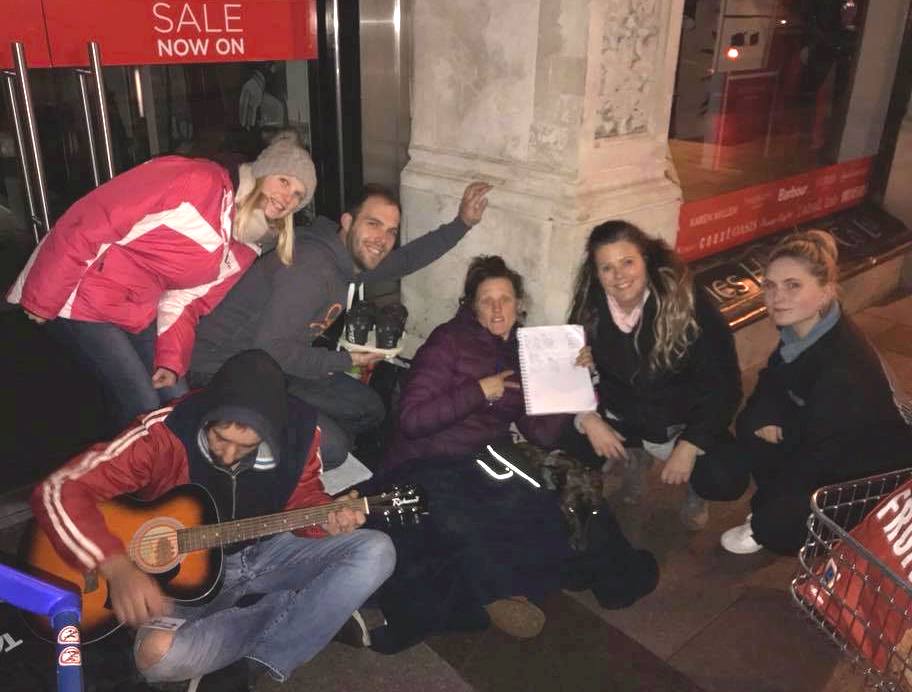
Helping our Homeless

Nicky Pugh, Ashley Morris and Sarah Mason
I recently came across this relatively new group in Llandrindod Wells on Facebook. Prior to that I had not realised that there was support for homeless people in Powys, and realised I knew very little about the subject. Homelessness is suddenly very much in the news – particularly in Windsor because of an imminent Royal wedding – but what of the situation in Powys?

Reading on further on the group’s Facebook page I discovered that much fundraising work had taken place locally in the lead up to Christmas 2017. As a result Helping our Homeless had “supported homeless in Swansea, Cardiff and in our local vicinity, most recently supporting local homeless with clothing, essential items of food and toiletries and footwear.”

Keen to find out more, I messaged the group on Facebook, and one of the group’s founders, Sarah Mason, quickly got in touch. She told me how she, Ashley and Kayleigh Morris, Lee Jarvis and Nicky Pugh came together to take action to help homeless people.


Tell us how the group Helping our Homeless came about and why?

Last year I saw a post on Facebook from Ashley, who was going to do a calendar where every day he placed an item in a box to give to the homeless at the end of the time. I messaged Ashley and his wife to offer some donations as she had been collecting items over the past couple of years and donated these. Ashley and Kayleigh accepted my donation, and this led to us talking about possibly going bigger.

During the year I met Lee Jarvis in a local supermarket and we spoke about homelessness and raising money. Lee agreed this was a good way forward and came on board. Another friend, Nicky, joined us soon later.

After September, I contacted all the interested parties and we met in a local pub where we put together a plan of what we would like to achieve. To be honest we have never looked back.

What is the main purpose of the group?

We want to provide practical and emotional support to homeless people and their animal companions. At the same time we hope to raise awareness of homelessness with the general population.

Who is eligible for support from Helping our Homeless?

Anyone who is street homeless in Wales (but not exclusively), and their animal companions.

We also work with agencies and individuals to reduce poverty and prevent homelessness. In particular we are keen to support Shelters across Wales and in surrounding areas.


How many homeless people are there in Powys roughly and how are where are they living?

A lot of homeless people in Powys are not accounted for on the rough sleeping count as unlike the street homeless in the cities, we don’t always see them here. In a large rural county people could be sleeping rough in barns or farm outbuildings, or in woodland, and remain hidden much of the time.

(The National Rough Sleeping Count, produced by the Welsh Government, is “an annual report which includes information on the estimated number of persons sleeping rough over a two week period and the number of persons observed sleeping rough.”)

Why are people homeless in Powys or elsewhere?

There is no one reason why people become homeless. All kinds of factors can lead to homelessness, including health issues, unemployment, and family breakdown. Many homeless people have previously been employed and in a position to pay for their housing, but something suddenly changes and their lives are turned upside down.

Some of the key factors leading to homelessness include: benefit changes, a rise in the cost of living, the loss of employment and a lack of new job opportunities. Also a person’s mental health may deteriorate, they may have drug and alcohol or other addictions, or a completely unexpected change in their circumstances could lead to homelessness.

It is said that most people are just two pay cheques away from poverty and three from homelessness.


What support does Helping our Homeless provide to people?

We provide essentials, care, and face-to-face interaction, whether in Powys or further afield.

On the practical side, we find that the essential items homeless people really do need are food, care packs, toiletries, clothing and some form of shelter for their time on the streets. Tents and sleeping bags are very popular! We will also provide first aid provisions.

We talk to people. We empathise. We guide people to other agencies that can offer support. We spend time engaging and trying to make day-to-day life easier for those on the streets.

Most importantly, we offer face-to-face confidential support without judgment. We are a face that cares.

In other parts of the UK we will work directly with local shelters and help promote the invaluable work they do.

As a group we provide online support to each other.

How does being homeless impact on a person’s mental health?

Hugely. Many homeless people are struggling with low self-esteem. Their confidence and morale have completely dipped. Some people have such low self-worth, and are so lonely, that they resort to self harming, including substance misuse. In worse case scenarios, some people have suicidal thoughts.

Physical health can also deteriorate rapidly when people are sleeping rough. If they are not eating regularly they can experience malnutrition, and, inevitably, they tolerate a deterioration in their personal hygiene.

If people don’t receive the support they need, what can happen to them?

Health can deteriorate rapidly, with the result that homeless people have a lower life expectancy.

They are also far more likely to commit crime. Due to their circumstances they may lack self control, and they may become addicted to drugs and alcohol.

Homeless people are still entitled to claim benefits using the Simple Payment card. However, in reality not everyone receives all the benefits that they are entitled to.

I know you want to grow your group – what are your main aims?


We would really like to register Helping our Homeless formally as a charity – we are working with PAVO development workers to progress this. The next step would be to expand the group, so we will raise awareness of our activities as much as we can with the aim of recruiting more volunteers. Bigger, more permanent premises, with sufficient storage space would be an added bonus!


If people are interested in volunteering for the group, what roles are available (alternatively, what skills do you need)?

Roles that we currently have available include:
  • Collecting donations.
  • Sorting the donations that come to us.
  • Advertising.
  • Distributing.
  • Fundraising.
  • Promoting the cause.
Do get in touch if you are interested! Contact details below.

Which other organisations do you work closely with, either locally in Powys, or in the rest of the UK, to provide support to people?

Quite a few, mainly in Wales. In Swansea these include Unity Group Wales, the Unum Project and Zac’s Place. In Llandrindod Wells – Mid Powys Mind, the local food bank, and the Herb Garden Community Café.

We also engage with lots of online shelters and organisations.

What are the main challenges of the role?

The big one - not being able to commit as much time as we would like. And feeling so far away as we are remotely based.

On a very practical level, we currently lack long-term storage, and vehicles – we would love a van.

We also have to deal with our own mental challenges as we carry out the work.


Tell us about some of the most rewarding work you have done at Helping our Homeless so far.

Our top 8 most rewarding aspects so far:
  1. Provided shelter to many rough sleepers.
  2. Food and drinks.
  3. Medical aid.
  4. Support and advice.
  5. Support to other shelters.
  6. Time with the street homeless.
  7. Making our street homeless feel wanted.
  8. Learning about the street homeless and building relationships.
When you are not volunteering how do you enjoy spending your time?

We all work full time, so we juggle working with volunteering. Some of our hobbies include bowls, football, pool, art and craft work. And we spend time with our families of course!


Many thanks to Sarah and the rest of the team at Helping our Homeless for telling us more about their work in Mid and South Wales in particular.

If you want to find out more or get involved you can contact Sarah by ringing 07775 851 718 or send a message on the Helping our Homeless Facebook page.

On the BBC website this week two articles feature Homelessness:


Tuesday, 31 October 2017

The Golden Boys – Men’s Shed Llandod

Tony White and Sean Tohill
“Somewhere for men to meet new friends, work on group or individual projects, learn new skills or just chill out and relax, to help prevent social isolation, frustration and boredom.”

The ‘Shed’ movement is slowly but surely spreading throughout the UK. One of its aims is to tackle loneliness and social isolation by creating community spaces where men can feel at home and work on projects in a safe and friendly venue.

Their local Shed is a great space to share skills and socialise with other men from the neighbourhood. Ultimately the men may regain a sense of purpose and find that their general wellbeing improves.

At the time of writing there are two Men's Sheds in Powys, one in Knighton and another near Llandrindod Wells. The Llandod Shed is based at Ashfield Community Enterprise in Howey, just a couple of miles south of the town. It was officially opened on 10 June 2017 by Assembly Member Kirsty Williams. Members Nigel Frankland, Sean Tohill and Tony White, who all helped set up the Shed, told me more about it.


How did you identify the need for the Men’s Shed?


We’d seen about it on the internet – how it was all over the UK. This was about two and a half years ago. Once we put feelers out it became apparent that a lot of men out there are at a loose end and have become socially isolated. Me for one! Some of us have had to retire from work for health reasons and we’d only go out of the house if we had to. If there wasn’t a need to go shopping, for example, we might not even bother getting dressed! We put posters around town about the Men’s Shed and men got in touch to find out more.

How did your involvement start? What was your role in making it happen?


We looked around for a location for a while but nothing suitable came up in Llandrindod town centre. Then we became aware of this space at Ashfield Community Enterprise. We put out an appeal for equipment on Facebook and Freecycle and were inundated with donations. We’ve had £1000 worth of tools given to us by people who no longer need the kit, everything from sliding mitre saws and plane thicknessers to work benches and loads of hand tools.

Now if people want to make donations we ask them to get in touch to discuss what they have. Having said that we are keen to acquire a standing pillar drill, and also a computer and printer! And we accept donations of timber to make products. In the early days we were also pleased to receive a £1000 grant from Greggs and other small grants from local groups.

Nigel Frankland (foreground)
Tell me more about what happens at the Men’s Shed?

We come in twice a week. We could be working on individual or group projects using the kit. A lot of the time we stand and talk – which does a world of good! We have a laugh, a joke, and a cup of coffee. One of the Ashfield staff said to me once: “It’s lovely to walk past the Shed and hear laughter.” We get on and do things. At the end of the day we’re here to have fun.

One of the members has dementia, and it was three to four months before he mentioned this to the others. “I have good days and bad days. I come here to unwind and relax. There’s no major pressure.”

Another member said “I was banned from my own shed by ‘senior management’ so I come here instead!”

Some people can’t always have a shed of their own at home. And even for those that do there is so much more space and equipment here. And there is an opportunity to learn new skills – one of the members is a very experienced woodworker.

Who can join?

It is open to all men aged 18 and over. The annual fee is £5, plus it’s £1 to attend a session. At the moment we are open for business on Tuesday and Thursdays between 10am – 1pm.

We also welcome “ladies by arrangement!” Particularly those who want to learn skills or have skills they can pass on. We have actually been approached by three women who want to learn how to make things like shave horses and three legged stools, so we will be running a session for them soon.


If the members didn’t have the Shed what would they be doing?

Well I would be climbing up the wall! I’m the sort of person that if I’m not doing something then it drives me nuts!

How does attending a Men’s Shed impact on men’s emotional wellbeing?

For most of the time I feel a lot happier once I’ve been to a session. We laugh and joke and I look forward to coming to the next session, which has to be a bonus.

So many people get stuck, trapped in their jobs – having to pay the mortgage, having to put food on the table. Yet some of them have no career prospects. These days there are few places to learn skills such as woodwork, bricklaying and plumbing. People aspire to white collar jobs and most go to university. Someone could come here for a year and learn something and set themselves up in business. The future of the country is in Small Medium Enterprises, not big business!

Do you network with other Men’s Sheds?


We are in contact with the Shed in Knighton – we visit each other and swap tips and ideas. They are in a similar position to us – looking for funding to pay their running costs.

Hereford Shed has also been in touch recently – their members want to make a visit.

The umbrella body for Men’s Sheds in Wales is – Men’s Sheds Cymru. We were the first Shed in Wales to be issued with the organisation’s new golden badges – and that is where the name The Golden Boys came from.


Where did the idea for Men’s Sheds come from? I read: “Women talk to each other, men like to talk while immersing themselves in a task.”


It was an Australian idea originally. They noticed that amongst men and women who had the same operation, on the same day, in the same theatre, with the same surgeon, that the women were much quicker in their recovery.

The men that were recovering turned out to be commercial fishermen. These men were not governed in their work by the clock, but by Nature. After fishing trips they would sit together to mend their nets and chat.

99% of Australian Sheds are government funded because they realise the value of them.

The first Men’s Shed in England and Wales opened in Hartford, Cheshire, in 2009. There are now nearly 300 Sheds across the UK.

Do you take part in other activities apart from those in the Shed?

At some Men’s Sheds the members fix bicycles or cars for people in the community, but most are based around woodwork. We need to look at our communities and see what is required. Members of our Shed have done gardening for people locally in the past and also refurbished council benches in town.

What is the most challenging part of your roles?


Trying to find a market for the products that we make in the Shed. We need to earn an income so that we can cover our running costs (rent and utility bills). The grants are never big enough or long enough! 3 – 5 year funding would be ideal. Organisations need stable funding.

To raise money we have made everything from planters, bird tables and owl boxes to Recycling Crate shelves (a bargain £35!). Local delivery can be arranged in return for a donation. The members also take on commissions – we are currently refurbishing the cold frames at Ashfield, have made signs for GP surgeries, and benches for other local charities. Occasionally we will have a market stall in Llandrindod on Fridays. At the same time we try not to turn it into a job as that is not what the idea of the Shed is all about…

What advice would you give to men hoping to set up a Shed in their community?


Go for it! You don’t need lots of equipment to start out with, just a few hand tools and some premises. Give it a go, and good luck!


Many thanks to Nigel, Sean and Tony for telling us all about The Golden Boys! If you want to find out more about the Llandod Men’s Shed you can contact Nigel by emailing thedoddyfixersmensshed@gmail.com

Thursday, 27 July 2017

Looking at Me - an arts and dementia initiative


Artist Terri Sweeney has been running some innovative mosaic workshops at the arts charity Celf o Gwmpas in Llandrindod Wells over the past few weeks (the last session was earlier today). They were specifically aimed at people living with dementia and those close to them.

Last week the PAVO meeting rooms were fully booked so we relocated to the Celf gallery for our team meeting. During a break I had the perfect opportunity to catch up with Anca Pancu, Project Co-ordinator at Celf, to find out more about how the workshops went.


Tell us more about your role at Celf

In this particular project, ‘Reaching Out, Drawing In,’ my role was to schedule dates and select artists to deliver sessions in liaison with the artists, volunteers and participants for each of the series of workshop sessions. I market our programme of workshop activities to relevant audiences and networks, manage the workshop bookings, and collect the relevant materials for evaluation purposes.

Who were the workshops for?

The workshops were for people in the early stages of dementia who were able to attend, communicate and participate in creative workshops. Sessions were free of charge for carers who were welcome to participate in the creative activities and socialise.

The weekly workshops are part of a two-year, European Union funded, Powys-based programme of arts & health activities (2017-2018). The programme aims to benefit over 150 participants and also includes:

  • 3 engagement artists’ residencies – working with people with a range of support needs.
  • Year-round weekly creative workshops for learning disabled adults at Centre Celf.
  • Outreach dementia support programme – creative opportunities for individuals in care settings & at home.
The programme is piloting and evaluating new ways of engaging with some of the most isolated people in Powys.

Tell us more about the workshops

Through our workshops we aim to reduce isolation for our participants, allowing people to develop new social connections and networks. We also bring disabled people into contact with wider society. 


We enable this process through exhibitions and events associated with residencies, improving communication and mutual understanding. We are helping people to develop new skills and to increase confidence which we hope will lead them towards engaging with the wider arts world. This is the reason we observe and act on the unmet needs of participants and we tailor work to support their needs and interests.

‘I wasn’t sure about the self-portrait mosaic workshop,
 if I will be able to do it, but the result surprised me, great fun!’

Why did you choose Terri to run the workshops?

We have chosen Terri Sweeney for the ‘Looking at me’ – mosaic workshops on the basis of her professional level of practice and experience of working with people with dementia. She works in a variety of media including mosaic, felt and mixed media painting and she has many years' experience working as an artist with people of all ages and background.


Why was there a focus on self-portraits in the mosaics?

This is a project that works very well for people with dementia. When they look down to their self-portrait they relate to their own identity as they are using an abstract manner of portraying. This method is challenging their preconceived ideas about who they are, it’s a reflection back in time: ‘this is who I am, this is who I always be’. 

It is a way for them to gain a better understanding of their condition in relation to dementia and to regain a sense of time, place and identity.

How did the participants find the sessions?


The participants were challenged by some of the activities in the beginning but they persevered and succeeded in producing mosaic work that they are happy with. 

They became more confident as the sessions went on, interacting with the artist and the volunteer. New skills were learnt and they interacted with each other and had fun. As the participants gained confidence they became more comfortable within the group.


What are the benefits of the creative arts for people with dementia?

The participants seemed to enjoy the social interaction of the group very much; they are very keen to come back. Through our research, preparation and running of these sessions they have learnt new skills, learning how to develop exercises that combine an appropriate level of intellectual stimulation with sufficient demands on manual dexterity. There was plenty of social interaction and with the right level of support the production of a satisfying result. 

At the end of the sessions they were pleasantly surprised by the standard of the work they have achieved. They have had fun and in the same time they have gained a sense of validation through their creative expression. ‘Looking at Me’ is not only about a memory journey, it's about finding strength inside yourself to do the best you can do, enjoying the moment, and the reflection of yourself in the present moment.

Do you have any other workshops coming up?

Trained artist facilitators are working with small groups, supporting them to use professional arts techniques and materials to keep their minds active and engaged. Examples include poetry and sculpture as well as sculpture, music and dance. The workshops take place year round in blocks of 6 x 2 hour sessions. The 2.5 hour workshops cost £3.50 to attend, and are free for carers. Participants should pre-book where possible.

All the workshops are listed on the Celf o Gwmpas website, but do get in touch if you want further information by ringing 01597 822777.


Many thanks to Anca for telling more about the mosaic workshops - and keep an eye out for more of their exciting programme of events and courses coming up in Llandrindod.

You can also read about Celf's 2016 project running sessional weekends for artists who have experience or knowledge of the arts and mental health.


Tuesday, 4 April 2017

LGBTQ+ - setting up a new Powys group


This week's guest author introduces himself:

My name is Shaun and I am a volunteer at Mid Powys Mind.

I should start by saying that LGBTQ+ (Lesbian, Gay, Bisexual, Transgendered, Questing) is not a mental health condition although it has a huge impact on mental health. Before we decided to have a LGBTQ+ peer support group I read an article that said 70% of people who identify as trans will contemplate suicide, members of the LGBTQ+ community are twice as likely to developed a mental health condition and LGBTQ+ youths are twice as likely to attempt suicide. The reasons for this are isolation, homophobia, biphobia, transphobia and ignorance.


As an openly gay man, who has a diagnosis of borderline personality disorder, this didn't shock me as much as as it should have. What shocked me was how little support there is in Powys; although Powys is the largest county in Wales it doesn't even have a sexual health clinic.

Mid Powys Mind's Wellbeing Coordinator asked me if I wanted to organise and run a LGBTQ+ peer support group and I jumped at the chance. I started by researching and soon found that there were far more sexuality and gender identities than I was aware of. I think it must be so confusing these days for LGBTQ+ youths, coming to terms with their sexuality/gender. We spoke about whether we need to add the Q. Some places will say that Q stands for queer, but I'm now aware that some find this offensive - for a long time queer was used as an insult and although a lot of LGBTQ+ have reclaimed the word queer, if asked I say the Q is for questioning. I have also been taken back how many times I have had to explain what LGBTQ+ stood for, I assumed everyone knew, maybe that is because I am the G in LGBTQ+.


Other things came up that I hadn't thought of since being a teenager. Mainly “coming out” and how we come out as a teenager and think that is it, but the truth is we “come out” through out our lives, friendships, work, socially... there is always that moment when someone says: "Do you have a girlfriend?"

Going around Llandrindod and asking strangers if they would put up a poster to advertise the LGBTQ+ group I was more or less “coming out” in every place I visited. In the back of my mind the same insecurities that plagued me as a teenager came back.... Is this the time I will have to face a negative reaction? And a certain amount of shame. If I feel this way as a confident middle-aged gay man, imagine how a teenager or someone who has low self-confidence may feel?

The group meets on the last Tuesday of each month (5pm - 7pm) in the basement at Mid Powys Mind's Wellbeing Centre in Llandrindod Wells. It is a small, diverse and friendly group. We have guest speakers: so far we have had someone from the Terence Higgins Trust and the Dyfed Powys Police LGBTQ+ Liaison Officer. Future plans for the group include arranging a social evening, a session to raise awareness, trips to the Pride festival and discussions to secure funding.


Anne Woods, one of the PAVO mental health team’s Participation Officers, has been attending the group.

Anne says, “I think it’s very important to be able to get together with people who share similar experiences, especially when we have something in common that can set us apart from others. Although I’ve not experienced much overt prejudice since moving to Powys, I have noticed some and I think it’s vital to have a safe place where we can explore issues around gender and sexuality with people who understand.

As part of the Comic Relief funded project I’m running, we have an opportunity to link up with the Iris Prize community outreach team to produce a short film about issues affecting people from the LGBTQ+ community in Powys and members of the group will be taking part. I would encourage anyone to contact me if they would be interested in taking part.”

For more information about the LGBTQ+ monthly group call Mid Powys Mind on 01597 824411, or email: vo@midpowysmind.org.uk

You might be interested in these links...

Anne Woods wrote about taking part in the 2016 Pride event in London in Taking Pride in Diversity.

At the start of LGBT History Month in February 2017, Sarah Carr, Associate Professor of Mental Health Research at Middlesex University, wrote "Queer in the head"? Do LGB people in the UK have poorer mental health?

Thursday, 19 January 2017

Celf Able - disability and the arts in Powys


This week's guest author is Amanda Wells - one of the founder members of the group Celf Able in Powys.

Celf-Able is a new group by and for disabled and disability artists in Powys. We provide opportunities for people to meet and create art, supporting and learning from each other. Our aim is to reduce isolation and raise awareness of disability arts and disability issues. We meet at Oriel Davies, Newtown one month and at Centre Celf, Llandrindod Wells the other. We are very grateful to have Arts Council of Wales ‘Sharing Together’ funding to meet until the end of March 2017. So the search for further funding to carry on beyond that has begun! 


The four initial members of the group had met on the Celf o Gwmpas Artist Training and Mentoring project, which ran from 2009 to 2014. As well as meeting regularly to develop our arts practice, we’d had some adventures including trips to Edinburgh, Glasgow and Finland. When the project came to an end we wanted to carry on meeting as a group as we all found working together and supporting each other very valuable with our various disabilities and the exclusion that disabled and disability artists often experience. We were lucky enough to secure funding from ArtWorks Cymru to meet bi-monthly, and meetings started in May 2015. 


We are pleased that some new members have joined the group since then. We have enjoyed sharing art skills and techniques, peer support, and we have even had a go at performance art, preparing and performing a short piece for ArtWorks Cymru conference in November 2016. For the performance we all chose a barrier that we face personally to engaging in opportunities, and between us we wrote a script about how the barriers affect us and how they might be overcome. The message we were trying to get across was serious but we used a lot of humour in the performance. 

We have just completed the process of becoming a not-for-profit company. This will open up the possibility of more grants for us. We would like to carry on getting together and are currently having discussions as to how the different members of the group would like to see Celf-Able develop. Some members just want to come along to do art in a supportive atmosphere, other members are more ambitious for the group, but there’s room for everyone to take part in whatever way they wish.


For our performance piece it somehow came about that we all took on the characters of birds (don’t ask, I really can’t remember how the idea came up but we decided to work with it), and we are now working on a group installation piece called ‘Bird House’. Celf o Gwmpas are kindly giving us a space to work in over several weeks, we have no funding but are meeting the costs involved ourselves, just because the idea came up and we all want to do it and we enjoy working together.

We are open to any new people who would like to come along, maybe just to meet us and find out what we’re up to. 

Our upcoming meetings are at Centre Celf, Llandrindod Wells, January 24th 11.00am - 3.00pm, and at Oriel Davies, Newtown, February 28th 10.30am - 3.00pm.


To mark the end of the Arts Council funding we are running a training day on arts and disability, and how the arts can be used for inclusion and wellbeing. The sessions are open to disabled people, arts workers, community workers, health and social workers and others. The days are taking place on March 21st in Newtown and March 28th in Llandrindod. The sessions are free and lunch is provided. To book a place call 01938 810058 or email admin@celf-able.org

Amanda

Voluntary (Un!)-co-ordinator, Celf-Able


Many thanks to Amanda for telling us about this innovative arts and disability group. You can read more on the Celf Able website, including a blog post by the Chair Sue Patch who writes "What Celf Able has done for me".  And you can learn about the development of Disability Art in the 1970s and 80s as a result of the new political activism of the disabled peoples' movement.

Monday, 7 November 2016

The Blue Boy


Our guest post this week is by a member of the new Llandrindod Autism Support Group which takes place monthly at Mid Powys Mind's Resource Centre in Llandrindod Wells.

Llandrindod Autism Support Group is a place where people are accepted for who they are and can be themselves without being misunderstood or unfairly judged for being "different".

We like to talk about what it's like to see the world in a different way from those around us and how we try to cope with the everyday world.

At the next meeting, on 11 November, we shall be discussing anxiety and what we do to reduce or avoid it. I would encourage anyone who is on the autistic spectrum, or who thinks they may be, to come along and meet others like them.

This is my story…

When I delivered my son Mark on the first of July 1995, I had no idea of the incredible journey I would take in learning about Autism and how differently I’d see the world 21 years later.

There was nothing particularly unusual about Mark’s first year and my wife and I settled into parenting our first child thinking we had it all worked out. The first indication that Mark’s brain was wired differently was when he crawled into the kitchen, put the palm of one hand on the oven door and just left it there. I pulled his hand away and the blisters healed quickly. What we now know are autistic meltdowns became common, especially in shops, and we became accustomed to withering looks directed at us by other shoppers as Mark lay on the floor screaming.

From about age four, it became clear that Mark didn’t understand other children – if they caused problems he would neither try to stop them or walk away. My heart went out to him – deep down I recognised this from my own childhood.

We had already decided to educate Mark ourselves and looking back we all agree this was the best option. It gave Mark the chance to learn with less distractions than in a class room and gave us the chance to make sure Mark’s social life was one he would benefit from.


When Mark was about ten years old, we went along to our own local group for children with Asperger syndrome and met other parents struggling with oppositional behaviour, meltdowns and problems coping with school. The groups supported each other by sharing their troubles and listening without judgement. There were also books to borrow and I read avidly about other parents' experiences bringing up autistic children.

There were unexpected things such as sharing interests in historic architecture and the paintings of Gainsborough with Mark from age six, and reading and discussing philosophy from age ten. Mark developed a passion for Jazz and we played most days until he started college.

What made life so difficult was seemingly compulsive oppositional behaviour which happened many times every day and drove us close to nervous breakdown. For example, he would not get dressed to go out, even to do his favourite things such as spending a day on the local steam railway, and as the time to leave got closer we became more and more frustrated and stressed and Mark got more resistant to our pleas. Imagine this behaviour in almost every situation and you might just begin to understand why autistic children and their parents need all the support and understanding they can get.


Embracing Individuality – a group for those on the autistic spectrum or those who think they may be – takes place on the second Friday of each month, 10.30am – 12.30pm at the Resource Centre, Mid Powys Mind, Llandrindod Wells, LD1 5DH. 


For board games, a chat and a discussion about what you would like to happen next.

For further information please ring Paul on 01686 440716, email paul.hostler1728@gmail.com or check out the Powys Autism Facebook page.


Tuesday, 21 January 2014

Man to Man - let's talk

Mike Buckley, who lives in Radnorshire, tells us more about the mens’ group which he organises which meets monthly in Llandrindod Wells.

Why did you decide to start the Man to Man group?
Men tend to find it more difficult to talk about the issues which they encounter in life. The group was formed to provide a place where men can be themselves fully without fear of being judged and to discuss things like anxiety, shame, self worth as well as happiness and joy.


What has been the response to the meetings so far?

Only a few people attend so far and I think it will grow by word of mouth. Those that have come to the first three meetings have responded in a really heartfelt way. One person went away after a meeting and wrote a piece describing an encounter in his past, which we then discussed at the next meeting.

Who can join the group?
Any males over 18. Anyone who wants to drop in. There is no course as such so someone can join at any stage.

When is your next meeting?
Our next meeting is on Thursday 30th January from 7.00 to 8.30 at The Court, Lant Avenue, Llandrindod Wells, LD1 5HY.

Tell us a bit about what will happen at the meeting
At this meeting there will be two ten minute periods of sitting in silence with guidance. The topic for the evening is identity. We will explore who we think we are and from where we derive our sense of identity. This will include looking at areas where our sense of self comes under question and how that makes us feel.

What plans do you have for future meetings?
The January meeting is the beginning place for a discussion which will span the next few meetings. We will go on to look at the viewpoint from which we look out at life and discuss how we come to hold our opinions and attitudes. We could for example look at what happens in an argument where two people disagree about any given thing. The group will be asked to consider whether the story about who 'I' am is completely related to the past and to a life story, and what happens to this 'I' in the present moment.

The value of all this will hopefully be felt when the discussion spills into the sense of self-worth, which is a topic we have already heard in the group. It is central to how a person feels about themselves and most people doubt their value to some degree or other.

At the next meeting we will also listen to about 10 minutes of a talk by Eckhart Tolle which neatly addresses the above points.


If people want to find out more, who can they contact?
People can call me on 07866 497 604.

Thanks Mike, for telling us more about the group. If you have ever been along to a men's group either in Powys or elsewhere, let us know your experiences.


Look out for dates of future meetings on our website here.

Tuesday, 1 October 2013

Volunteering at Mid Powys Mind

Today Philip Moisson tells us about his experience volunteering at the mental health charity Mid Powys Mind, based in Llandrindod Wells in the heart of rural Powys.


"Of the many organisations that I have worked for over the years the place where I have made the deepest connections with other people has undoubtedly been whilst volunteering at Mid Powys Mind in Llandrindod Wells.

For the past ten months I have been a regular helper in the Art Cafe – which for those of you who have not visited yet combines unique local arts and crafts with a relaxed and homely experience centred around hot drinks and homemade cakes. There are ten or so volunteers currently involved in the Art Cafe and we cover Monday to Friday between us.

The building which Mind uses hosts a drop-in centre for members, the Art Cafe which is open to the public, rooms for groups to meet above the cafe and also spaces for counselling and therapy to take place. There are also a few small offices up another flight of stairs.

As a member and a volunteer I am able to have a hot meal at lunchtime, usually with other people at the drop-in centre. Alongside the Art Cafe there was the chance to try a couple of other voluntary roles around the building, and I can genuinely say that I have looked forward to coming in to help almost every day I have been involved.

Over time I have found out about other opportunities nearby by speaking to other members, other volunteers and of course, paid staff. A few of us have spent quite a bit of time being involved in a Time to Change Wales project (further details on the free Creative Writing sessions can be found here!).

Of all the perks of being involved with a charity, training has to rank quite highly. Some of us have been on the Mental Health First Aid course and a physical First Aid course too. Usually I have a good idea what is going on in terms of the range of courses, services and events which Mid Powys Mind is able to facilitate - in no small part because I update the Facebook page.


Of course, no organisation in the broad mental health sector is immune from the pressures stemming from cuts or from the blunt realities that some of us may refer to in polite or abstract terms through well-meaning debates and arguments. The town, Llandrindod Wells, for all its nearby scenic charm, struggles to offer much in the way of employment opportunity - and that’s whether you have a known mental health concern or not.

However, in terms of focussing on positive outcomes whenever possible, finding a place within reach where people regularly share lived experience with one another has been the most important feature in my own personal journey so far. This will now hopefully involve going forward from a point in the past where I struggled on strong medication with no meaningful support in place, to a position where I am able to live medication free and can fully consider life choices once again."

If you would like to read more of Philip's writings, you can take a look at his own blog, Knowledge of Dark Matters.

Or, if you would like to share your mental health volunteering experience with a wider readership via this blog, and you are based in Powys, then please get in touch.

You can find out more about Mid Powys Mind here.  And congratulations to all those involved in the Art Cafe which was awarded the Group award at the Powys Volunteer of the Year Award recently.