Showing posts with label arts and health. Show all posts

Tuesday, 19 December 2023

A Private Land Art Lab – Gweithdy Celf TirDiaffordd


Sat 28 – Sun 29 October 2023

by Penny Hallas & Susan Adams

The Art Lab was the culmination of A Private Land project, featuring 2 days of co-produced, collaborative art including sculpture, video, painting, drawing, animation - and events featuring performance poetry, music and projection. Having an Art Lab rather than an exhibition felt like the work was live, a workshop, generating collaborative activity and conversations, a work in progress. We offered free refreshments to visitors while they looked around, there was also a relaxed area with sofas, books, things to do, or just sit, talk or contemplate.

The chosen venue was the Muse in Brecon, which had the advantage of being familiar to many of our participants from Brecon and District Mind, and also just a lovely characterful and friendly place, usually used for clubs and music nights. Some of the 155 visitors stayed for the majority of both days; people came mainly from a 30 mile radius, but also from Bristol, Cambridge, London, Newport, Cardiff, Hereford and the Midlands. Most moving was the way people came especially to share their stories and memories – of their own or loved one’s experiences of care at the old Mid-Wales Hospital and elsewhere.

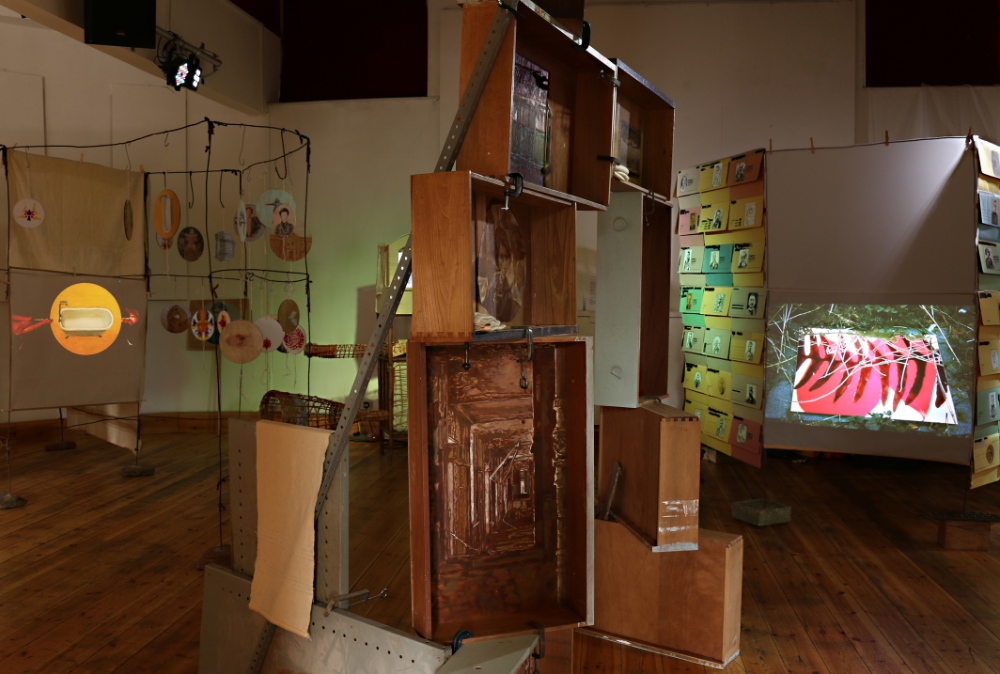
After you entered the space you were faced with an off-kilter arch that Susan had made with
drawers from various chests, reflecting the heaps of moldering furniture inside the old hospital when it was abandoned. It could be that the arch echoed the grand portico of the Mid Wales Hospital, entry through which must have been a terrifying experience for some. Also that the inside of a drawer – in this case, painted with imagery - feels like the only space allotted you that feels private when you entered the hospital as an inpatient.

We wanted many of the artworks to invite interaction and a feeling of playfulness instead of the detached contemplation that visitors to art exhibitions might expect. We also wanted our art to be seen on a par with our participants and the work intermingled. Rather than the solidity of walls, rickety support structures formed from rusty reclaimed reinforcement rods held much of the work, perhaps echoing the fragility of the collapsing Mid-Wales Hospital and the experiences of those who lived there.


People took down and spun the thaumatropes - disks that rely on persistence of vision to come to life – that Susan and Mind members had made. Though playful, the optical toys also feel uncanny and disquieting because they offer a glimpse of something that isn’t really there. (Click here to see a few spin). The disks were partly inspired by our visit to the Powys Archives where we saw the 1900-1923 records of those admitted to the Brecon and Radnor Asylum, many of which were accompanied by circular photographic portraits. They were also inspired by the card games played at Mind meetings we joined, which eased social interaction and helped people feel relaxed.


Our participants were so generous with their time and creativity, extra to the workshops; artist and poet Eve Thomas produced photo-works, poems, and made jam from blackberries growing at the Mid Wales site for the Art Lab. Other participants made free-standing sculptural works and wrote poetry. We were very honoured also to have recorded conversations with two individuals who were treated at the Mid-Wales, and these were quietly playing at opposite ends of the room.


Penny drew over 75 portraits inspired by the photos we saw in the archives. These were mounted on recycled manila folders with redacted details of previous contents, to try to give a visual equivalent to institutional record keeping. At the centre of the structure was a video made of the 130 flower slides made in our workshops.

One of the activities offered in our workshops was weaving with nettles, brambles, briars - plants that are slowly taking over the grounds of the old Hospital. Often seen simply as weeds, they have a protective role and have been highly valued in the past. Penny combined the weavings with large works of her own to create sculptural pieces, suggesting sometimes shelters, and sometimes traps. The hope was that this would offer a kind of parallel experience to Art Lab visitors and this in fact happened with people temporarily inhabiting and animating them. Some people found them spiky and felt off-balance whilst others found them comforting, like the nests children make in bushes. One person said that his was a voluntary admission, but that he wouldn't be staying in for long.


On 2 television screens people could sit and watch an absorbing 30 minute video in 6 chapters reflecting Penny’s personal experiences through the project and something of how she chose to position herself in relation to its complexity and multiple challenges. Lyndon Davies provided a hauntingly beautiful sound-piece, amplifying and carrying the narrative. To see and hear a tiny clip, click here.


A sculptural piece by Susan involved a little blanket clad theatre atop an Edwardian what-not from which emerged woven willow tubes and horns. The little theatre is based on the stage in the dining hall at the Mid-Wales Hospital, the blankets for her a recurring metaphor, reflecting the dichotomy of comfort and restraint, or care and control. In the theatre a pencil drawn animation played, looking at cycles within nature and the irony of the ‘butterfly’ design of the hospital.


The Saturday evening event wasn't like a normal art opening, it felt like the heart of the Lab, with people really focusing on the experience of being there. We had performative events interspersed by periods when people could refresh their drinks and continue conversations.

The poet Angela Morton spent time in the Mid Wales hospital and wrote about her life during periods of mental illness and experiences in the hospital. Her daughter, Becky was going to read from Angela’s collection the Holding Ground, (the collective press 2002) but our dates coincided with a trip away, so she liaised with close friend and colleague, poet Graham Hartill, who read for her, shared his own memories of Angela and reflected on her poems. Her grandson musician Gwyn Daggett and creative partner Beth Flynn played some of their new material, it was beautiful.


Eve Thomas began and ended the evening with reading poetry and speaking from the heart about mental health challenges. Well over £100 was raised for Brecon and District Min

The following day in the afternoon we held a talk and feedback discussion, about 25 people came along, including Brecon and District Mind members, Stella Man and Cerys from Glenside Hospital Museum, psychotherapists, curators, historians, artists, participatory arts workers, a psychoanalyst and doctor. During the discussion we learnt that the books we had to fight so hard to see at the Archives were almost discarded when the hospital had closed – the attitude had gone from extreme carelessness to hyper vigilance and restricted access.

Afterwards people stayed to look around at the artworks and the discussions continued in smaller informal groups. Like everything during the Lab weekend, there was a feeling of energy in that so many interesting ideas were shared in a short period of time with a buzz of potential for what could be.


Here’s just a little of the feedback we received about A Private Land and the Art Lab:

'I was so impressed to see so many people come through the doors and share their stories reflecting on the old Mid Wales Hospital ruin in Talgarth. It felt so valuable and necessary to take this time to talk about the hospital and the people who lived, worked and died there.

Taking part in this project has been so affirming for me. It’s made me certain that I want to pursue a career as an artist as much as I possibly can. This was the first time I’ve ever stood up in front of a room full of people and talked about my art processes and shared my poetry - and the feedback I received was invaluable. I’ve gained some interesting insights about my work, and the confidence to seek out this kind of experience again. Massive thanks to Susan and Penny who created the project and let me be involved - you supported and inspired me throughout.’

‘I feel a deep resonance between the works here and my own lived experience as someone impacted by mental health issues. Privacy, emotional intelligence, confidence and self expression explored and shared here in a nurturing space has been profoundly affecting. Thank you for this unique experience facilitating the unfurling of much of my vulnerability.’

‘LOVE this so much – the art feels really alive and so many different elements. Immersive, intriguing and fascinating reaction and response to a place – its history, stories and its demise. The way the artists have involved others in the creative process including at the exhibition itself is great – the slide making is a huge hit with my son! Thanks.’

‘An emotive exhibition which captured the negative and supportive lifestyle of people in the hospital.’

‘Evoked so many memories of people we have known and loved.’

‘We really enjoyed this show and loved the way it had interactive parts! Wonderful! Hauntingly Beautiful with a dose of playful innocence. Loved it! ‘

‘Thank you so much for the experience and the opportunities brought by this event. Words are not enough.’

‘A Private Land’ stretched my thinking, so many threads spinning on conversations had and not had. Thank you.’

Resources and links

PEAK cymru https://www.peakcymru.org

Talgarth Museum https://www.facebook.com/TalgarthMuseum

Glenside Hospital Museum https://www.glensidemuseum.org.uk

Bethlem Gallery https://bethlemgallery.com

Outside In https://www.instagram.com/outsidein_uk/?hl=en

The restoration Trust Change Minds Project https://restorationtrust.org.uk/change-minds/

Mendip Hospital Cemetery http://www.mendiphospitalcemetery.org.uk

High Royds Hospital website, Talgarth page

http://www.highroydshospital.com/resource/mid-wales-hospital-talgarth/

The role of Arts in Improving Health and Wellbeing

https://assets.publishing.service.gov.uk/government/uploads/system/uploads/attachment_data/file/929773/DCMS_report_April_2020_finalx__1_.pdf

The Wales Arts Health & Wellbeing Network (WAHWN) https://wahwn.cymru


Tuesday, 15 August 2023

A Private Land Project Tir Diarffordd


by Susan Adams and Penny Hallas

What is A Private Land?

A Private Land is an art-based research and development project, supported by Arts Council Wales and undertaken in collaboration with community groups, with a central theme of the links between emotional and environmental health. Its funded timeframe is February - October 2023, but it is expected that relationships and processes developed in this R&D phase will inform on-going projects.

How did the project start?

Artists Susan Adams and Penny Hallas share deep interest in inner and outer worlds: the intersections between the visible world and the realm of imagination. In searching for a collaborative project in which we could explore these concerns further, we were drawn to the former Mid Wales Hospital, Talgarth, Powys, Wales. After more than a century, its physical remains are falling into the final stages of dissolution and will most likely soon be demolished. But it is of historic importance to the local community and former patients and continues to be a site of intense and complex emotional resonance for many different communities and groups.


What are the main themes?

Our project references geographical and psychological territories and the nature of the boundaries that may both protect and / or restrict us. Where are we positioned in relation to boundaries: how much choice do we have and can past actions and decisions be reconsidered? Whose voices are heard and who is remembered? Whereas many other former hospitals (e.g. Ely or Whitchurch in Cardiff, Bethlem in London and Glenside in Bristol) have preserved memories and artefacts, patient voices and stories, we've noticed that it is particularly difficult to find accounts from the people who received treatment at Talgarth. So we have tried to enter imaginatively into the Talgarth site and the hidden stories it suggests, and we invite the voices of people who have experienced mental health issues there or do so currently in the community. Culminating in co-produced arts events/installations, we are trying to form new narratives in creative ways before both site and memories are lost to us.

Our project touches on important but sensitive issues and themes, and we are aware of the need for both courage and delicacy to work together with everyone involved to follow the project through with care. Negotiating strong and contradictory feelings evoked by the project themes in participants, communities, organisations and ourselves is a large part of our work. This includes adapting to a wide and sometimes conflicting range of views as to what is or 'should be' private and what can be shared.

Who are your partners?

We are encouraged by the support and involvement of our partners. Arts Council of Wales; Brecon and District MIND; Powys Teaching Health Board; Research partner, writer and historian Dr Bob Adams, BSc, MB BS, FRCPsych, M Psychotherapy; Creative mentor, Mel Brimfield, Royal College of Art. We're particularly grateful to Marie Davies, CEO at Brecon and District MIND and to Lucinda Bevan, Arts in Health Co-ordinator, Powys Teaching Health Board, for the inspiration, experience and ideas that shaped our plans as well as the support in safeguarding, risk assessments, levels of consent and observation of service protocols that gave us confidence to go ahead.

These were our key partners, but one of the pleasures of the project has been the way unexpected alliances have emerged. For example, the arts organisation PEAKcymru have lent us technology that was outside our budget but has been key to engagement. And mid-way through the project, artists, writers and an art psychotherapist responded to our invitation to form a community artist peer discussion group, inspired by Bethlem Gallery's Questions of Care online workshop earlier this year. Together we shared some of the dilemmas and pleasures of community engagement and all agreed this should be an on going group.

In methodology, our project follows the many existing models of good practice in exploring these themes, including artist-led projects, some of which are listed in the resources and links section.

What has been happening in the project so far?

Our activities have included looking inward to our own emotional and artistic journeys, and outward - to historical archives, online resources, other former hospital sites and communities and arts engagement with local community groups.

Research activities have included initial consultation with our research partner and our creative mentor to deepen our understanding of historical context and help identify the shape of our own and collaborative art activities. We visited Glenside Hospital Museum to see how they have turned their former chapel into a lively resource for the local community and a centre of good practice in dealing with historic and current attitudes to mental health.

From the earliest days of the project we knew that a visit to the Mid Wales Hospital archives, held at Powys Archives in Llandrindod Wells, would be vital to getting a sense of hidden stories. We were able to view registers, case notes, maps and other documents that fall outside the 100 year limitation on viewing but it was the personal accounts, letters and photographs that touched our hearts. We're unable to share photos for this research and development project, but this may be possible in any future phase. Both of us have made images inspired by what we saw. This one is by Susan.


Arts engagement has been through a series of arts workshops as well as digital input and engagement to extend reach. Our initial ideas were simply to offer a broad range of options for workshop participation including audio, video, animation, textiles as well as more traditional art media, based on the areas of expertise we have developed in our own practices. We wanted to meet people first though, to find out what they would like to happen so we had three initial meetings, at Brecon, Talgarth and Hay Mind groups. From these meetings we learnt that some people were interested in the Mid Wales Hospital and had memories to share, whilst others made it clear that they preferred to focus on the natural and environmental elements of the project. So we devised four activities that we offered across all three groups: weaving with foraged and natural materials, making simple animations, making slides for projection with flowers and creating a thaumatrope - an optical toy. We hoped that all these activities would allow multiple points of entry so that people could join in to the level that they felt comfortable with. 


There have been six workshops so far and we will be doing a demonstration / workshop at Felindre Ward, Bronllys Hospital too. We've seen amazing levels of engagement and enthusiasm. Quite a few people wanted more time to continue their artworks, so in addition to the workshops we have supplied materials and activity packs. We have welcomed the contribution of people who preferred not to use art materials, but who kept us company and joined in the conversations.


Participants at the Brecon & District Mind workshops told us about the tiny but packed Museum in the Old Post Office in Talgarth which they thought would have artefacts relating to A Private Land. So we made a visit and were surprised and delighted to find objects, images, artworks and records from the Mid Wales Hospital, donated by the community.

We met so many people with fascinating tales to tell. This thread has led us to adapt our plans for final events in order to be part of the Talgarth Festival

What will happen next and how can people get involved?

We'll be having final events to show what we have all done together in the project and to continue to gather stories and memories. We'll be inviting people to bring any artefacts they may have from the old hospital site to help form an archive and preserve memories. The events are free and open to all, so please do come along and spread the word.

We'll be having a stall at Talgarth Festival on Saturday 26th August making contacts, offering more opportunities for sharing stories verbally, through art making and display of objects. We plan a shared walk up to the old hospital site, late afternoon / early evening.

There will be a co-produced exhibition at The Muse, Brecon, 28th and 29th October, with guest artists, a writing / poetry workshop, performers and poetry reading. And of course, more opportunities for people to contribute. Full details of all our events will be posted on A Private Land / Tir Diarffordd Facebook page

We've only been able to give a broad overview of our complex project in this blog, but if you would like to see more we have been keeping a record of most of our activities and engagement on our Artist Information Company blog: https://www.a-n.co.uk/blogs/a-private-land-tir-diarffordd/ Brecon and District Mind suggested we set up a Facebook page (QR code below) to help keep in touch with participants and as a focus for ideas / exchanges so there's lots to see there too and we'd love it if people would like to add comments and posts. We're happy for people to contribute in language of choice. Croeso i chi gyfrannu yn y Gymraeg!

About the artists


Susan Adams lives near Brecon and Penny Hallas lives near Crickhowell, forming a kind of triangle with Talgarth. Both artists have extensive experience of working with communities, in education, health and with a wide range of organisations and institutions. They have exhibited widely in Wales and internationally. You can see more of their work on the links below.

Susan Adams https://susan-adams.co.uk https://www.instagram.com/susan_j_adams/?hl=en

Penny Hallas https://www.pennyhallas.co.uk https://www.instagram.com/pennyhallas/?hl=en

Resources and links

PEAK cymru https://www.peakcymru.org

Talgarth Museum https://www.facebook.com/TalgarthMuseum

Glenside Hospital Museum https://www.glensidemuseum.org.uk

Bethlem Gallery https://bethlemgallery.com

Outside In https://www.instagram.com/outsidein_uk/?hl=en

The restoration Trust Change Minds Project https://restorationtrust.org.uk/change-minds/

Mendip Hospital Cemetery http://www.mendiphospitalcemetery.org.uk

High Royds Hospital website, Talgarth page http://www.highroydshospital.com/resource/mid-wales-hospital-talgarth/

The role of Arts in Improving Health and Wellbeing 


Tuesday, 12 April 2022

Creative writing workshops on Felindre Ward


Emma Beynon is a writer and creative facilitator based in Mid Wales. Since the pandemic she has “led creative writing workshops on Zoom and face-to-face. Every workshop is carefully planned to guide participants through a series of exercises designed to fire up their creativity and strengthen their writing skills.”

Late last year Emma began facilitating creative writing workshops on Felindre Ward, the mental health inpatient ward in South Powys.

This week I caught up with Emma to find out more about more about the workshops and her creative writing work in general.


Tell us more about your role on Felindre Ward

Millie, the Occupational Therapist, invited me to attend to run creative writing workshops to compliment the work she already does on the ward. I’d already been running creative writing workshops online during Covid, working with Mid & North Powys Mind, and had a tremendous response.

Creative writing was part of the choice of activities people have during their stay on the ward.

What happened at the workshops

I came in for an hour every Wednesday for 11 weeks in total until the end of March 2022. There is an amazing creative room on Felindre Ward where they do pottery. I brought in a table cloth and objects such as flowers, feathers, rocks and postcards to soften the room and set up the table as if we were in a cafe.

I always start with a short warm up. It could be a playful question such as: If you were a packet of crisps what flavour would you be today? This would be followed by a ‘free write’. This technique is used by many professional writers to limber up.

Free writing invites participants to write without stopping, letting their thoughts flow onto paper. There is no wrong answer. The emphasis is upon catching ideas rather than worrying about spelling or punctuation. I find it is really useful to use a prompt when free writing, a starting point such as a shell, a feather -  something to hold and look at.

I might also let everyone choose a postcard of a painting and ask them to free write in response to that. If I can sense participants are stuck I ask questions about the painting. What do you see or hear? What do you smell, what textures might you sense? I invite them to draw upon memory. If people get stuck I encourage them to not let your pen stop moving! Just write “I don’t know what to write” until the stuckness stops. If people can look at me very grumpily – that’s fine – I smile and invite them to continue. I try and shift the parameters until they feel safe enough and ready to give it a go.


Free writing is a great way of focusing on the five senses and noticing too. Millie (OT) was the first to notice the link between creative writing and mindfulness, but during the course of the project many of the participants enjoyed making that link too.

I would then share a selection of poems: poems about nature, weather, working on building sites, even a ping pong ball. I wanted everyone to understand that poetry is a broad church, it can be about anything, not just flowers and feelings. We then read the poems aloud, line by line. This is often a wonderful moment of group performance where we all rely upon each other. Everyone’s voice brings a new meaning to the lines. After reading the poem a number of times we’d talk about about how the poem makes us feel, what we enjoy, what we don’t like.

I was very keen that everyone could be honest about what they felt about the poems, you do not have to like them, they were there to be discussed. I was really impressed by everyone’s response, it was always so detailed, evocative and yet always so true. I learnt so much from the group.

I will never forget the day we read The Door by Miroslav Holub, it is one of my favourite poems, I have read it so many times and always loved it. But this time when we read it, one of the participants just looked up, smiled and said ‘It’s about change’. I had never thought of that, to me it was about risk and opportunity. But they were right, it was great to witness everyone bring their own view of the world to strengthen our understanding. Inspired by the poem, the discussion or maybe just a line or image, everyone would be given the chance to write and they did!

How did the project come about?

As part of the HORIZON project led by Powys Teaching Health Board in partnership with Powys County Council. “HORIZON aims to strategically embed person-centred creativity at the heart of mental health and wellbeing practice.”

One of the aims of the HORIZON project is to learn about patient experiences through involvement in the arts.

Other creative interventions are being planned in Powys, including somatic experiencing and dance with people engaged in the Improving Cancer Journey, and clay modelling, sculpture making and printing workshops for young people at risk of substance misuse at the Mid Wales Arts Centre.


How do you support someone who says they can’t write?

A lot of people think creative writing is like the writing you did at school. But creative writing is completely different. I make this explicit at the start of the workshops when I introduce free writing. I explain that everyone has an individual voice which develops from what they notice. Creative writing is about capturing what you notice in words so there is no wrong answer. Creative writing, in its early stages,  is always messy, misspelt, and the punctuation can be wrong – but it doesn’t matter!

It’s a bit like a sport - you need to practice to get match fit. So I support people from the start to feel they can give it a go. During the project sometimes participants got stuck or did not want to write a particular poem so I would offer them an alternative. That’s the great thing about creative writing - it is very adaptable. Often when I find I get stuck with my own writing I just make myself write a list of questions or objects or thoughts or feelings and somehow this helps get over the ‘stuckness’.


What are the benefits of the creative arts, and specifically creative writing, for mental health inpatients?

A chance to relax

‘It was really relaxing because it does not matter what you write, there is no fear of judgement. If you hate it, so what? You don’t have to share it or go back to it if you don’t want to. Next time you will have a chance to develop different skills. It develops a resilience. It’s just about the person who is writing, the participants lead it, they can write what they like, they have control, they can share their views on a poem and then do what they like.’ Feedback from Occupational Therapist, Bronllys Secure Mental Health Unit.

Confidence

‘I feel as if my confidence in my own creative abilities has grown’. Mind Participant.

‘Creative writing gives me confidence, a voice and certainly an outlet to escape the daily pressures of life.’  Mind Participant.

‘They've made me feel about fitting in, and confidence to maybe not fit in, but still be a part of things?’  Mind Participant.

Companionship

‘You could see that they wanted each other to be good, they really listened. Sometimes out on the ward this does not happen.’  Feedback from Occupational Therapist, Bronllys Secure Mental Health Unit.

‘I love sharing our creations, I feel like I'm getting to know everyone a little better through the sharing of our work. It's beginning to feel like a family in a way’. Mind Participant

New skills and hobby

‘I have gained so much knowledge and confidence as well as interest to definitely try and find more courses to learn more skills in writing.’  Mind Participant.

‘I learnt how to have more structure to writing. I learnt how to write in a time frame without pondering too much and without over thinking. I learnt how to believe that what I write is worth more than to be lost on random bits of paper and thrown away when it's clear up time.’  Mind Participant.

‘I cannot thank you enough for connecting, engaging and inspiring me to write. I ask myself questions about what I am writing as you would at times. I enjoy stripping away words and using the magic of simple language. I will carry it on and what you have taught us I will carry with me always’. Mind Participant.

Participants on one of Emma's creative writing workshops in Newtown

What are the benefits to the providers of health services?
  • Millie remarked positively on the way the workshop provided an escape from the ‘enclosed hospital environment of the ward’. Everyone shared all or part of their writing so we could imaginatively join them in Anglesey or out in the field in a valley somewhere in Mid Wales.
  • The patient feels in control in an environment where they cannot control much as they control what they write about. If they like the poem and if they want to discuss/share it – it’s up to them.
  • Patients are out of their room so can be assessed more easily.
  • Concentration, motivation can be assessed as to whether they can concentrate throughout the duration of the group and then this can be monitored and compared to other weeks.
  • Patients often feel a change in mood following the sessions as they have been off the ward (in the pottery room) which is a change of environment and so feel happier and brighter in mood.
  • They can express themselves in a different means which they are comfortable about and say what they feel.
  • It’s so good they get a chance to see the patient in a different and very positive light.

What happens to the creative work that the workshop participants produce?


My practice is all about process - those moments in the workshop rather than the outcome.

I bought notebooks for everyone, plus copies of poems to slip in. They all took their notebooks away and wrote in them in the evenings. They would often show me what they had written at the next session.

Those poems stayed in the notebooks and kick-started private writing and journaling.

Tell us about some of the more unusual places where you have held workshops over the years?

I once led writing workshops for the opening of a new Sustrans bicycle track in Paddington – it was a one-day celebration. Michael Bond, the author of ‘Paddington’, was there. It was difficult to start a workshop as people were milling around so I just went up to them and asked them to read ‘What If This Road,’ a poem by Sheenagh Pugh. Everyone loved the poem and they were keen to respond to it with a story or memory of hope for a road which I then scribed into a poem.

I do a lot of sailing and was sailing from Iceland to Greenland and got terribly seasick so they dropped me back in Iceland. There I was in NW Iceland when I was supposed to be in Greenland. I was feeling quite lonely and abandoned when I came across a tiny 1950s shoe shop which had been turned into a Museum of the Everyday. I went in there and talked to the girls who had started the Museum and within a week I was running writing workshops which developed into a residency every February in the town.


Do you have any other workshops coming up in Powys?

I have some new creative writing Workshops for Wellness starting on 21 April in Newtown in North Powys working in partnership with the Oriel Davies gallery.

We will try and capture the hidden beauty of Newtown’s parkland in words - noticing the changing seasons, the weather and wildlife. It’s about feeling good in body and mind and connecting us to the bigger picture.

Readings and reflections will also be shared to inspire participants to write as we explore Dolerw Park.

No previous experience is required, just curiosity and two hours of time on Thursday afternoons. Workshops are free of charge, funded through Welsh Government.

Workshop dates: April 21, 28 and May 5, 12, 19 & 26, 2 – 4pm.

Feedback from workshop participants

'I like it – poetry is a little like mindfulness.'

'I really enjoyed it.'

'I like it – it's random.'

Feedback from staff

‘It was really relaxing.’

‘I liked it, I enjoyed it. M enjoyed it and engaged much more than I thought he would be. I was surprised when he shared his first poem. It was good.’

A big thank you to Emma for telling us all about the creative writing workshops on Felindre Ward and other aspects of her writing life.

If you want to find out more about Emma Beynon’s work check out her website. You can contact Emma here and find her on Instagram here.


HORIZON is strategic, action-based pilot project designed to inform the production of the Creative Arts, Health & Wellbeing Strategy (led by Powys Teaching Health Board in partnership with Powys County Council) by providing arts interventions for people experiencing mental ill health across a whole range of areas. HORIZON aims to capture the patient voice / service user story around their creative experiences. The project is funded and supported by the Powys Teaching Health Board Charitable Fund and Powys County Council.

Wednesday, 15 September 2021

Radiate Arts - boosting mental health in North Powys

L - R: Jenny Botha & Pam Gordon of Radiate Arts
Claire Powell & Jackie Newey of Powys Association of Voluntary Organisations

Claire Powell (Community Connector for Newtown & Llanidloes) and I recently paid a visit to Radiate Arts CIC  (a community interest company) at its current base in North Powys. Radiate Arts is a not-for-profit organisation which delivers creative workshops in the community. Each workshop is tailored to the group, but the goal remains the same – to use art for mental and physical wellbeing.

We caught up with Pam and Jenny of Radiate Arts at their beautiful lakeside location high in the hills to find out more about the organisation’s current activities. We also learnt more about how art can have such a positive impact on people’s mental health.


Why is art so important for wellbeing?

Art can provide a space for relaxation and focus. Participants on our courses often comment about how creative activities help them forget their worries and it gives them headspace to focus on something new. The social element of our workshops is also a big benefit, as it encourages others to get out and meet people too (socially distanced of course).

It's important to remember that using creativity as a way to relax has real benefits. People who do art, or write regularly, tend to have lower levels of anxiety and stress. It's even been known to lower blood pressure, improve sleep and reduce chronic pain. These, among other benefits, can improve your overall quality of life and help you to feel more content.


Where is Radiate Arts based?

Our Creative Hub is located under 5 miles from Llanidloes town centre. This is our main location for our art workshops, and we work across Chester and the west of England too.

We overlook the Clywedog Reservoir, so there are some stunning views across the valley. We’re lucky to be placed in such a beautiful location. In fact, we use the beauty of nature to inspire us in our work and for green prescribing.

Tell us a bit more about the workshops

We run a wide range of workshops, from stone carving, painting, sketching, macrame, creative writing and printing - there's something for everyone!

We lead workshops for those who may not have had many opportunities to interact and participate in creative spaces before, or had access to these facilities. We provide a safe space to develop positive feelings of self-worth, mindfulness and mental awareness through a creative process.

Have you ever tried to use art or poetry to relax? Sometimes it's hard to know where to start...many of our participants have found success in unlocking their creative intuition through our inclusive workshops.

Creativity is for everyone, regardless of skillset.


Are workshops open to the public?

Yes, we run workshops which are open to the public, but you will need to book in advance. All of our live public workshops can be found on our Eventbrite page here.

Do you run creative workshops for community groups, as part of social prescribing?

Yes, we do! Social prescribing workshops from referred groups, form most of our workshops at our Creative Hub. Examples include stone carving with ex-service personnel, to printing with care homes.

Radiate Arts recently ran an outdoor photography workshop for ex-army veterans in partnership with The Armed Forces Covenant Fund's 'Positive Pathways Programme'.

The course, called 'Creative Freedom,' saw participants roam the beautiful landscape of Mid Wales, taking photographs along the way. The aim was to increase physical and mental wellbeing, and was spread out over three days on the hillsides nearby the Clywedog Reservoir. You can read more on our blog here.

Who leads the workshops?

We have a team of expert artists who deliver the workshop in their field. They are experienced with hosting groups, and enjoy sharing their artform with others. We host an Artist Q and A on our blog, which you can read here.


How can I find out more or get in touch?

To find out more, please visit our website www.radiatearts.co.uk , or email office@radiatearts.co.uk. You can also follow us on social media:

Facebook – RadiateArts

Twitter – ArtsRadiate 

Instagram – RadiateArts

Monday, 22 July 2019

Music Therapy - A Young Man's Introduction

by guest blogger Evan Griffiths


Evan Griffiths is a Powys based 15 year old musician currently doing work experience at the Powys Association of Voluntary Organisations (PAVO).

His interests in music and mental health have led him to begin researching into the rising medical field of music therapy as a treatment for various mental illnesses such as depression and/or anxiety.

Evan has since decided to spend a morning of his work experience briefly outlining the benefits of music therapy as well as giving some information on it. He would also like to note he’s finding writing a third person introduction to himself a little bit weird.


So, what got you interested in this topic?

Well as anyone who knows me will tell you I’m a bit of a nerd for practical uses for music. I just enjoy seeing my passion being used to help people, so naturally I was drawn to the idea of using music as therapy like a moth to flame because I’d been using music as a kind of self therapy already for years. Because I already had an interest in this topic all I needed was a good excuse to do some research into it (as my spare time was already far too full with being a teenager) so then when we were told by the school to do a 2000 word project on something of our choice I decided then would be a good time to start digging my teeth into some research.

And so I started researching and I’m doing some more currently to fact check the rest of this blog post. The project is yet to be completed but I have so far looked into a fair few sources as well as asked a load of my peers for their thoughts so I will try and give data to fairly represent both the therapy itself as well as my generation’s opinion on it.

Can you briefly explain what music therapy is?

Yeah, sure. Music therapy is, to put it simply, people using music as a way of dealing with mental illness or other issues. It first began in the 1800s but has sat on the back burner of world of treatment for mental illness for many many years. However, recently it has begun to come into the limelight with very high success rates in the face of a mental health crisis. I believe that music therapy is the kind of innovation we need and Powys should have more facilities and support available for people who would enjoy and hopefully reap benefit from this treatment. It’s been shown to help everyone but especially young people and seniors who are exactly the people with highest demand for better mental health treatments.

Do you have any first hand experience with music therapy?

I do, however not from a formal organisation. I learnt music at a young age and have now learnt to write my own songs so I will often do that as a form of escapism when I’m in a bad patch. I have a few friends who have done/are doing the same and though it is helpful it’s nothing compared to the overwhelming success rates of formal music therapy. I’ve talked to my songwriter friends about this a lot and we’ve all agreed that encouraging young people to take up music and creating formal music therapy organisations, or supporting existing ones, would be excellent for the young people of Powys or anywhere really.


Why do you believe music therapy would be helpful, specifically to young people?

Well as much as I hate to admit it, it is true that young people spend far too much time on their phones and this has proven to have an incredibly negative effect on mental health. So encouraging teens to take up an instrument would provide them with something positive and productive to do instead. This would be as well as the positive effects music gives anyway as a distraction from a problem to help a person temporarily feel better. Or it could be used as a method of facing these emotions and communicating them through song, which for some people (including me) is far easier than talking about them to a therapist or counsellor.

So, not only would it be providing teens with a healthier outlet or distraction from their emotions it would also be keeping them off things that could (and probably will) damage their mental health.

What other benefits does music therapy offer?

Music therapy has also shown huge success rates with seniors due to its social benefits. Music has always had a sense of community about it and music therapy reflects that. It brings people together from all kinds of walks of life to share a love of music. And of course, loneliness is a huge problem amongst elderly people and a chance to come and hang out with some friends and sing some songs would likely be a great opportunity for elderly folks to get out of the house a bit, and jamming out to “Sweet Caroline” with the lads twice a month would give them something to look forward to. 


Music can also improve your memory and has been shown to reduce dementia risk which is excellent and only further shows why it’s important for people of all ages to get involved in music therapy if they want/need it. Also if you begin learning an instrument young you’re much more likely to continue with it into adult life so music therapy could turn a depressed teen into a lifelong musician. I think anything that can inspire that kind of change in a person needs to be at the forefront of mental health treatment.


Do the benefits of music therapy carry over to other forms of art? 

That hugely depends on what type of art you mean but generally yes, it seems they do. Many of the things I discussed in my last answer are music specific such as the memory and social aspects. However, many of the emotional therapies offered by music do carry over to traditional art, poetry, acting, or any other kind of art you can think of. It seems that just to create can be a therapy for people as a way of venting emotions.

However I think music therapy is the most widely beneficial of the types of art used in therapy (I know traditional art and poetry are also often used) as it also offers the social experience to the elderly and music can be more easily learnt than, say, drawing. However if you really cannot make music but happen to be an incredible poet then that can also have many of the same benefits for you.

Ponthafren Singing for Well-being - End of Term Showcase

Any charities that support this come to mind?

Off the top of my head I’d say if you want to support music therapy donate money to the Nordoff Robbins organisation. They’re the leading charity for music therapy in the UK and it would be excellent if they could open a branch somewhere in Powys.

But if you do want something more local Ponthafren are truly excellent. I was lucky enough to have the chance to see one of their showcases and talk to members of the charity as well as people the charity has helped. Everyone was really lovely and well informed as to the benefits of music therapy and how they benefited from it personally. There’s an excellent atmosphere at Ponthafren and I’d strongly recommend the organisation to anyone whether you want help with your mental health or if you want to listen to some music. Of course they also do other stuff to promote good mental health. 

Any closing notes or final thoughts you’d like to say? 

It seems like music therapy is a rising medium that just needs to be professionally recognised and implemented alongside traditional therapy methods. It has begun to grow exponentially in the past few years with small scale music events happening to raise money for mental health all over Mid Wales. I believe therefore that it will continue to grow further judging by the amount of advertisements I found for music therapist training courses whilst trying to find a Welsh music therapy charity (I could not find one but I imagine one will open in the near future). If Powys could have a place in this growing medium I believe that would be really cool and I’m certain more of these charities need to be created and supported.

Thursday, 27 June 2019

Celf-Able - peer support in a creative environment in North Powys

Andrew Logan (Celf-Able's patron) donated this artwork for the Secret Art Sales
Two and a half years ago we introduced our readers to a new group by and for disabled artists in Powys called Celf-Able. This week's guest author Amanda Wells - one of the founder members of the group - gives us an update on Celf-Able's recent and planned activities, and ongoing development.

Hello, I’m Amanda, voluntary co-ordinator for Celf-Able, a disabled-led inclusive art group in Montgomeryshire. We have been having a busy time at our meetings in Machynlleth, Caersws, Llanfair Caereinion, Welshpool and Newtown. We meet once a month in each venue and get together to do art in a social and peer-supportive atmosphere. We provide materials and people can have a go at different types of art, and when funding allows we invite artists to do workshops with us on different art materials and techniques. We have done pottery, mosaics, linoprinting, portrait painting, abstract painting and a host of other activities.

We believe in the role of art in wellbeing and social inclusion. Members benefit from exploring their creativity and doing art in a relaxed and supportive atmosphere. We share skills and help each other achieve our artistic aims. We hold regular exhibitions at Newtown library and Centre Celf in Llandrindod Wells. We are disabled-led but we are open to all.


We have recently changed our logo to a dragon who’s a wheelchair user, this has sparked us into doing a series of dragon paintings. These will be on display and for sale at our fundraising event on July 20th at Oriel Davies, Newtown. There will also be a ‘secret art sale’ of decorated postcards in sealed envelopes. The postcards have been decorated by Celf-Able members and also artists Andrew Logan, Mary Lloyd-Jones, Linda Jane James, David Bannister and Steffan Jones-Hughes. We also have a ‘Lucky Squares’ raffle for original artworks and limited edition reproductions by Brian Jones, Linda Jane James, Steffan Jones-Hughes and others. We are very lucky that Andrew Logan recently agreed to be our first patron.

Artist Linda Jane James has made a temporary dragon mascot for us and s/he needs a name, so we have a ‘name the dragon’ raffle too. We hope to get funding to make a permanent mascot soon.


We have been hand-decorating mugs to sell to raise funds, members have decorated them with lots of different designs. This was my idea, I donated some plain white mugs to the group and we have been using Posca paint pens to decorate them. When baked in the oven the paint becomes permanent (although not dishwasher-proof). Members have enjoyed decorating the mugs with their designs.

Recently we had a stall at Llanfair Carnival, we sold donated items and brought the dragon mascot for its first outing, we also had original art for sale. With grants ever harder to get we have been increasing our activity to raise our own funds.

I was one of the founding members of Celf-Able back in 2014, we developed out of a group on Celf o Gwmpas’s Artist Training and Mentoring scheme. We wanted to carry on meeting when that project ended so we set up on our own. Celf-Able has grown a lot since then and we have had many activities as well as our regular meetings. We had a trip on Welshpool canal and also a horse-drawn canal boat trip in Llangollen. We hope to get funding to go on some day trips to galleries in Aberystywth, Machynlleth, Birmingham and Walsall, we will then produce artwork inspired by the trips.


I fell into the role of voluntary co-ordinator and have had to learn how to make grant applications and do various admin and co-ordinating tasks. This has been very demanding at times but I have gained a lot of project management skills. I would quite like to study a course on project management to get a qualification. I have also grown in confidence, personally and as an artist, so although it can be hard work and stressful at times I still get a lot out of Celf-Able, and have made lots of new valued friends. I enjoy the meetings as it’s a time I set aside to do art, mixing with like-minded people. I have been encouraged to study for the MA Fine Art at Wolverhampton, this is nearing completion now, I would never have had the confidence to do this without Celf-Able. I’m even looking into going on to do a PhD, on disability arts and society.

I really enjoy seeing other people grow in confidence too. Sometimes people are very apprehensive when they first come to the group but after a few sessions they start to relax and enjoy their creativity. It’s also good for Celf-Able to connect with other organisations. We attend a variety of networking events locally and further afield, such as Aberystwyth and Chester. We are going to be a case study group for ArtWorks Cymru’s Quality Principles, this work starts in July.

We are holding two ‘Beth Am Gael Tro/Have A Go’ workshops at Llanfair Caereinion Institute, Upcycling on July 27th and Creative Writing on August 17th, these will be led by members who have gained the confidence to run workshops through the group. So a busy time ahead, but we do it for the love of art!


Many thanks to Amanda for the latest news on this thriving disability-led arts group. 

Celf-Able now has a Powys Lotto page - you can support local causes and have a chance of winning prizes with the local lottery. You can find out more about the organisation by phoning 01938 810058 or emailing: admin@celf-able.org

Monday, 25 February 2019

Celf o Gwmpas – Reaching Out, Drawing In

Maud & Pauline beneath a display of their artwork
Last week I attended the opening of this truly inspiring exhibition at Centre Celf in Llandrindod Wells. We originally wrote about one of the art organisation’s workshops for people living with dementia in Looking at me – an arts and dementia initiative - in 2017 in the early days of the project. 

This exhibition – "Reaching Out, Drawing In" - is the result of all the many workshops that have taken place over the past two years, for people living with dementia and learning disabled adults. 


Anne Evans is the chair of Celf o Gwmpas, and she told us more about the show:

In 2017 Celf o Gwmpas received funding from the Arwain LEADER programme for an ambitious project piloting new ways of delivering arts workshops to adults with a learning disability and people living with dementia and their carers.

We partnered this with funding from the Arts Council of Wales to run four residencies for artists with disabilities; two engagement residencies bringing to Powys highly regarded artists such as Helen Ivory and Ira Lightman, and a ground-breaking digital residency linking, in real time, with Canadian learning-disabled artist Scott Berry and participants with learning disabilities here.


We have run 174 workshop sessions, with an average attendance of 7 per workshop, and provided around 1218 places with this funding. It’s phenomenal really. Participants have experienced a huge range of art forms, developed skills in making and have taken up opportunities to explore aspects of their own lives through art. 

Artist Jane Mason worked with learning disabled adults in Tile Tales

The creativity really is amazing. We’ve had print making, puppet-making, film and animation, tile making, mosaics, watercolour painting, sewing and quilting, linocuts, multi-media personal mapping, poetry, instrument making and creative bird box construction. 

The Tile Tales ceramics workshops followed the story of tile making and explored ancient and modern decorative techniques to create two dimensional and relief designs out of clay.

In Dreamlands and Landscapes learning disabled adults worked with Vagabondi Puppets to explore their fears and dreams with puppeteer and sculptress Jo Munton using different techniques and materials.

Ruth Hogg, Project Coordinator, playing drums made from recycled materials
Some of the women in this wonderful project looked at what they were wearing when they were 25 years old in Fashion Memories: When we were 25. Artists Jane Titley and Annie Levy worked with people living with dementia to create quilted pieces using patterns and costumes which I remember from my childhood. The quality and creativity is excellent.

People may be living with dementia or as a learning-disabled adult, but that does not stop them from being artistic, creative and having skills that really should be shown which tells us about who they are. 

In the mosaic workshops participants worked with artist Terri Sweeney
Celf o Gwmpas is at the forefront of arts and health work in Powys, based on a 21 year history of working with socially excluded people and mentoring artists living with physical and learning disabilities, mental health difficulties and other ‘outsider’ experiences. 

We do a lot of work on very small amounts of money, and there are very few staff. This year we are starting up a membership scheme, so you can pay a small amount of money per month to support the work Celf o Gwmpas does such as offering arts activities like these.


You can continue to enjoy the exhibition until 4 April 2019 but gallery opening times are variable so please ring for details on 01597 822777 or email: centrecelf@celfogwmpas.org