Showing posts with label powys teaching health board. Show all posts

Wednesday, 15 May 2024

Mental Health Awareness Week 2024 – Movement for disabled people

Sport Wales Mums & sons, Sue and her son - left

Sue Williams is the Health Disability Activity Practitioner for Powys Teaching Health Board (PTHB). During Mental Health Awareness Week, with its 2024 theme of Movement for Mental Health, it seemed the perfect opportunity to find out more about her role and how the pathway can support disabled people on their way to better physical and mental wellbeing.

What is the Health Disability Activity Pathway?

The Health Disability Activity Pathway supports disabled people across the lifespan to become more physically active. The pathway has been created to enable health professionals to instigate referrals that support the signposting of disabled people to physical activities and sporting opportunities in the local community. This occurs using the expert knowledge of teams within Local Authorities. Moreover, the pathway can be used by anybody, not just healthcare professionals.

The referral and signposting process (which is not a medical referral), was rolled out nationally with Welsh Government funding in 2022 following a successful pilot project in Betsi Cadwaladr University Health Board (BCUHB). Notably, people can be referred to another scheme the National Exercise Referral Scheme (NERS) and also use the Health Disability Activity
 Pathway.


Health Disability Activity Pathway Process

Tell us more about your role as a Health Disability Activity Practitioner

I moved to this new role in PTHB in May 2022, having previously worked as a physiotherapist in BCUHB.

A major part of my role is delivering presentations about the pathway to staff groups and individuals who work with people with disabilities. I talk about the benefits of physical activity (including participation in sport). I also get the opportunity to attend conferences and events to promote the pathway and learn more about the opportunities available, particularly within local communities across PTHB, and to work on projects that help promote physical activity and its benefits.

Recently, I have also started co-delivering sessions to university physiotherapy courses with a colleague from Disability Sport Wales. I love that through this work we are also starting to embed engagement with the pathway from the very outset of health professionals' careers.


Volunteering at a Boccia event

What drew you to the role originally?

This role brings together my experience as a healthcare professional, and my passion for sport and physical activity, and their many benefits. Through many years of NHS community and inpatient work, I have gained an excellent understanding of the teams who work with patients whether this is NHS, Social Services or the Third Sector. 

I have taken part in sport and outdoor activities for most of my life, but not on a regular basis for several years while my children were growing up. When my son started playing hockey for our local hockey club, I gradually got drawn in. New starters were always welcomed (and still are) and another hockey mum and I started training. Very soon we were both playing in league matches. I never imagined I would return to competitive hockey at age 45, having last played on grass in school! I have experienced first-hand so many benefits of being active and being involved in a sports club; as a player, parent of a player, coach and committee member.

I’ve always been captivated and inspired by “the power of sport” in changing people’s lives whether through rehabilitation, bringing people together, the social impacts (individual and community) disability or masters sports for those aged 35 to 80+. Through the COVID-19 pandemic, I developed a growing interest in the benefits of blue and green outdoor spaces, in particular the positive impacts on mental health and wellbeing.

NHS Wales works closely with Disability Sport Wales and Local Authorities to provide this service. How does that work?

The pathway relies on collaborative working between Disability Sport Wales, the 22 Local Authorities, and their corresponding health boards. Each health board has a Practitioner in post who, as well as delivering training sessions, facilitates the links and relationships required to ensure the pathway is a success. Monthly partnership team meetings involving the Practitioners and relevant Disability Sport Wales team members is just one example of how this is achieved.

Wheelchair Fencing World Cup Cardiff 2024

Why is this project particularly innovative?

To the best of our knowledge this pathway, or anything remotely similar, does not exist in any of the other Home Countries, or indeed elsewhere in at least Europe. There is an overall pathway, but not as simple or purely focused on disability, in place in Scotland. The all-Wales pathway focuses on signposting disabled people and giving them the chance to explore and access opportunities they historically may not have been aware existed. It also aims to make the most of every contact to improve their knowledge around the benefits of physical activity and the options available. All of this is led by the underpinning aim of increasing physical activity (including sport participation) and decreasing healthcare resource use.

During the pilot project from 2013 to 2016 there were 560 signposts, with Disability Sport Wales reporting a 21% increase in physical activity levels in North Wales.

Who is eligible to receive support through the HDAP initiative? Is it All Age?

The pathway is for people with a wide range of impairments from age 2, but more opportunities are available from age 5. There is no upper age limit. Referrals for signposting can be made for all types of physical impairments including wheelchair users, sensory impairments, and intellectual impairments.

How are people referred into the pathway?

A form can be filled in with any healthcare professional/other or a self-referral can be made by an individual or their parent/guardian. The form is available on the HDAP website. Health Disability Activity Pathway | Disability Sport Wales + NHS Wales. The person referred or their parent/guardian will be contacted by a Sport Powys team member to arrange to discuss the referral. This is usually by phone. The conversation will aim to explore what the person is interested in and inform them of relevant opportunities. This is usually followed up with a further phone call or email.


Chartered Society of Physiotherapists' conference

Tell us more about the mental health benefits of getting involved in sport and physical activity

The benefits of physical activity for mental health and welling are well-established; both in terms of general wellbeing and their role in the management of specific conditions. Benefits range from improving mood and sleep; increasing motivation and focus, and increasing self-esteem and confidence; to reducing stress, tension and anxiety, and preventing the onset and managing the symptoms of depression. Importantly, getting involved in sport and opportunities to be physically active can also reduce loneliness by connecting people.

There is some great advice and information from Mind about the benefits of physical activity on your mental health.

It is important to remember that there are so many resources available online if someone is not quite ready to try out a new club or activity. In addition, people can be active in so many other ways such as walking and gardening. There are benefits to physical and mental wellbeing from volunteering at a club as well.

What might happen to people if they did not receive the right support?

The pathway is there to bridge a gap. Staff/volunteers working with people with disabilities might only know about 1 or 2 local opportunities. Therefore, without a conversation about physical activity the person may not be made aware of everything available and might miss out on the right club/opportunity for them.

When people find something that suits them, and that they enjoy, they are more likely to continue with it and therefore gain more benefits, more regularly, and long-term.

What are the main challenges of your role?

NHS pressures: this can have a significant impact as there is often a lack of time to fit in training with teams. The geographical size of Powys is another challenge: at an individual level, barriers to engagement in opportunities can be travel or that a certain activity happens in one part of Powys, or indeed regionally within Wales, but not in multiple locations.


Will and Rygbi Gogledd Cymru

Tell us about some of the most rewarding work you have done as a Health Disability Activity Practitioner

Without a doubt this is hearing about success stories: from people just trying a sport because of using the pathway, to being able to follow their journey. I met Will, who lives in mid Powys, last year after speaking with his physiotherapist. Will has a condition that has led to him having a curved spine, needing to use a wheelchair and only being able to walk short distances unaided. He had been playing wheelchair basketball since he was eight after being signposted to the N-able club in Newtown. 

Will then found that two people with the same condition as him were playing wheelchair rugby including Wales and GB’s Josh Williams. Despite not having the correct sport chair and there not being a club in Powys, Will was determined to start playing wheelchair rugby. With the support of his family and Mark Baines of GB Wheelchair Rugby, in the past 12 months, Will has been training with and playing for RGC (Rygbi Gogledd Cymru) Wheelchair Rugby team and continues to progress in the sport. He will admit to being very competitive, but Will loves the social aspects and enjoys being able to play these sports with his friends and family.

My role and work have also challenged my own knowledge and perceptions; for example, observing Boccia training sessions and competitions has allowed me to gain a deeper understanding to be able to promote the activity in a more informed way. Seeing physiotherapy students' perceptions change when they learn about and take part in Boccia in the sessions we run, has been very gratifying.


The hockey playing Williams family

When you’re not working how do you enjoy spending your time?

I live with my husband on a small holding where we keep sheep, so some of my spare time is spent helping with farmwork especially at lambing time. A big portion of my time is for hockey related activity; I play for Dysynni Hockey Club Ladies 2s, I am the vice-captain, and also the club secretary. I have been getting more involved in coaching, particularly with the junior goalkeepers, and I am leading on the work for our club to become Insport accredited (Insport is a Disability Sport Wales scheme, delivered with the support of Sport Wales, which recognises good work in creating inclusive opportunities).

My husband and 2 children also play hockey, so we enjoy going to the social hockey session together, watching and talking about hockey! I love watching sports-related documentaries - one of my favourites and a huge inspiration for me taking this job was “Take His Legs”; about comedian and TV presenter Adam Hills and the inclusive rugby team (Physical Disability Rugby League) he joined. “The documentary deals with issues of mental health, Post Traumatic Stress Syndrome, and the true impact of sport and teamwork in overcoming both physical and mental challenges.”

You can find out more about the Health Disability Activity Pathway on the website or contact Sue directly by email suzanne.williams15@wales.nhs.uk

Tuesday, 2 April 2024

NHS 111 Press 2 - mental health support in Powys


We recently welcomed Marielle Restall, NHS 111 Press 2 Team Lead for Powys Teaching Health Board, to our Health & Wellbeing team meeting to give us an update about this relatively new service in Powys.

What is 111 Press 2?

111 Press 2 is a mental health service available 24 hours a day, 7 days a week, for all ages. People can use the number if they have an urgent mental health concern for themselves or someone they know. It provides access to a mental health professional without the need for a GP referral. It can help people to support mental health crisis and in many cases be an alternative to attending emergency departments or calling the police.

The service can be accessed by calling NHS 111 and selecting option 2. Callers are then transferred to a dedicated member of the mental health team in their locality. The call includes an assessment of needs and a telephone based intervention to reduce stress. Where appropriate individuals can be referred to mental health services, given self-care advice or signposted to other support.

Why do we have 111 Press 2?

It came about following the publication of a report called Beyond the Call. This took a snapshot in Wales of where people presented in mental health crisis. People presented to 17 different places in total, including the police, Welsh Ambulance service, C.A.L.L. Helpline, Psychiatric Liaison Teams and others, which shows that it was not clear how to access mental health services appropriately.

The idea was to provide one number across Wales that’s easily accessible and people know they can rely on to access mental health support. This would then also reduce pressure on police, ambulance and other emergency services.


Beyond the call report, 2020

Who can call 111 Press 2?


Anyone, any age, registered with a Powys GP or visitors to Powys, can call 111 Press 2. If you are calling about someone else the staff can only give advice, they need to speak to the person directly concerned to make referrals to other services.

We take calls from any person registered with a GP in Powys, or visitors to Powys, whether they are known or not to mental health services. 111 Press 2 can refer on to any of the services within mental health. They are encouraging people to call 111 Press 2 as an alternative to attending their GP. People are triaged by a mental health practitioner and onward referral is made if required. Some GPs are actually redirecting people who call in to surgeries to access support. It’s important that the general public know that if they call 111 Press 2 they can be referred anywhere and receive any support. An exception would be if it is a medication query, for example, the person may have commenced medication and want to discuss this further with the GP.

We are working with the Powys Child & Adolescent Mental Health Support (CAMHS) Schools In-Reach team to help spread the word in schools about the service, and CAMHS teams are also promoting it.

There is a separate dedicated Professionals’ Line which is prioritised in the call queue. So far in Powys it is available to GPs, the police and the ambulance service. Currently an average of 2 calls a day are received by this line, so further promotional work is required to spread the word.

The call handlers are using an interpreting service called LanguageLine to provide support to people who speak a language other than English or Welsh. The issue is whether there is a translator available at the time of the call.

There are two Welsh speakers in the team. People can request a Welsh language speaker when they call which would take them directly to a Welsh-speaking call handler.


What can 111 Press 2 do?
  • Conduct a mental health triage to assess a person’s needs.
  • Provide a therapeutic conversation.
  • De-escalate crisis situations (and reduce pressures of A&E and emergency services).
  • Give advice on how to improve and maintain your mental wellbeing.
  • Signpost to Third Sector services.
  • Refer directly into mental health services for a mental health assessment, eg: Local Primary Mental Health team, Community Mental Health team, Crisis Resolution Home Treatment team, Perinatal team, Early Intervention Psychosis, Eating Disorder Services, Child & Adolescent Mental Health Services single point of access.

What 111 Press 2 cannot do


There is no face-to-face or video calling service available. Staff cannot prescribe medication - a referral would be made to mental health services or advice to attend the GP surgery or call ShropDoc out of hours.

111 Press 2 does not call people back at others’ request - the person must call themselves.

Is 111 Press 2 a listening service?


The service is different to CALL Helpline or other listening services. It is a mental health triage service so you would expect a person to ring with a mental health need.

The practitioners will always listen to the person calling and seek to support them with their mental health need whether that be through de-escalation or onward referral to an appropriate service. Callers who are not presenting with a mental health need will be advised to call another helpline or listening service if they wish to.

111 Press 2 seeks to reduce the distress felt by the caller - practitioners use a measure called the Subjective Unit of Distress Scale. It is used as a reflective tool at the end of a call to find out if there has been a change in how people feel from the beginning to the end of the call. If nothing has changed it could be that this highlights areas that have been missed. It gives control over to the person. Nobody’s distress has gone up since the Powys service began. It is about a 50/50 split on - stay the same or decreased. However, not all callers want to engage with this scale, and it is not appropriate for third party callers.


Who’s in the 111 Press 2 team?

7 x Band 5 Wellbeing Practitioners (Support Workers, Psychology graduates, therapists & social care staff).

1 x Band 5 Service Coordinator (administrative).

6 x Band 6 Senior Mental Health Practitioners (with a professional registration in Mental Health Nursing, Social Work or Occupational Therapy).

1 x Band 7 Team Lead (Mental Health nurse).

1 x Band 8 Service Manager (Mental Health nurse).

In a normal shift one of the senior practitioners will be supporting two of the wellbeing practitioners.

Triage scale

Practitioners use a triage scale as a guide to decide how quickly a person needs support.

The majority of the calls (over 60% May 2023 - January 2024) are for advice and information, or advice to contact alternative providers. Emergency responses made up 11% of the calls.

Live Data (May 2023 - January 2024)

We have gathered information about the number and type of calls the team have been receiving since the service started in Powys:
  • 3421 calls received in total.
  • Calls equally distributed across Powys
  • Averaging 19 calls a day.
  • On average calls are answered in less than 2 minutes.
  • Calls are evenly spread throughout the week, with peak times - 6 - 8pm.
  • Age range of callers - 11 years to 95 years.
  • Average caller is male, 44 - 65.
  • 53% callers active to mental health services, 24% closed to mental health services, and 23% no mental health history.

Highlighting gaps in service provision


The new service has already highlighted the need to the health board of certain gaps in current mental health services, for example out-of-hours crisis care. The Crisis Care team is not available after 9.30pm so by default 111 Press 2 are taking many crisis calls during the night time, as the only out of hours contact for Powys Teaching Health Board.

The team is working closely with other services to identify where the service gaps are so that they can really focus on developing those areas. It’s finding what is working for individuals and what isn’t. 111 Press 2 is in the early stages at the moment but has amazing potential to do great things. In fact, 111 Press 2 is at the forefront of transforming how services are operating!


In summary

111 Press 2 is a single point of access into mental health services for the general public.

111 Press 2 is for everybody.

111 Press 2 provides quick access to a mental health professional 
for advice, support and / or a referral.

Many thanks to Marielle for telling us more about the NHS 111 Press 2 service.
You can find out more about 111 Press 2 on this Welsh Government website.


Tuesday, 12 March 2024

Powys Substance Use Harm Reduction Plan launch

Linda Hutchings, Brecon peer support worker

“Developing a partnership response to Harm Reduction across Powys 
to meet the needs of people with drug and alcohol concerns.”

The first thing I picked up at this Harm Reduction Plan launch recently was a flyer about nitazenes (synthetic opioids known for their potent nature) and the changing face of heroin. I hadn’t even pinned on my attendee badge. The bizarre names of drugs like naloxone (a potentially life-saving medication) and nitazene (an extremely harmful drug) were scattered throughout the day and I realised I had a lot to learn.

Fortunately this highly informative day at the Metropole Hotel in Llandrindod brought together a multitude of statutory and voluntary sector agencies with a wealth of knowledge and experience around substance misuse. But perhaps even more importantly it called upon those with the lived experience of the harm that can be caused by substance misuse - be that alcohol or drugs - and the often catastrophic effects resulting in damaged mental and physical health, relationships, living arrangements (homelessness and debt being extreme but not unusual outcomes) and an increased likelihood of coming into contact with the criminal justice system.

Jan Roberts (Suicide Prevention, Harm Reduction & Postvention Quality Improvement Lead), Joy Garfitt (Interim Executive Director of Operations, Mental Health Services) & Carol Daly (Harm Prevention & Reduction Lead - Substance Misuse)
Powys Teaching Health Board

Joy Garfitt, Interim Executive Director of Operations - Mental Health Services in Powys, and chair of the Area Planning Board, welcomed everyone. She explained that the APB brought together agencies across the county with the shared ambition of reducing harm from substance use. (There is a longer definition in the Welsh Government document Working together to reduce harm). The APB plans, commissions and delivers services and also brings networks together. As Joy explained, Powys is actually as long as the distance between the Severn Bridge and the Marble Arch, so this is quite challenging!


What is harm reduction and how can it benefit Powys - Rick Lines, Public Health Wales, Head of Programmes, Substance Use

Rick described how he was first introduced to harm reduction 30 years ago in his hometown of Toronto in Canada. He worked supporting prisoners who, he explained, were inevitably using drugs. His experience supporting people who had been traumatised by early life events, and went on to use drugs, led him to ask in court: “Have you heard this woman’s story? Why is the state looking at it through the context of drugs?” Rick highlighted that putting this particular woman in prison repeated the trauma she had experienced from authority figures when she was a child.

Rick saw the same scenario play out when he later worked in Eastern Europe. He said 90% of drug use is not problematic (how many people do we know who use alcohol on a regular basis socially…?) and asked what we can do to reduce deaths, to show that we care whether people live or die, and to help reduce the risk of using drugs in a risky fashion. We should be respecting the dignity of people who use drugs by providing services, and reducing feelings of vulnerability and stigma.

Recent concerns are around changes in the drug market whereby synthetic and highly dangerous drugs (like nitazenes) are increasingly coming onto the market. Rick championed the ongoing work in the 3rd sector and community pharmacies to provide harm reduction services - “it is the people on the ground who are making the difference”.

Welsh Government policy is committed to harm reduction, and is unique in the United Kingdom, and rare in the world. This policy influences how the police, prisons and partners regard substance use and filters down to the statutory and community organisations.


Current position in Powys and the focus of Harm Reduction - Carol Daly, Harm Prevention and Reduction Lead (Substance Misuse)

Carol’s aim is to set up a multi-agency Powys Harm Reduction sub-group (one of seven across Wales) to drive action across the county. This would draw on the knowledge of local organisations to deliver the key priorities, including:

Supporting the work of the Health Board in working to the World Health Organisation's global aim of eliminating Blood Borne Viruses by 2030. Powys is rolling out treatment and testing for people at risk of Blood Borne Viruses such as HIV, Hepatitis B and C.
  • Training up peer supporters and carers.
  • Developing pharmacy services to increase the uptake of Needle and Syringe Provision and Blood Borne Virus Testing.
  • Raising awareness of the real risks of synthetic drugs coming onto the market.
  • Increasing availability of Naloxone across partner agencies.
  • Addressing the stigma (it was again pointed out that most people use some sort of substance, for example, alcohol).
  • Prevention - the APB has commissioned services to educate children and young people about drugs, and Carol is working with Child & Adolescent Mental Health Services (CAMHS) to increase knowledge of new synthetic opiates.

This important agenda would save lives - and has saved thousands of lives already with the information and tools to help people who take drugs do so in a safer manner.

During discussion Barry Eveleigh from Kaleidoscope (the local substance misuse service provider) highlighted the financial element - if you can keep someone out of A&E you can save £2000. A liver transplant is £150,000. It costs £1000 a week to keep someone in prison. In comparison to these figures the costs of providing safe drug alternatives are minor.

There were also questions about decriminalising drugs as has happened in other countries such as Portugal, where the person using drugs is regarded as a patient rather than a criminal. Michael Curties from the Welsh Government explained that the criminal justice system is not devolved to Wales so this is not an option open to the Welsh Government.


What’s already being done and what are our priorities? - Neville Brookes, Area Planning Board Manager

Neville asked: “how can co-production work with this agenda?” We need to learn from people with lived experience, and spend time with individuals in the treatment system. “Who better to talk to when waiting for a service than another peer?”

Peers design relapse prevention programmes - they know what works. If people become part of a peer mentor programme they often give back to services and there is an onward pathway to work within the field if they choose.

He also said:
  • Harm reduction should be on all our agendas - not just thought of as a clinical intervention.
  • Out of hours community support is needed (this was identified by focus groups).
  • We need to simplify the service so that individuals have a single pathway.
The overall outcome would be to enhance and improve systems and processes for everyone involved.


How we use peers, with lived experience, to enhance service provision - Elwyn Thomas, Co-production Lead, Kaleidoscope

Elwyn has been in post for 18 months now. He started as a peer on a script in a prison cell. He worked on a Welsh Government peer to peer support project providing the heroin substitute naloxone - over an 8 week period 237 kits were delivered! Amazingly eighty people did not even know that it existed.

There are now seven teams across Wales delivering this important service. Everyone was trained in just a year, and other initiatives have also been put into place including creating pathways to treatment and needle exchange schemes. Elwyn spoke of how people’s esteem and self-worth was raised after having access to the training, with peer uniforms (branded “ask me about Naloxone”) and lanyards breaking barriers.

In 2 years the delivery of harm reduction has changed massively in Wales, from prescribed scripts from nurses to working alongside peers.

Linda Hutchings, a Brecon peer, has lived experience for many years using drugs but is now drug free. She agreed that people can be the best they can be with training and involvement. She is now accepted in her community, not as a drug addict, but as someone with lived experience. “I built up belief in myself as I didn’t have any.” Linda started work with peer mentoring service Cyfle Cymru on 8 February.


Round table discussions & feedback

In round table discussions we looked closely at Powys challenges and priorities. The top three challenges on our table were: rurality, silos and stigma. We were very keen to promote the idea of a support bus which could travel the whole length of the county, the distance from the Severn Bridge to Marble Arch - and back again!

Our priorities were - prevention, communication and collaboration. We agreed that it was important to reach out into the community (it’s that bus again!) rather than expect people to come to us.


Overall it felt that there was a great enthusiasm in the room for genuine collaboration and partnership working to make real change so that people using drugs and alcohol, for whatever reason, could live well in the county.


Closing remarks - Michael Curties, Substance Misuse Policy Team, Welsh Government

Michael raised many relevant and important topics in his summing up in relation to the APB, data sharing, working more closely with GPs and prevention, etc. To finish off I’ll highlight just a couple of his comments that particularly resonated with me:

The Harm Reduction challenge is the same as it is for all other services - we solve it by working together. “How do we get to the point where there is no wrong door? Where people walk in and get a service wherever they are?”

“Coproduction is about learning - what do we say that gets in your way? We need to hear if there are those barriers. Ask - can we do it differently?”

I look forward to finding out more about developing drug and alcohol services in Powys as Carol continues her vital work on the Harm Reduction plan.


You find out more about Alcohol and Substance Misuse resources


Tuesday, 19 December 2023

A Private Land Art Lab – Gweithdy Celf TirDiaffordd


Sat 28 – Sun 29 October 2023

by Penny Hallas & Susan Adams

The Art Lab was the culmination of A Private Land project, featuring 2 days of co-produced, collaborative art including sculpture, video, painting, drawing, animation - and events featuring performance poetry, music and projection. Having an Art Lab rather than an exhibition felt like the work was live, a workshop, generating collaborative activity and conversations, a work in progress. We offered free refreshments to visitors while they looked around, there was also a relaxed area with sofas, books, things to do, or just sit, talk or contemplate.

The chosen venue was the Muse in Brecon, which had the advantage of being familiar to many of our participants from Brecon and District Mind, and also just a lovely characterful and friendly place, usually used for clubs and music nights. Some of the 155 visitors stayed for the majority of both days; people came mainly from a 30 mile radius, but also from Bristol, Cambridge, London, Newport, Cardiff, Hereford and the Midlands. Most moving was the way people came especially to share their stories and memories – of their own or loved one’s experiences of care at the old Mid-Wales Hospital and elsewhere.

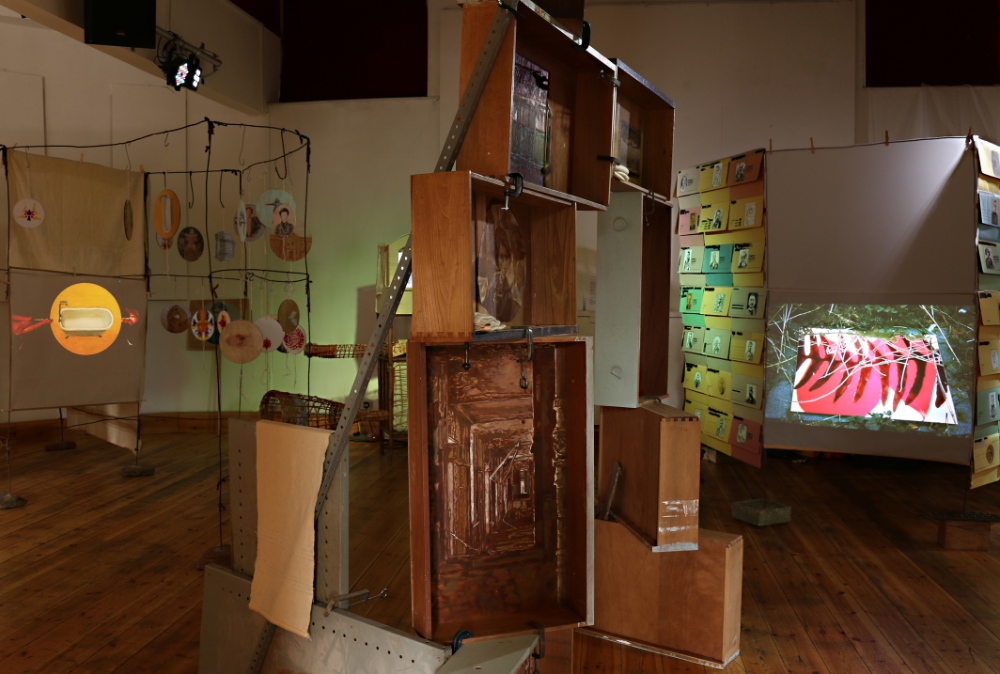
After you entered the space you were faced with an off-kilter arch that Susan had made with
drawers from various chests, reflecting the heaps of moldering furniture inside the old hospital when it was abandoned. It could be that the arch echoed the grand portico of the Mid Wales Hospital, entry through which must have been a terrifying experience for some. Also that the inside of a drawer – in this case, painted with imagery - feels like the only space allotted you that feels private when you entered the hospital as an inpatient.

We wanted many of the artworks to invite interaction and a feeling of playfulness instead of the detached contemplation that visitors to art exhibitions might expect. We also wanted our art to be seen on a par with our participants and the work intermingled. Rather than the solidity of walls, rickety support structures formed from rusty reclaimed reinforcement rods held much of the work, perhaps echoing the fragility of the collapsing Mid-Wales Hospital and the experiences of those who lived there.


People took down and spun the thaumatropes - disks that rely on persistence of vision to come to life – that Susan and Mind members had made. Though playful, the optical toys also feel uncanny and disquieting because they offer a glimpse of something that isn’t really there. (Click here to see a few spin). The disks were partly inspired by our visit to the Powys Archives where we saw the 1900-1923 records of those admitted to the Brecon and Radnor Asylum, many of which were accompanied by circular photographic portraits. They were also inspired by the card games played at Mind meetings we joined, which eased social interaction and helped people feel relaxed.


Our participants were so generous with their time and creativity, extra to the workshops; artist and poet Eve Thomas produced photo-works, poems, and made jam from blackberries growing at the Mid Wales site for the Art Lab. Other participants made free-standing sculptural works and wrote poetry. We were very honoured also to have recorded conversations with two individuals who were treated at the Mid-Wales, and these were quietly playing at opposite ends of the room.


Penny drew over 75 portraits inspired by the photos we saw in the archives. These were mounted on recycled manila folders with redacted details of previous contents, to try to give a visual equivalent to institutional record keeping. At the centre of the structure was a video made of the 130 flower slides made in our workshops.

One of the activities offered in our workshops was weaving with nettles, brambles, briars - plants that are slowly taking over the grounds of the old Hospital. Often seen simply as weeds, they have a protective role and have been highly valued in the past. Penny combined the weavings with large works of her own to create sculptural pieces, suggesting sometimes shelters, and sometimes traps. The hope was that this would offer a kind of parallel experience to Art Lab visitors and this in fact happened with people temporarily inhabiting and animating them. Some people found them spiky and felt off-balance whilst others found them comforting, like the nests children make in bushes. One person said that his was a voluntary admission, but that he wouldn't be staying in for long.


On 2 television screens people could sit and watch an absorbing 30 minute video in 6 chapters reflecting Penny’s personal experiences through the project and something of how she chose to position herself in relation to its complexity and multiple challenges. Lyndon Davies provided a hauntingly beautiful sound-piece, amplifying and carrying the narrative. To see and hear a tiny clip, click here.


A sculptural piece by Susan involved a little blanket clad theatre atop an Edwardian what-not from which emerged woven willow tubes and horns. The little theatre is based on the stage in the dining hall at the Mid-Wales Hospital, the blankets for her a recurring metaphor, reflecting the dichotomy of comfort and restraint, or care and control. In the theatre a pencil drawn animation played, looking at cycles within nature and the irony of the ‘butterfly’ design of the hospital.


The Saturday evening event wasn't like a normal art opening, it felt like the heart of the Lab, with people really focusing on the experience of being there. We had performative events interspersed by periods when people could refresh their drinks and continue conversations.

The poet Angela Morton spent time in the Mid Wales hospital and wrote about her life during periods of mental illness and experiences in the hospital. Her daughter, Becky was going to read from Angela’s collection the Holding Ground, (the collective press 2002) but our dates coincided with a trip away, so she liaised with close friend and colleague, poet Graham Hartill, who read for her, shared his own memories of Angela and reflected on her poems. Her grandson musician Gwyn Daggett and creative partner Beth Flynn played some of their new material, it was beautiful.


Eve Thomas began and ended the evening with reading poetry and speaking from the heart about mental health challenges. Well over £100 was raised for Brecon and District Min

The following day in the afternoon we held a talk and feedback discussion, about 25 people came along, including Brecon and District Mind members, Stella Man and Cerys from Glenside Hospital Museum, psychotherapists, curators, historians, artists, participatory arts workers, a psychoanalyst and doctor. During the discussion we learnt that the books we had to fight so hard to see at the Archives were almost discarded when the hospital had closed – the attitude had gone from extreme carelessness to hyper vigilance and restricted access.

Afterwards people stayed to look around at the artworks and the discussions continued in smaller informal groups. Like everything during the Lab weekend, there was a feeling of energy in that so many interesting ideas were shared in a short period of time with a buzz of potential for what could be.


Here’s just a little of the feedback we received about A Private Land and the Art Lab:

'I was so impressed to see so many people come through the doors and share their stories reflecting on the old Mid Wales Hospital ruin in Talgarth. It felt so valuable and necessary to take this time to talk about the hospital and the people who lived, worked and died there.

Taking part in this project has been so affirming for me. It’s made me certain that I want to pursue a career as an artist as much as I possibly can. This was the first time I’ve ever stood up in front of a room full of people and talked about my art processes and shared my poetry - and the feedback I received was invaluable. I’ve gained some interesting insights about my work, and the confidence to seek out this kind of experience again. Massive thanks to Susan and Penny who created the project and let me be involved - you supported and inspired me throughout.’

‘I feel a deep resonance between the works here and my own lived experience as someone impacted by mental health issues. Privacy, emotional intelligence, confidence and self expression explored and shared here in a nurturing space has been profoundly affecting. Thank you for this unique experience facilitating the unfurling of much of my vulnerability.’

‘LOVE this so much – the art feels really alive and so many different elements. Immersive, intriguing and fascinating reaction and response to a place – its history, stories and its demise. The way the artists have involved others in the creative process including at the exhibition itself is great – the slide making is a huge hit with my son! Thanks.’

‘An emotive exhibition which captured the negative and supportive lifestyle of people in the hospital.’

‘Evoked so many memories of people we have known and loved.’

‘We really enjoyed this show and loved the way it had interactive parts! Wonderful! Hauntingly Beautiful with a dose of playful innocence. Loved it! ‘

‘Thank you so much for the experience and the opportunities brought by this event. Words are not enough.’

‘A Private Land’ stretched my thinking, so many threads spinning on conversations had and not had. Thank you.’

Resources and links

PEAK cymru https://www.peakcymru.org

Talgarth Museum https://www.facebook.com/TalgarthMuseum

Glenside Hospital Museum https://www.glensidemuseum.org.uk

Bethlem Gallery https://bethlemgallery.com

Outside In https://www.instagram.com/outsidein_uk/?hl=en

The restoration Trust Change Minds Project https://restorationtrust.org.uk/change-minds/

Mendip Hospital Cemetery http://www.mendiphospitalcemetery.org.uk

High Royds Hospital website, Talgarth page

http://www.highroydshospital.com/resource/mid-wales-hospital-talgarth/

The role of Arts in Improving Health and Wellbeing

https://assets.publishing.service.gov.uk/government/uploads/system/uploads/attachment_data/file/929773/DCMS_report_April_2020_finalx__1_.pdf

The Wales Arts Health & Wellbeing Network (WAHWN) https://wahwn.cymru


Tuesday, 15 August 2023

A Private Land Project Tir Diarffordd


by Susan Adams and Penny Hallas

What is A Private Land?

A Private Land is an art-based research and development project, supported by Arts Council Wales and undertaken in collaboration with community groups, with a central theme of the links between emotional and environmental health. Its funded timeframe is February - October 2023, but it is expected that relationships and processes developed in this R&D phase will inform on-going projects.

How did the project start?

Artists Susan Adams and Penny Hallas share deep interest in inner and outer worlds: the intersections between the visible world and the realm of imagination. In searching for a collaborative project in which we could explore these concerns further, we were drawn to the former Mid Wales Hospital, Talgarth, Powys, Wales. After more than a century, its physical remains are falling into the final stages of dissolution and will most likely soon be demolished. But it is of historic importance to the local community and former patients and continues to be a site of intense and complex emotional resonance for many different communities and groups.


What are the main themes?

Our project references geographical and psychological territories and the nature of the boundaries that may both protect and / or restrict us. Where are we positioned in relation to boundaries: how much choice do we have and can past actions and decisions be reconsidered? Whose voices are heard and who is remembered? Whereas many other former hospitals (e.g. Ely or Whitchurch in Cardiff, Bethlem in London and Glenside in Bristol) have preserved memories and artefacts, patient voices and stories, we've noticed that it is particularly difficult to find accounts from the people who received treatment at Talgarth. So we have tried to enter imaginatively into the Talgarth site and the hidden stories it suggests, and we invite the voices of people who have experienced mental health issues there or do so currently in the community. Culminating in co-produced arts events/installations, we are trying to form new narratives in creative ways before both site and memories are lost to us.

Our project touches on important but sensitive issues and themes, and we are aware of the need for both courage and delicacy to work together with everyone involved to follow the project through with care. Negotiating strong and contradictory feelings evoked by the project themes in participants, communities, organisations and ourselves is a large part of our work. This includes adapting to a wide and sometimes conflicting range of views as to what is or 'should be' private and what can be shared.

Who are your partners?

We are encouraged by the support and involvement of our partners. Arts Council of Wales; Brecon and District MIND; Powys Teaching Health Board; Research partner, writer and historian Dr Bob Adams, BSc, MB BS, FRCPsych, M Psychotherapy; Creative mentor, Mel Brimfield, Royal College of Art. We're particularly grateful to Marie Davies, CEO at Brecon and District MIND and to Lucinda Bevan, Arts in Health Co-ordinator, Powys Teaching Health Board, for the inspiration, experience and ideas that shaped our plans as well as the support in safeguarding, risk assessments, levels of consent and observation of service protocols that gave us confidence to go ahead.

These were our key partners, but one of the pleasures of the project has been the way unexpected alliances have emerged. For example, the arts organisation PEAKcymru have lent us technology that was outside our budget but has been key to engagement. And mid-way through the project, artists, writers and an art psychotherapist responded to our invitation to form a community artist peer discussion group, inspired by Bethlem Gallery's Questions of Care online workshop earlier this year. Together we shared some of the dilemmas and pleasures of community engagement and all agreed this should be an on going group.

In methodology, our project follows the many existing models of good practice in exploring these themes, including artist-led projects, some of which are listed in the resources and links section.

What has been happening in the project so far?

Our activities have included looking inward to our own emotional and artistic journeys, and outward - to historical archives, online resources, other former hospital sites and communities and arts engagement with local community groups.

Research activities have included initial consultation with our research partner and our creative mentor to deepen our understanding of historical context and help identify the shape of our own and collaborative art activities. We visited Glenside Hospital Museum to see how they have turned their former chapel into a lively resource for the local community and a centre of good practice in dealing with historic and current attitudes to mental health.

From the earliest days of the project we knew that a visit to the Mid Wales Hospital archives, held at Powys Archives in Llandrindod Wells, would be vital to getting a sense of hidden stories. We were able to view registers, case notes, maps and other documents that fall outside the 100 year limitation on viewing but it was the personal accounts, letters and photographs that touched our hearts. We're unable to share photos for this research and development project, but this may be possible in any future phase. Both of us have made images inspired by what we saw. This one is by Susan.


Arts engagement has been through a series of arts workshops as well as digital input and engagement to extend reach. Our initial ideas were simply to offer a broad range of options for workshop participation including audio, video, animation, textiles as well as more traditional art media, based on the areas of expertise we have developed in our own practices. We wanted to meet people first though, to find out what they would like to happen so we had three initial meetings, at Brecon, Talgarth and Hay Mind groups. From these meetings we learnt that some people were interested in the Mid Wales Hospital and had memories to share, whilst others made it clear that they preferred to focus on the natural and environmental elements of the project. So we devised four activities that we offered across all three groups: weaving with foraged and natural materials, making simple animations, making slides for projection with flowers and creating a thaumatrope - an optical toy. We hoped that all these activities would allow multiple points of entry so that people could join in to the level that they felt comfortable with. 


There have been six workshops so far and we will be doing a demonstration / workshop at Felindre Ward, Bronllys Hospital too. We've seen amazing levels of engagement and enthusiasm. Quite a few people wanted more time to continue their artworks, so in addition to the workshops we have supplied materials and activity packs. We have welcomed the contribution of people who preferred not to use art materials, but who kept us company and joined in the conversations.


Participants at the Brecon & District Mind workshops told us about the tiny but packed Museum in the Old Post Office in Talgarth which they thought would have artefacts relating to A Private Land. So we made a visit and were surprised and delighted to find objects, images, artworks and records from the Mid Wales Hospital, donated by the community.

We met so many people with fascinating tales to tell. This thread has led us to adapt our plans for final events in order to be part of the Talgarth Festival

What will happen next and how can people get involved?

We'll be having final events to show what we have all done together in the project and to continue to gather stories and memories. We'll be inviting people to bring any artefacts they may have from the old hospital site to help form an archive and preserve memories. The events are free and open to all, so please do come along and spread the word.

We'll be having a stall at Talgarth Festival on Saturday 26th August making contacts, offering more opportunities for sharing stories verbally, through art making and display of objects. We plan a shared walk up to the old hospital site, late afternoon / early evening.

There will be a co-produced exhibition at The Muse, Brecon, 28th and 29th October, with guest artists, a writing / poetry workshop, performers and poetry reading. And of course, more opportunities for people to contribute. Full details of all our events will be posted on A Private Land / Tir Diarffordd Facebook page

We've only been able to give a broad overview of our complex project in this blog, but if you would like to see more we have been keeping a record of most of our activities and engagement on our Artist Information Company blog: https://www.a-n.co.uk/blogs/a-private-land-tir-diarffordd/ Brecon and District Mind suggested we set up a Facebook page (QR code below) to help keep in touch with participants and as a focus for ideas / exchanges so there's lots to see there too and we'd love it if people would like to add comments and posts. We're happy for people to contribute in language of choice. Croeso i chi gyfrannu yn y Gymraeg!

About the artists


Susan Adams lives near Brecon and Penny Hallas lives near Crickhowell, forming a kind of triangle with Talgarth. Both artists have extensive experience of working with communities, in education, health and with a wide range of organisations and institutions. They have exhibited widely in Wales and internationally. You can see more of their work on the links below.

Susan Adams https://susan-adams.co.uk https://www.instagram.com/susan_j_adams/?hl=en

Penny Hallas https://www.pennyhallas.co.uk https://www.instagram.com/pennyhallas/?hl=en

Resources and links

PEAK cymru https://www.peakcymru.org

Talgarth Museum https://www.facebook.com/TalgarthMuseum

Glenside Hospital Museum https://www.glensidemuseum.org.uk

Bethlem Gallery https://bethlemgallery.com

Outside In https://www.instagram.com/outsidein_uk/?hl=en

The restoration Trust Change Minds Project https://restorationtrust.org.uk/change-minds/

Mendip Hospital Cemetery http://www.mendiphospitalcemetery.org.uk

High Royds Hospital website, Talgarth page http://www.highroydshospital.com/resource/mid-wales-hospital-talgarth/

The role of Arts in Improving Health and Wellbeing