Showing posts with label music therapy. Show all posts

Monday, 14 December 2020

Harnessing the power of music - a dementia project


Steff Griffiths is the Local Coordinator in Mid Wales for the music and dementia charity Playlist for Life.

The charity was founded in 2013 by writer and broadcaster Sally Magnusson after the death of her mother, Mamie, who had dementia. The charity’s vision is that everyone living with dementia has a unique, personal playlist and everyone who loves or cares for them knows how to use it.

I caught up with Steff on Zoom recently to find out more about this amazing work.


What is your role with Playlist for Life and which area do you cover?


My role as a local coordinator for Playlist is basically to get out and about in the community and tell everybody how helpful music is in the lives of people living with dementia. So before Covid I would go and visit dementia cafes, dementia groups, carers organisations – basically any organisation that deals with people either directly living with dementia or their carers, their families, and people who support them. And I talk to them about the way music affects the brain and the way music brings back memories and then show them how to build personal music playlists.

I cover the whole of Wales north of Cardiff and the Valleys. I've a colleague in Cardiff but otherwise I'm everywhere!

What brought you to work in this field?

I’ve always found it very interesting and I have experience in my family of people living with dementia and had already realised how much music helps. So when I saw this lottery-funded post I thought I've got to do this job. It's a simple tool that really helps people. We've been based in Wales about a year now. The charity started originally in Scotland and it’s spread to London, the Southwest of England and now Wales. 


How does Playlist for Life work in brief?

Basically we give organisations and groups step by step help so that they you can choose songs that have memories attached to them and put them into a playlist for people living with dementia to listen to. You can create playlists in a number of ways, for example on YouTube, and then email them to people if they've got a phone or laptop or an iPad. It's free. When a song is played the memory comes back and you can talk with people about when they were children, when they married, when they used to go to gigs, and all the songs that remind them of Christmas, holidays or celebrations from their past.

We have lots of case studies of people living with dementia who are very withdrawn. But then when certain songs with memories attached are played, they get up and sing and dance. They play the piano, they will remember seeing Pink Floyd in concert or perhaps the Rolling Stones. And I think – wow, that's cool. But it's just the power of music that's personal to you which really does bring people back to the present and it helps people connect.

If you're caring for people who can communicate with you it's very easy to build a playlist because you can have a chat about the songs from the past. If they're not able to communicate those memories to you we also provide training called Music Detectives. It's all the tips and the tricks about how to build a playlist for somebody who has difficulty communicating and remembering their special songs. There’s also a Mini Music Detectives for children to help as well so they can work with their grandparents or go with their school into a care home (although not at the moment obviously).

Why is music such a powerful force for people living with dementia?

It's the memory. When you listen to music, you're hearing some of the melody, the words, the tone and the pitch and this connects parts of the brain that don't normally connect together for people living with dementia. It can fire off a lot of the neurons in the brain. You don't have to listen to professional music you can just sing the song. I spend a lot of time singing (I can't sing very well!) on the phone to people. Over the summer, when I was working with the Alzheimer’s Society creating personal playlist for people, Neil Diamond’s bank balance must have grown exponentially because everybody liked Sweet Caroline and it was on a lot of Playlists!

The Playlist for Life website is open to everyone and there are loads of downloadable resources on there. Create the Soundtrack to your Life is a popular one. It's a little booklet and it's where you write the song and the associated memory and then the booklet goes with the person if they go into respite for example. So staff know that the song “Sweet Caroline” has this memory associated with it, then the conversation starts and it builds that trust and bit of rapport. We have case studies on the website but you have to get your tissues ready to watch some of the video stories because it can be quite emotional, even though it’s a happy story.

How can creating a personal playlist impact on the emotional wellbeing of someone living with dementia?

Well, we have an example of a lady who is very withdrawn. But when she plays the piano she’s very engaged with the music and her audience. She's engaging with people which ordinarily she wouldn't do if the music wasn't there. It's not a panacea. It's not going to cure people but it really works with some people and it can help people a lot.

If people living with dementia aren’t able to reminisce in ways like this, what can happen to them?

It's probably a very lonely existence. People can be very withdrawn and anxious, and can't connect with the outside world. They get very upset and they don't know why.

There's a lovely video featuring Harry and Margaret on our website showing how they connect via music. You can see on Margaret’s face - she's got her husband back. They talk about when they used to go dancing and that's when they met. He knows the words to songs from the 1950s yet ordinarily he doesn't remember things. It's that connection which the music helps with. 


How has the Covid pandemic impacted on your work?

Lots - because the job is very face-to-face. We go out and talk to organisations and show them all these resources for creating playlists. But of course nothing's face to face now. So we've been holding webinars for people to sign up to and we've been doing music detective training over Zoom.

We've also been working with the Alzheimer’s Society creating playlists for people who can't get out and about as their usual meeting places have been closed. And it's been online for the past nine months. We’re also doing whatever we can to spread the word about the charity and the resources so that hopefully, in six months’ time, when all this hopefully will go away, people will know what the charity can offer them.

One example was when we made a playlist for a lady in her 90s and her son-in-law was telling me “we know exactly what song is playing because even though she's got headphones on she's singing at the top of her voice!”

Which other organisations do you work closely with in Powys, a very rural county?

So far Dementia Matters in Powys and yourselves. It’s early days so far. The community councils are also keen to get involved as well. So if there are any organisations in the area interested in using music to help people living with dementia, please get in touch.

Tell us what a “dementia friendly Powys” looks like to you personally

It's about people having the knowledge of what dementia is and understanding the many different types of dementia. Then knowing how best we can support people living with dementia, and their carers, and their families. So it's all about knowledge. It's about using all of the tools that we've got available to help and to support people. And everyone having their own personal music playlist, of course. 

What are the main challenges of the role?

I made the mistake early on when I started the job of sending out 50 emails in one day to all these organisations to say hello. I had about 36 of them come back within a day saying yes, we want to meet you and find out more. So keeping up with demand was the biggest challenge in the early days.

But during the past few months the challenge has actually being the technology side of things. We've got some lovely organisations that I met before lockdown that are not able to use technology very well. So they’re waiting to return to face-to-face before engaging with me again. So, it's tough now getting to the grassroots’ groups.

And also the need to diet from eating all those cakes, when we were meeting up, has been a real challenge!

Tell us about some of the most rewarding work you have done at Playlist for Life so far

It's definitely been creating playlists for people. We have such a laugh! One couple were having a disco in the garden with a little MP3 player of all the personal music we gave them. The gentleman had the story of his life turned into his playlist. It was a fantastic playlist.

Another highlight was running Music Detective training courses with colleges. We trained 60 - 70 of a college’s access students in the Music Detectives’ work – it’s been great to have that opportunity.

When you are not working for Playlist for Life, how do you enjoy spending your time?

I love walking and cycling. I'm an out-and-about person. I love to travel abroad as well. During Covid I have found so many new parks and places to go locally that I never would have thought about before. That’s been great. 


If you want to find out more about Playlist for Life you can contact Steff by emailing: steff@playlistforlife.org.uk or ring 07712 273 946.

Thursday, 18 June 2020

Impacts on the Covid Kids


by guest blogger Evan Griffiths

Evan Griffiths is a Powys based singer songwriter. He is 16, is afraid of crabs, and finds talking about himself in the third person very weird. The lovely folks at PAVO asked him to do a blog post on the impacts of COVID-19 on him and the people he knows.

So what have the kids of the Powys area been up to since lockdown?

Well, obviously I can't speak for everyone but from what I've seen, it's a lot of video games. I spoke to some of my mates and we all agreed that without online games you can play together with other humans we'd all have gone mad months back. Personally I also find that on top of this finding a solid creative outlet is also vital for the whole “not going bananas” thing.

As you might expect I’ve made a lot of music since the world went on standby and I must say I've not had the worst time doing it! Since day 1 I tried my best to encourage my friends and strangers on the internet to take up something creative now that none of us can go outside. I even did a short YouTube sketch reviewing people's projects. It wasn't very good.

Also (shameless plug) I’ve been working towards opening the Radnor Fringe Festival on Friday the 19th of June at 7pm GMT so like go watch that, I put a lot of work into it.

Other fun projects I’ve encountered where: learning a new language, making art from loads of old rubbish (this one wasn't from a teenager but is still very cool), learning bass guitar, making animations, it's been really cool to see what people can do now that they have virtually unlimited time to do it. If ever there was a time to finally learn that skill you've been putting off learning, it's now!


What effects have these activities had?

I have become dependent on coffee and have not left the house in three days.

And everyone else?

Oh right yeah, it's been really interesting to see at what rates people start to lose their marbles from social isolation but certainly those of us who are used to not talking to people for a while did a fair bit better in the short term. By this point everyone has more or less acclimatised to our new and weird reality and are back to feeling how we normally do.

Since this blog is about mental health I’d like to do a short piece on that. A lot of kids get bullied in school. Personally, I had a really terrible time of it towards the end of high school with gossiping teenagers and all that awful stuff and so for some of us the release from our nine to three coke light prison in favour of staying inside most of the time actually resulted in a marked improvement in our self worth and ability to cope with problems and situations. It’s almost as if it's easier to do your thing without people constantly telling you how awful you are.

However, this wasn't the case for everyone. For a lot of people the school environment provides a set structure and support group and to lose that means it becomes a lot harder for that person to cope with everything that goes on in their lives. And as a person who values structure myself I can seriously empathise with this. So the impacts of specifically the lockdown can change massively from person to person to person.

This got really heavy really fast.

It did, didn't it? Still I think it's important for people to talk openly about mental health, even now when it feels like the world's caving in. When did this become a lecture? 

Anyway to go back to a previous point I genuinely believe the escapism offered by video games has saved me and many others at least a portion of our sanity. For a long time when i couldn't go out and see my friends we'd boot up a Minecraft world and play virtual Lego for 5 straight hours and that all might seem silly or trivial to a lot of you reading this after the serious topics discussed and frankly I don't blame you but even from a mental health point of view spending time with your friends has always been shown to be good. Whether that be sharing a bag of crisps or blowing them up in Team Fortress 2. 


You talked before about the more creative activities you and your friends have been up to since lockdown, care to elaborate on how COVID affects the creative process?

The big C hasn't so much changed the creative process as it has simply forced it to adapt. For example I used to go and sit in my mate's house writing songs for hours on end, now I play a lot of Minecraft.

Please stop talking about Minecraft.

Okay fine, one of the few things I’ve found that's actually pretty cool about this whole lockdown thing is that it's given me loads of time to pour my everything into what I enjoy doing, making music. However, I am so criminally bored. I cannot articulate to you just how bored I am. 


Last week I cleaned my room, by choice, out of boredom. THAT’S HOW POWERFUL THIS ISOLATION IS! I’m up to date on school work for the first time in 5 years. So whilst me and many others have enjoyed the extra time to work on projects, if I go much longer I might make a TikTok and then it's really over. And if you don't know what TikTok is, thank your lucky stars and know that I envy you greatly.

Any closing thoughts about the impacts of COVID on the youth?

Firstly, I hate the term “the youth” makes me sound like an old man. Secondly, is it me or does February feel like it occurred sometime around 1996? And finally, I hope you enjoyed this article as much as I enjoyed writing it, and I bid you all an at least interesting rest of your day.

>>> l i n k s <<<

Monday, 22 July 2019

Music Therapy - A Young Man's Introduction

by guest blogger Evan Griffiths


Evan Griffiths is a Powys based 15 year old musician currently doing work experience at the Powys Association of Voluntary Organisations (PAVO).

His interests in music and mental health have led him to begin researching into the rising medical field of music therapy as a treatment for various mental illnesses such as depression and/or anxiety.

Evan has since decided to spend a morning of his work experience briefly outlining the benefits of music therapy as well as giving some information on it. He would also like to note he’s finding writing a third person introduction to himself a little bit weird.


So, what got you interested in this topic?

Well as anyone who knows me will tell you I’m a bit of a nerd for practical uses for music. I just enjoy seeing my passion being used to help people, so naturally I was drawn to the idea of using music as therapy like a moth to flame because I’d been using music as a kind of self therapy already for years. Because I already had an interest in this topic all I needed was a good excuse to do some research into it (as my spare time was already far too full with being a teenager) so then when we were told by the school to do a 2000 word project on something of our choice I decided then would be a good time to start digging my teeth into some research.

And so I started researching and I’m doing some more currently to fact check the rest of this blog post. The project is yet to be completed but I have so far looked into a fair few sources as well as asked a load of my peers for their thoughts so I will try and give data to fairly represent both the therapy itself as well as my generation’s opinion on it.

Can you briefly explain what music therapy is?

Yeah, sure. Music therapy is, to put it simply, people using music as a way of dealing with mental illness or other issues. It first began in the 1800s but has sat on the back burner of world of treatment for mental illness for many many years. However, recently it has begun to come into the limelight with very high success rates in the face of a mental health crisis. I believe that music therapy is the kind of innovation we need and Powys should have more facilities and support available for people who would enjoy and hopefully reap benefit from this treatment. It’s been shown to help everyone but especially young people and seniors who are exactly the people with highest demand for better mental health treatments.

Do you have any first hand experience with music therapy?

I do, however not from a formal organisation. I learnt music at a young age and have now learnt to write my own songs so I will often do that as a form of escapism when I’m in a bad patch. I have a few friends who have done/are doing the same and though it is helpful it’s nothing compared to the overwhelming success rates of formal music therapy. I’ve talked to my songwriter friends about this a lot and we’ve all agreed that encouraging young people to take up music and creating formal music therapy organisations, or supporting existing ones, would be excellent for the young people of Powys or anywhere really.


Why do you believe music therapy would be helpful, specifically to young people?

Well as much as I hate to admit it, it is true that young people spend far too much time on their phones and this has proven to have an incredibly negative effect on mental health. So encouraging teens to take up an instrument would provide them with something positive and productive to do instead. This would be as well as the positive effects music gives anyway as a distraction from a problem to help a person temporarily feel better. Or it could be used as a method of facing these emotions and communicating them through song, which for some people (including me) is far easier than talking about them to a therapist or counsellor.

So, not only would it be providing teens with a healthier outlet or distraction from their emotions it would also be keeping them off things that could (and probably will) damage their mental health.

What other benefits does music therapy offer?

Music therapy has also shown huge success rates with seniors due to its social benefits. Music has always had a sense of community about it and music therapy reflects that. It brings people together from all kinds of walks of life to share a love of music. And of course, loneliness is a huge problem amongst elderly people and a chance to come and hang out with some friends and sing some songs would likely be a great opportunity for elderly folks to get out of the house a bit, and jamming out to “Sweet Caroline” with the lads twice a month would give them something to look forward to. 


Music can also improve your memory and has been shown to reduce dementia risk which is excellent and only further shows why it’s important for people of all ages to get involved in music therapy if they want/need it. Also if you begin learning an instrument young you’re much more likely to continue with it into adult life so music therapy could turn a depressed teen into a lifelong musician. I think anything that can inspire that kind of change in a person needs to be at the forefront of mental health treatment.


Do the benefits of music therapy carry over to other forms of art? 

That hugely depends on what type of art you mean but generally yes, it seems they do. Many of the things I discussed in my last answer are music specific such as the memory and social aspects. However, many of the emotional therapies offered by music do carry over to traditional art, poetry, acting, or any other kind of art you can think of. It seems that just to create can be a therapy for people as a way of venting emotions.

However I think music therapy is the most widely beneficial of the types of art used in therapy (I know traditional art and poetry are also often used) as it also offers the social experience to the elderly and music can be more easily learnt than, say, drawing. However if you really cannot make music but happen to be an incredible poet then that can also have many of the same benefits for you.

Ponthafren Singing for Well-being - End of Term Showcase

Any charities that support this come to mind?

Off the top of my head I’d say if you want to support music therapy donate money to the Nordoff Robbins organisation. They’re the leading charity for music therapy in the UK and it would be excellent if they could open a branch somewhere in Powys.

But if you do want something more local Ponthafren are truly excellent. I was lucky enough to have the chance to see one of their showcases and talk to members of the charity as well as people the charity has helped. Everyone was really lovely and well informed as to the benefits of music therapy and how they benefited from it personally. There’s an excellent atmosphere at Ponthafren and I’d strongly recommend the organisation to anyone whether you want help with your mental health or if you want to listen to some music. Of course they also do other stuff to promote good mental health. 

Any closing notes or final thoughts you’d like to say? 

It seems like music therapy is a rising medium that just needs to be professionally recognised and implemented alongside traditional therapy methods. It has begun to grow exponentially in the past few years with small scale music events happening to raise money for mental health all over Mid Wales. I believe therefore that it will continue to grow further judging by the amount of advertisements I found for music therapist training courses whilst trying to find a Welsh music therapy charity (I could not find one but I imagine one will open in the near future). If Powys could have a place in this growing medium I believe that would be really cool and I’m certain more of these charities need to be created and supported.

Thursday, 21 September 2017

I've Got Soul


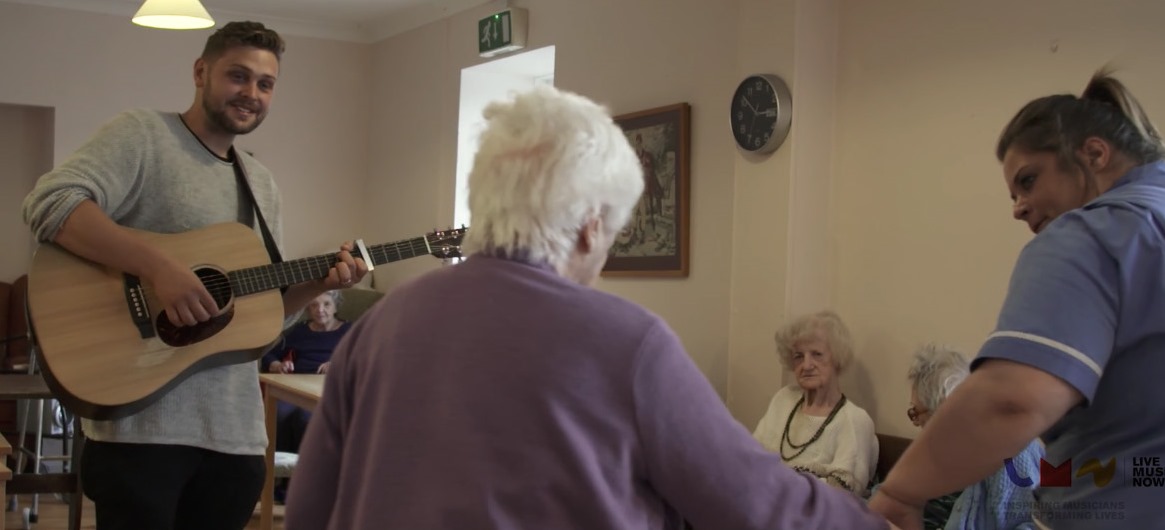
Every now and again on our blog we showcase good practice from other parts of Wales. This week we found out more about a dementia initiative in Pembrokeshire. As part of the Gwanwyn Festival in July 2017, Live Music Now Wales was funded by Age Cymru to deliver a week of performance and loop pedal workshops with elderly residents living in care homes across Pembrokeshire.

Claire Cressey, Director of Live Music Now Wales, told us more:


Care home residents aren’t the usual chart topping performers you’d associate with a potential hit single, but with the rapid rise of older people in society and a continual increase in those living with dementia, our national charity has made the most of their musical talents and done just that.


Residents in six Pembrokeshire care homes have demonstrated their songwriting and vocal talents, with the help of Bridgend based musician John Nicholas (performing as John Llewelyn) through the work of musicians' development and outreach charity, Live Music Now in Wales, who are celebrating their 40th anniversary this year.

Funded by Age Cymru, as part of the Gwanwyn Festival - a celebration of arts, creativity and old age across Wales - this summer John took his loop pedal, percussion and acoustic guitar to rural residents in Haverfordwest, Goodwick and Fishguard for two week long sessions of workshops and performance. Crafting the lyrics through the input and commentary of residents, John used his experience of working with isolated older people across Wales through his role with Live Music Now, to remind us of the challenges old age can bring, whilst celebrating the heart and passion that remains even when bodies may fail us.

In short the song speaks of the value of all life, regardless of age and ability, and with a movingly emotional video that shows some of the residents involved in the project, it is an important reminder of the many members of our local community who though unseen to us, still have much to contribute from within the walls of what have been termed “islands of the old”.


Lynne Jones, Manager of The Graylyns in Haverforwest commented, “The sessions were absolutely fantastic. John was a brilliant performer, and he definitely picked up a fan or two from our ladies! The whole Home responded so well to his choice of songs and his relaxed manner. The enjoyment on their faces was evident throughout. We are delighted they’re included on this single.”

With a heart reminiscent of Nina Simone’s 1968 “Ain’t Got No../I Got Life” this track is a real celebration of old age. Residents involved help to sing the chorus, and play percussion, and all funds raised through downloads of the single will go towards continuing Live Music Now’s work with older people in care homes, day centres, hospices and hospitals across Wales.

Older people are expected to make up one fifth of the world's population by 2050, with 1,735,087 - an increase of 154% from now - living with dementia by 2051. A recent Age UK report showed that creative and cultural participation was the number one contributor to wellbeing in later life from a list of 40 different areas, so why shouldn’t they be releasing new music?

As John commented, “This was probably the most fun I've had working in care homes in Wales with LMN. We can be too quick to write people off in old age, yet even for those with dementia the connection to music is one of their last remaining abilities, helping people recall memories and emotions, shifting mood, bringing emotional and physical closeness. It is truly humbling work to be involved with, and as a gigging musician, really reminds me of how powerful live music can be.”


Whilst they may not all become the next Ed Sheeran, the inclusive nature of the loop pedal and percussion elements allowed everyone to take part regardless of ability, and residents' mental and emotional health improved as a result. Now even their grandchildren will be able to download their hard work from iTunes.

The song “I’ve Got Soul” is released as a charity single via all good online music stores (iTunes, Amazon, Spotify, Deezer, CD Baby) from Tuesday 19th September 2017. The video can be seen via Live Music Now UK’s Vimeo and YouTube channels. 

For more information on the work of LMN in Wales and the UK visit the Live Music Now website.


Thursday, 23 July 2015

Hafal's All Together Now! Campaign Rocks at the Royal Welsh!

 Aims to unite people through music

Glynis Luke (PAVO mental health team - far right) being photographed
with an army dragon mascot and Hafal staff
High summer is here - time for shows and festivals and having fun. My colleague Glynis Luke was at the Royal Welsh Show earlier this week, and met up with staff and visitors at the stand of the mental health charity Hafal where she was introduced to a giant blue dragon and listened to some banjo playing amongst other things...
A visitor to Hafal's stand plays the banjo!  Photo courtesy Hafal
"We get by with a little help from our friends"
The Beatles

I visited the Hafal stand at the Royal Welsh Agricultural Show earlier this week to find out more about their All Together Now! Roadshow. The campaign is promoting opportunities for peer support and wider social integration for both clients and carers with a priority to develop the social life sections of individual care and treatment plans and sharing information of appropriate agency referral. Run by service users and carers, and supported by Hafal, Bipolar UK, the Mental Health Foundation and Diverse Cymru, the All Together Now! Roadshow is currently travelling across Wales and calling at music festivals and events taking place in each of the 22 counties

The Hafal staff were all wearing annotated All Together Now! purple T-shirts (the colour of recovery). There was a huge welcome at their Royal Welsh stand, including a cup of tea, and the sun was shining (I was ignoring the slight drizzle of rain). 

Gill Colerick, Hafal's Powys Family Support Officer  Photo courtesy Hafal
I met up with Gill Colerick, a former colleague from PAVO. She introduced me to her colleagues and told me more about the campaign and her work in Powys. Gill is Hafal's Powys worker, setting up groups for carers of those with "serious mental illness" in the county. Gill and I chatted about the benefits of both music and animals as good therapy when connecting with people experiencing mental distress.

I haven't played any musical instruments since the recorder at school, but I love to hear music and will dance around the house to my favourite songs. I will sing away in the car too when I don't think anyone can hear me! It's universal - it touches everyone's heart. It can bring all sorts of different emotions to the surface. I grew up in a musical family, my Nan used to play the piano. I have an image of people gathering round the piano as she played, and we would sing. My father used to sing for Brighton & Hove Opera, he used to be in all the musical shows and knew all the words to the songs.

"I like to boogie!"
T-Rex

I was able to speak to other visitors to the stand, including the wife and carer of a gentleman with dementia. She shared with me a variety of the difficulties that had been encountered since his eventual diagnosis of dementia, as well as the impact on family and friends. She said, “It’s difficult to know where to go to get help, what is ‘out there’ and when it's available, we ‘alternate’ between good days and not so good days…… Weekends are the hardest, it can be quite lonely.” I was able to share details of the Welsh Dementia Helpline with her. 

Visitors to the Hafal stand    Photo courtesy Hafal

Getting out and meeting people at events like the Royal Welsh Show can reduce isolation and that feeling of loneliness. There are practical, achievable things you can do now which could reduce your chance of developing dementia or, at the very least, improve your general health and wellbeing, and I was able to share some of these with her. Research has identified many risk factors associated with dementia, you can find out more at The Alzheimer’s Society website.

The famous Hafal VW camper!
I popped inside the VW camper to take a look. There were boxes of toys for children playing in there. You could measure your height against the blow up green snake and try out a pedometer. If members of staff were around children were allowed to sit in the front! It was a great way to keep youngsters busy while people were talking to the Hafal staff.

"If we hold on together"
Diana Ross

L-R: Dawn Williams (Hafal), army dragon mascot, Gill Colerick (Hafal),
Glynis Luke (Mental Health team - PAVO)   Photo courtesy Hafal

All Together Now!, was officially launched at the Norwegian Church Arts Centre in Cardiff Bay by Health and Social Services Minister Mark Drakeford AM. 

Launching the event the Minister said: “Music has an ability to connect to the emotional side of our lives in ways that very few other things do. And we know this very well in the field of mental health.

This campaign, as it goes around Wales, will use the All Together Now! strap line to draw people into a much wider set of discussions about their own place in the world and about connecting to people who have shared their own experience, but do it in a way that has a lot of joy!”

"Take a chance on me"
Abba

Tuesday, 26 May 2015

Music therapy - Olivia & Finding Frank


Olivia Bradbury is a musician and performer, who uses music as a therapeutic tool, who recently moved to Powys from London. She has considerable experience of working with people in mental distress. She tells us more about her past work, her play 'Finding Frank' which will be staged in Hay-on-Wye in June 2015, and her hopes for the future.

Olivia leading an orchestra
About me

I am a musician and creative facilitator working for the past few years mainly in mental health settings. This is where I am most interested in working and where I feel music is badly needed. Music workshops provide a way to connect with people who, for whatever reason, struggle with communicating their feelings. I have found that if patients and service users can find ways to speak through making music, they generally feel happier and consequently feel more motivated to take a positive, proactive approach to improving their mental health.

Olivia conducting the Crisis Choir
My workshops

My workshops provide environments in which participants feel supported to express what they want to express through the more abstract route of music/poetry/rhythm which may feel safer and more satisfying than communicating verbally. I provide starting points for participants’ ideas and frameworks in which their ideas can grow. This helps people not 
to  feel overwhelmed by the freedom of creativity. This careful balance of structure versus freedom is something that is tricky to get right and I have spent years trying to achieve this!

Too much freedom = overwhelmed, too much structure = stifled. I feel this is what is special about what I can offer and what is central to the nature of my workshops.


Olivia in 'Finding Frank'
My play

One of the places I have led workshops in London is Bethlem Royal Hospital. Here I met an elderly man who was suffering from severe anxiety and depression which was having a devastating effect on his communication skills, his memory, his relationships and his senses.

Over six months I saw him improve. It was the most rewarding experience of my career so far. I was so moved by what I saw in this man that I wrote a play about it -  'Finding Frank'. I had questioned whether making music did anything significant in the past, but this confirmed my belief that it most certainly did. This man was transformed! He used to get lost walking from the music room back to his ward, but not after the music work. He began communicating with his wife again and he was remembering how to play chord progressions on his guitar having initially described it to me like holding a foreign object - like an aubergine! He was cracking jokes, looking at me in the eye... I won’t say what else he achieved as I don’t want to ruin the story if you come to see the play.

When the funding cuts hit, I lost my work at Bethlem. Many who work in the arts have lost work over the last few years and it is only depriving thousands of people from a way of healing which is natural, sustainable and life enhancing. The play draws attention to this issue and my touring the piece is my way of building up awareness of the importance of music in treating mental health. 


Whilst making Finding Frank, I carried out many interviews of other people. I ran workshops with people who lived with mental health issues. I wanted to hear as many people's stories as possible - of their experiences of their minds and of their interactions with music. I learnt a great deal and felt very lucky to be able to gain this insight. I used audio clips of some of these interviews in the play (with their permission) and those that were featured came to see it and told me they were "proud to be part of a genuine piece" that talks "fearlessly and respectfully" about mental health. I felt very relieved that they approved! It was music that brought me close to all of these people. Music which is a bonding and unifying experience for any that get involved in it.


And now?

I have just moved to Powys after 11 years in London working in this field. I would love to continue my work here but need to find opportunities to do so. I know that organisations have an allowance for workshops but I know that funding is tight across the board. If you work for a hospital that would benefit from some musical activities and/or know of how I could source some funding to carry on with my work, I would love to hear from you!

For more information about what I have been up to and for contact details do have a look at my website.

Finding Frank is on at The Globe Theatre in Hay-on-Wye for three nights - 18, 19 and 20 June. Watch this YouTube video made for the production in London:


Monday, 13 May 2013

Music: passion and therapy

AJ, who has volunteered at the mental health charity Ponthafren Association in North Powys for many years, talks to us at Powys Mental Health about the regular weekly music therapy session he set up in 2005.

When does the music therapy take place at Ponthafren in Newtown?

On Thursday nights, between 5 – 6.30pm, the sounds of the music therapy group at Ponthafren emerge. Up to 6 – 8 members attend weekly, from a guitar player – myself – who writes and composes songs and runs the group, to a member who plays bass guitar and several other instruments such as keyboards. One musician makes his own instruments. He made a three stringed guitar out of a cigar box. It’s electric and he plays lead guitar on it. He also plays a banjo and a mandolin. We play electric for three weeks, and acoustic for the next three, and alternate the two.
Anyone who is interested can turn up on the day – it is not regimented, they can turn up and leave when they want.

Why did you set up the music therapy session originally?

Because I was a musician and I thought it would be a good idea to pass on some of my talents to other people. I don’t teach guitar in music therapy, but if anyone wanted it taught I would outside the session. It also helps my mental health. I suffer from depression, anxiety and stress and for 1.5 hours of my life I’m doing something I enjoy and my brain works in a different way. I can ask someone for three music chords and I can put that into a song and compose words out of my head. I can ask for a subject, someone can give me a subject, and I can sing a song about it off cuff. People will stand in amazement because this song has just come out of my head. I am asked how I do it but I have no idea. That takes me away from everyday stresses and strains, which is why I volunteer.

What actually happens during the session?

We start at 5pm. For part of it, this is where the other people come into it, I will play a song first and I will shout the chords out and the others will play along with me although they don’t know what I will play. They follow me – look at my fingers and follow the chords and get the song.
For the second part – I have “copy songs” that people know and they will follow me as I sing them and also play them on their instruments. Mainly - it’s fun. If somebody comes and plays completely out of tune – so what. They will get it in the end, they are there and they will enjoy themselves.

What is the reaction of those who attend the music therapy?

I am told by people that music makes you feel better than loads of pills.
I have actually taught someone from scratch – he’s been learning guitar for a year, he now comes to the music therapy groups and joins in and he also sings his own songs which he has created himself. It has opened a fantastic door for him because his family are musicians and he was always left on the sidelines. Now they have invited him in. He also suffers from mental helath problems and it has helped him tremendously.
People say after the 1.5 hours – "thank you!" I get texts from people who have just been, saying – "I feel great, I really enjoyed that." What more do you need?

Thank you, AJ, for talking to us! And if you want to tell us about your experiences of music, and how it has impacted on your mental health, please either add a comment or get in touch - we'd love to hear from you.

Tuesday, 29 January 2013

TED and a dementia story

My friend's Dad, who is 90 later this year, has what is described as "a little bit of dementia." He lives alone in his own home, and is relatively independent for his age. But over the last couple of years my friend had noticed that his memory and his mood had started to deteriorate.

"Every time I said something positive, he hit me with the negative. The dementia seemed to accelerate if he was socially isolated for long periods."

At first, it wasn't clear what might help, but my friend suddenly hit on an idea after watching an inspiring online video from TED talks. TED (Technology, Entertainment & Design)  is a global conference set-up run by a non-profit organisation called the Sapling Foundation, and has taken off big-time online. You can watch inspirational talks from speakers on almost any topic imaginable (climate change, health, science & technology, to name but a few).

My friend had downloaded the TED app to use on her tablet, and then searched "mental health" issues. Whilst browsing she came across a talk called "Music is medicine, music is sanity," by Robert Gupta, a violinist with the Los Angeles Philharmonic Orchestra who is also passionate about neurobiology and mental health issues. You can link to the video and watch it here.

Enthused by what she had seen, my friend encouraged her Dad to join a local singing group ("he has a magnificent voice,") as a form of music therapy, and after initial reluctance he was soon thriving in amongst new-found friends participating in an activity which he clearly much enjoyed.

"The increased activity and reduced isolation has improved his mental health, which has also impacted on his dementia.... the music therapy and activity has changed his mindset. Now he is keen, enthusiastic, and can remember things better."

Here at Powys Mental Health we are looking at providing more information about the dementia support you can access locally in the county, and we have just set up some information pages on our website which you can link to here.

Do you know someone with dementia? Let us know if you have ideas about support which have worked.