Showing posts with label bereavement. Show all posts

Thursday, 19 October 2023

The DPJ Foundation launches vital children’s books

Lawnsiad Sefydliad DPJ o lyfrau plant hanfodol


DPJ founder Emma's children - Trystan, Mali & Erin 
Plant Emma, sylfaenydd DPJ - Trystan, Mali ac Erin

On Tuesday 10 October 2023, World Mental Health Awareness Day, The DPJ Foundation shared their first series of therapeutic children’s picture books the “Dan Y Bont” series with schools across Wales.

The DPJ Foundation, founded in 2016, supports the mental health of agricultural communities across Wales, providing a 24/7 helpline ‘Share The Load’. This includes supporting those who are bereaved and are experiencing grief.

Ar ddydd Mawrth 10fed o Hydref, 2023, Diwrnod Ymwybyddiaeth Iechyd Meddwl y Byd, rhannodd Sefydliad DPJ, gydag ysgolion ledled Cymru, llyfrau “Dan Y Bont”, eu cyfres gyntaf o lyfrau lluniau therapiwtig i blant.

Mae Sefydliad DPJ, a sefydlwyd yn 2016, yn cefnogi iechyd meddwl cymunedau amaethyddol ar draws Cymru, gan ddarparu llinell gymorth 24/7 ‘Rhannwch y Baich’. Mae hyn yn cynnwys cymorth i’r rhai hynny sydd wedi cael profedigaeth ac sy’n galaru.

The idea for this project came from the DPJ Foundation’s charity manager, Kate Miles. Kate recognized the increasing need for bereavement support for children in rural communities, especially those in agriculture and often found parents turning to the DPJ Foundation for assistance when their children were grappling with the complexities of grief. Thanks to a grant from the Welsh Government’s Bereavement Support Fund, the charity was able to create a collection of three books specifically tailored to primary-age children, aiming to provide them with much-needed support during difficult times. Fundraising from within the agricultural community has enabled the DPJ Foundation to place books within schools and libraries across the country. Kate said:

“We know that everyone will experience bereavement at some point, and dealing with this as a child can be difficult. We wanted to support parents, grandparents and teachers to have conversations that can enable their children to deal with often overwhelming feelings. We know that it is hard to support your child whilst trying to face your own loss so we wanted to offer something that may help.”

Lluniwyd y prosiect yn dilyn awgrymiadau Kate Miles, rheolwr elusen Sefydliad DPJ, a oedd wedi adnabod yr angen cynyddol am gefnogaeth profedigaeth i blant mewn cymunedau gwledig, yn enwedig cymunedau amaethyddol. Roedd hi’n aml yn gweld rhieni’n troi at Sefydliad DPJ am help pan roedd eu plant yn brwydro gyda chymhlethdodau galar. Diolch i grant oddiwrth Gronfa Cynnal Profedigaeth Llywodraeth Cymru, fe’m galluogwyd ni i greu casgliad o dri llyfr a deilwrwyd yn arbennig ar gyfer plant oed cynradd, gan anelu at ddarparu’r gefnogaeth sydd mawr ei hangen arnynt yn ystod dyddiau tywyll. Mae gwaith codi arian yn y gymuned amaethyddol wedi galluogi Sefydliad DPJ i osod llyfrau mewn ysgolion a llyfrgelloedd ar draws y wlad. Dywedodd Kate:

“Mae pawb yn dioddef profedigaeth ar ryw adeg. Gall delio â hyn pan yn blentyn fod yn anodd. Roeddwn am gefnogi rhieni, neiniau a theidiau ac athrawon i gynnal sgyrsiau a allai alluogi eu plant i ddelio â theimladau sydd, yn aml, yn gwbl llethol. Deallwn ei fod yn anodd cefnogi’ch plentyn tra’n ceisio wynebu’ch colled eich hun, felly roeddwn am gynnig rhywbeth a allai fod o gymorth”.


Collaborating with the dedicated team at Green Wellies Publishing in Builth Wells, the Charity’s founder, Emma O’Sullivan alongside Kate, worked to lay the foundations for these stories. Anwen Nicholls and Kenneth Rees then skilfully crafted the words and illustrations to bring these ideas to life.

The Dan Y Bont series revolves around the lives of three children in a small village, each of whom has experienced a different type of loss—whether it's the passing of a grandparent, the sudden loss of a sibling, or the tragedy of a parent's suicide. These books approach these sensitive topics with great care and in a child-friendly manner, offering children explanations and suggestions for moving forward while reinforcing the message that it's okay not to feel okay during such difficult times.

Wrth gydweithio’n agos gyda thîm cyhoeddi ymroddgar Green Wellies yn Llanfair ym Muallt, aeth Emma O’Sullivan, sylfaenydd yr elusen, a Kate ati i ddatblygu seiliau cysyniadol y llyfrau hyn. Yna, defnyddiwyd talent creadigol Anwen Nicholls a Kenneth Rees i ysgrifennu a darlunio’r storïau er mwyn rhoi bywyd i’r syniadau hyn.

Troella gyfres Dan Y Bont o gwmpas bywydau tri o blant mewn pentref bach, ac mae pob un ohonynt wedi dioddef colled wahanol - p’un ai bod hynny’n farwolaeth tadcu neu famgu, colli brawd neu chwaer yn sydyn neu hunan-laddiad trasig rhiant. Mae’r llyfrau hyn yn trafod y themáu sensitif hyn gyda gofal mawr ac mewn dull cyfeillgar i blant wrth gynnig esboniadau ac awgrymiadau ynghylch symud ymlaen, tra’n atgyfnerthu’r neges ei fod yn iawn i beidio â theimlo’n iawn mewn cyfnodau mor anodd.

Emma, who is also a primary school teacher, established The DPJ Foundation after losing her husband Daniel Picton-Jones to suicide. Emma's personal experiences with her own children following the loss of Daniel served as inspiration for these books. Emma says:

“I am so proud of what we have achieved with these books, alongside the team at Green Wellies. When Mali and Trystan lost their dad, there was little support for them so to now see these books available for children who are experiencing grief is wonderful. As a teacher, I see the impact of books every day and I’m glad we can now contribute to that with our own books.”

Sefydlodd Emma, sydd hefyd yn athrawes ysgol gynradd, Sefydliad DPJ wedi iddi golli ei gŵr, Daniel Picton-Jones, drwy hunanladdiad. Hysbrydolodd profiadau personol Emma gyda’i phlant ei hun yn dilyn colli Daniel i fynd ati i lunio’r llyfrau hyn. Dyma oedd gan Emma i’w ddweud:

“Dw i mor falch o’r hyn ‘rydym ni, ochr yn ochr â’r tîm yn Green Wellies, wedi’i gyflawni. Pan gollodd Mali a Thrystan eu tad doedd fawr o gefnogaeth ar gael iddynt, felly mae’n hyfryd gweld bod y llyfrau hyn ar gael i blant sy’n galaru. Fel athrawes, gwelaf yn ddyddiol effaith llyfrau a dw i mor falch ein bod yn gallu cyfrannu at hynny gyda’n llyfrau ni’n hunain”.


Books have been distributed to over 160 schools right across the country along with an accompanying assembly that is available in both English and Welsh and which can be delivered to introduce the books and open the conversation around bereavement and mental health. Assemblies will be delivered in some schools by the DPJ Foundation’s Regional Champion volunteers, including one by Mali, Emma’s daughter, who had also fundraised along with her brother Trystan and friends Reuben, Freddie and Isla who are also helping to distribute the books. Mali said:

“When mum told us about the books, we all decided to wanted to fundraise to make sure we could get these books out to schools. We didn’t have anything like this when we lost dad so it’s nice that other children and families can use the books to help.”

Trystan said “I really liked being able to look in a book and see another child who had lost their dad too and was able to get help and understand what happened. I think they will be really good for other children who have been through the same thing as me.”

Mae llyfrau wedi’u dosbarthu i dros 160 o ysgolion ar draws y wlad, ynghyd â gwasanaethau boreuol cyfrwng Cymraeg a Saesneg. Mae modd eu defnyddio i gyflwyno’r llyfrau a dechrau’r sgwrs am brofedigaeth ac iechyd meddwl. Cafodd rhai o’r gwasanaethau eu cyflwyno yn yr ysgolion gan wirfoddolwyr Pencampwyr Rhanbarthol Sefydliad DPJ, gan gynnwys un gan Mali, merch Emma, a oedd hefyd wedi bod yn codi arian yng nghwmi ei brawd Trystan a’i ffrindiau Reuben, Freddie ac Isla, sydd hefyd yn helpu dosbarthu’r llyfrau. Dyma a oedd gan Mali i’w ddweud:

“Pan soniodd mam am y llyfrau, roedd pob un ohonom wedi penderfynu ein bod am godi arian i wneud yn siwr bod y llyfrau hyn yn cyrraedd ysgolion. Doedd dim byd tebyg ar gael i ni pan gollon ni Dad. Felly, mae’n braf bod plant a theuluoedd eraill yn gallu defnyddio’r llyfrau i’w helpu”.

Dywedodd Trystan “Roeddwn wir yn hoffi darllen am blentyn arall a oedd hefyd wedi colli ei dad a chael help yn ogystal â deall yr hyn a oedd wedi digwydd. Dw i’n credu y byddant yn dda iawn ar gyfer plant eraill sydd wedi profi’r un sefyllfa”.


The charity was committed to making the books available in both English and Welsh to ensure widespread accessibility and Welsh books are currently in the print stage.

Anwen Nicholls and Ken Rees of Green Wellies Publishing are proud to have worked on these books. They said:

“We hope that the books offer some support to families when they are facing sadness, and looking to find images and words to help make sense of the challenging times in their lives. It has been an honour and great responsibility working with the DPJ on this project, and we would like to extend our thanks for being tasked with this very important piece of work.”

Roedd yr elusen wedi’i hymrwymo i sicrau bod y llyfrau ar gael yn Gymraeg a Saesneg, fel eu bod yn hygyrch i bawb, ac mae’r fersiynau Cymraeg yn nwylo’r argraffwyr ar hyn o bryd.

Mae Anwen Nicholls a Ken Rees o gwmni cyhoeddi Green Wellies yn falch eu bod wedi gweithio ar y llyfrau hyn. Dyma oedd ganddynt i’w ddweud:

“Rydym yn gobeithio y bydd y llyfrau’n cynnig rhywfaint o gymorth i deuluoedd pan y maen nhw’n wynebu tristwch, ac yn chwilio am luniau a geiriau sy’n helpu gwneud synnwyr mewn cyfnodau heriol yn eu bywydau. Mae wedi bod yn anrhydedd a chyfrifoldeb mawr i weithio gyda DPJ ar y prosiect hwn, ac hoffwn estyn ein diolch iddynt am gael y fraint o weithio ar y darn pwysig yma o waith”.

As the week commencing 10th-16th October was also ‘Ag Mental Health Week’, it’s an important opportunity for the charity to highlight the support available for mental health in agriculture, including around bereavement. Kate was keen to highlight that the books are just one aspect of the support available from the DPJ Foundation:

“We all cope differently with loss and for those that need a bit of extra help, we are here at the DPJ Foundation to listen and to support, including with counselling and other therapy. We have developed some information about the practical aspects of a death in agriculture and hope that this along with these books will help make things if not easier, then a little less hard. We also have developed free training for those in the community who want to support others with their bereavement.”

Gan fod wythnos y 10fed – 16eg o Hydref hefyd yn ‘Wythnos Iechyd Meddwl Amaeth’, mae’n gyfle pwysig i’r elusen i amlygu’r gefnogaeth sydd ar gael ar gyfer iechyd meddwl mewn amaeth, gan gynnwys profedigaeth. Roedd Kate yn awyddus i ddweud bod y llyfrau ond yn un agwedd o’r gefnogaeth sydd ar gael gan Sefydliad DPJ:

“Mae pawb yn ymdopi â cholled mewn gwahanol ffordd ac, i’r rhai hynny sydd angen ychydig mwy o help, rydym yma yn Sefydliad DPJ i wrando a chefnogi, gan gynnwys cynnig cwnsela a therapi arall. Rydym wedi datblygu peth gwybodaeth ynghylch yr agweddau ymarferol yn dilyn marwolaeth ym myd amaeth, ac yn mawr obeithio y bydd hyn, ynghyd â’r llyfrau, yn gwneud pethau’n ychydig llai anodd, os nad yn haws. Rydym hefyd wedi datblygu hyfforddiant am ddim i’r rhai hynny yn y gymuned sydd am gefnogi eraill sydd wedi dioddef profedigaeth”.


To find out more about The DPJ Foundation, their picture book launch and their services, make sure to follow them on social media. You can find them on Facebook, Instagram, LinkedIn, X, Snapchat and TikTok.

If you believe that individual children or families in your school would benefit from their own copy of a book, please contact the DPJ Foundation.

If you need mental health support, you can call them free on 0800 587 4262 or text them on 07860 048 799 (this number doesn’t accept calls).

I wybod mwy am waith Sefydliad DPJ, y lansiad o’i llyfrau lluniau a’n gwasanaethau, gwnewch yn siwr eich bod yn ein dilyn ar gyfryngau cymdeithasol yr wythnos hon. Gallwch ddod o hyd i ni ar Facebook, Instagram, LinkedIn, X, Snapchat a TikTok.

Os ydych o’r farn y byddai plant neu deuluoedd unigol yn eich hysgol yn elwa ar dderbyn copi personol o lyfr, cysylltwch â Sefydliad DPJ os gwelwch yn dda.

Os oes angen arnoch gefnogaeth iechyd meddwl gallwch ein ffonio’n ddi-dâl ar 0800 587 4262 neu anfon neges testun ar 07860 048 799 (nid yw’r rhif hwn yn derbyn galwadau).


Wednesday, 24 August 2022

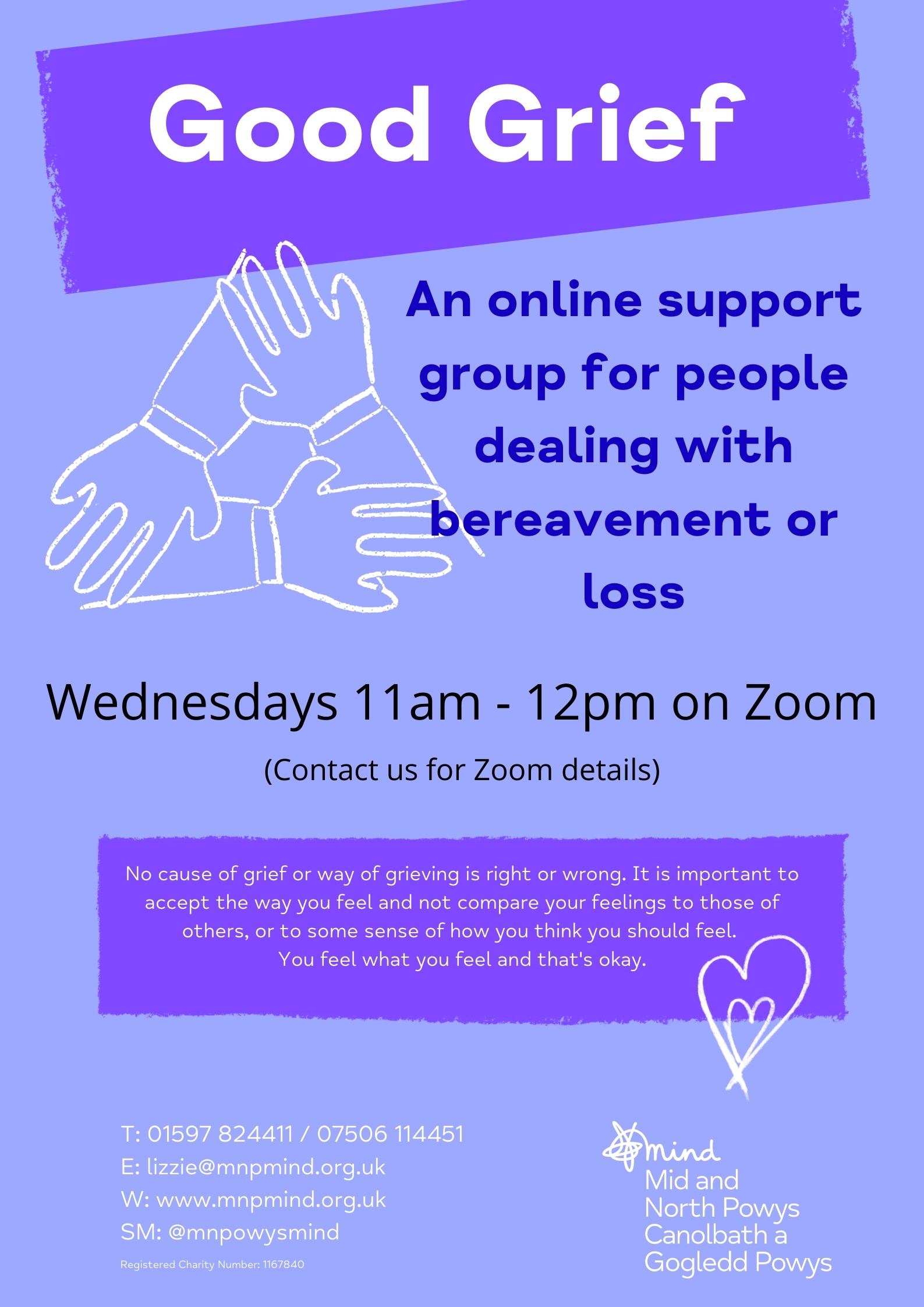
Good Grief - bereavement service in Powys


by Abbie Lycett
Bereavement Support Service Co-ordinator - Mid & North Powys Mind

Grief


There are many reasons why you might experience grief:
  • When a partner, close friend or relative dies.
  • The end of a pregnancy, through miscarriage or termination.
  • The end of a significant relationship.
  • The death or loss of a much loved pet.
There are many causes of grief and loss and no way of grieving is right or wrong. It is important to accept the way you feel and try not to compare your feelings to those of others and think you ‘should’ be feeling and grieving in a certain way.

You feel what you feel and that is okay.

Grief can sometimes feel overwhelming and we can feel lonely. In the Mid and North Powys Mind bereavement support group we want to support you so you don’t feel alone.


The Good Grief group

This is a friendly, supportive group open to anyone who has experienced grief and loss – whether it’s a loved one, a pet, a job, or a relationship.

It’s a safe, non-judgemental and confidential space for you to talk about your experience and your feelings if you wish, and to listen to others.

We meet on the second and fourth Wednesday of the month on Zoom, 11am - 12pm. Feel free to bring along a cuppa.

If you’d like to join us, do get in touch at bereavement@mnp.org.uk and we will send you the Zoom details.


Stevie

Stevie is regular group member, who has since started volunteering to support the running of the group. He says:

“I have been joining the Good Grief group since the group began in February 2021. When I first joined the group, I felt so welcomed by the member of staff, Lizzie, as she so loving and caring, and everyone else in the group as well - they are all so friendly!

I feel that the Good Grief group has really helped me to open up about the loss of my Gee (my Grandmother) and my best mate. I’ve been able to talk about my difficulties and worries, and also the good times we had too, without feeling judged.

Also there is an amazing Facebook group you can use if you’re struggling in between the weekly Zoom sessions, where you can talk to others from the group about how you’re feeling and what’s going on, or even private message the member of staff Lizzie who is always willing to listen and help, and will get back to you as soon as she can.

I would really recommend this group to anyone who is struggling with the loss of a loved one, a pet, a family member, a friend, etc. So come along and say hi in a safe, friendly, loving environment. You will feel so welcomed to this amazing group.

Feedback from others

“The thing I found most useful was the perspective the group gave me on my own grief. You stop wallowing when you find there are plenty of people in a tougher situation than yours.”

“That call was amazing today, I felt so welcomed.”

“I walked past the seasonal aisle in Home Bargains today. All the Mother’s Day gear was out and I laughed. For once I didn’t feel like I was alone in my bitterness. Thanks Lizzie and all you guys for making me feel a bit less alone in this mess.”


The Good Grief bereavement service covers Mid and North Powys and is for adults, 
young people and children.


You can find out more from on Mid & North Powys Mind’s 

To book an appointment or for more information contact Abbie:

Tel: 07496 870 039


Office phone: 01597 824411

You can read about the Powys Bereavement Project in our August 2020 post 

Monday, 10 August 2020

Bereavement support in Powys

Powys Bereavement Project Stakeholder Engagement Event 2019

As I write some 93 people from Powys have sadly died due to the COVID-19 outbreak. Across the UK as a whole the huge number of deaths is hard to take in by anyone; sometimes it’s just another awful statistic at the end of our day, but for the close family members and friends of those who have been lost to this awful disease, the pain will be only too real. 

Today we talk to Charity Garnett, a Palliative Care Nurse for North Powys and a Bereavement Project Co-ordinator, to find out more about bereavement support services in the county. 


First tell us what brought you to work in the field of palliative care nursing?

My Dad died suddenly when I was 15, so I understood earlier than most about the impact of death and dying. 

Then when I was 22, my Grandma died really beautifully, over Christmas, in a local hospital. I saw the way the nurses supported her, and supported us, and I thought ‘that is a real job.’ 

It was another 8 years before I trained as a nurse, but I always knew I wanted to work with dying people and their families. It is the biggest honour in the world to support people at these important moments.

What is your role as a Palliative Care Nurse?

I support people and their loved ones with the full range of things that affect them when approaching the end of life. From helping with physical problems like pain or nausea, to practical and financial worries, and emotional and spiritual support. We help people to think about the future and explore what is most important to them - we call it ‘advance care planning’ and it can be so helpful. The My Life, My Wishes project in Powys is brilliant. Anyone can download the documents here.

What key qualities does a good Palliative Care Nurse need to have?

Compassion is key and an open mind. It is so important to remember that everyone deals with death differently, just as they deal with life differently, and none of us know how we will feel about approaching the end of our lives until we get there ourselves. You have to be able to build relationships over a long time, and work with other health and social care professionals, and be good at co-ordinating often complicated situations. Good self-care is important, because supporting people with so much loss all the time means you need to have good reserves.


Tell us about the Bereavement Project – why now, and how it started.

We were aware in palliative care that we supported people really closely up until someone died, and then we would always call and often visit, but then for relatives sometimes the really hard work of grieving begins. People living with grief often struggle to know what they need or make decisions. Across Wales people are recognising bereaved people need more support and information. People grieve in very individual ways, but there are some common themes and we know some kinds of losses need more support for example children and young people, people bereaved by suicide, sudden and traumatic deaths.

We started by inviting everyone with an interest together to share experience and vision what excellent bereavement support would look like in Powys – and that is what we are now working towards.

Which organisations do you work most closely with on the Bereavement Project? And which organisation might it surprise us to find out you work with?

We’ve worked very closely with the bereavement charity Powys Cruse, our local hospices, and Powys Association of Voluntary Organisations, and many of their members have been brilliant. Grief and loss are a part of life so there is no part of our community that is not affected. The police and the ambulance service have been really motivated to be involved, as they are often there at traumatic moments, and then worry about what support is available for people later on.

Many people who are currently struggling to cope with grief caused by the loss of a loved one may not know about the Bereavement Project. How do they access support?

With the pandemic, grieving has become even more challenging for many people. We have put together some advice and local organisations that people can contact. The new Powys Teaching Health Board website has just been launched and will soon feature a whole page on bereavement resources. All our local Community Connectors are aware of local support for people dealing with bereavement. I am also really happy for people to contact me directly at charity.garnett@wales.nhs.uk


People’s reactions to grief can vary widely. Can you give us some examples, and also of the types of death aside from COVID-19 

Grief can seep into all areas of your life, and people can feel like their brain isn’t functioning very well, have difficulty eating and sleeping. They may feel angry, sad, overwhelmed, numb, relieved – so many different emotions. There is no right or wrong way to grieve, and it often comes in waves, especially around anniversaries, birthdays or big life events. My favourite quote about grief is ‘Grief, I’ve learned, is really just love. It’s all the love you want to give, but cannot… Grief is just love with no place to go.’ Jamie Anderson

In Powys during the pandemic, a lot of our deaths have been more difficult for patients, their families, and staff because of visiting restrictions in care homes and hospitals. Even people at home have struggled with decisions about seeing family or not close to the end. Goodbyes can be so important for people. I’ve encouraged some people who didn’t feel they said what they wanted to say to write a letter to their loved one who has died, even 15 or 20 years later. Although you can’t send it, expressing the feelings can be really helpful in releasing them.

People can grieve the loss of a pet just as much as a family member. Does the project provide support in these cases?

That is so true, my dog died two years ago and I cried for months – they have such an unconditional place of love in our lives. The Blue Cross provides support on 0800 096 6606 in the UK. Rainbows Bridge also has an online forum for people grieving pets. A fantastic resource is The Good Grief Trust, which was set up by bereaved people, for bereaved people. You can type in the kind of loss you have experienced, and where you live, and it will give you a range of options for support.

The Llanidloes Tenovus Choir performing at the Engagement event


What do you suggest to family and friends when someone they know is bereaved, and really struggling with grief, but finds it hard to ask for help?

I think just being alongside someone, for the long haul, is the best you can do. I often suggest taking the lead from them, and asking them what they do want. Sometimes people just want to talk about something normal, or be distracted for a while. Finding ways to show them you care, which might be very practical, can be very helpful. Sometimes it can take a long time for someone to seek help. There are a big range of support organisations out there, sometimes doing someone’s research for them can help – they can then decide to make the call to reach out.

If you could change one thing in the bereavement support world what would it be?


That we recognise that grief and loss is a part of life, and we don’t need to hide it away from ourselves, and from each other. When we lose someone, or something we love, it is totally natural that we would grieve and feel sad. I wish it held a more honoured place in our culture, it can feel like the thing that everyone feels but no one wants to talk about!

When you are not working as a Palliative Care Nurse, how do you enjoy spending your time?

I find being in nature very supportive, with my lovely dog. I enjoy dancing, meditation, hanging out with children, and being near (or in) the sea. I read a lot – if I could recommend one book it would be Kathryn Mannix’s ‘With the end in mind’ – it contains so much practical wisdom. 


Many thanks to Charity for telling us all about her work as a Palliative Care Nurse. If you want to find out more about the Bereavement Project you can contact Charity by emailing charity.garnett@wales.nhs.uk

You can also find out more about Powys Palliative Care Services.


My colleague Jen Hawkins wrote more about the launch of the Powys Bereavement Project held in December 2019 in her post It's Time to Talk about Dying.

Sunday, 31 March 2013

Is grief a treatable illness?


All of us are affected by bereavement at some point in our lives. Whether we lose a parent, grandparent, child, sibling, other family member or friend, it is hard, especially if unexpected. Grief is a natural response, one which affects different people in different ways, hits harder or lasts longer with some of us, but is in the end a perfectly understandable process given what we have lost. Everyone deals with it differently too, perhaps coping after time, with support from loved ones or bereavement counselling, or any number of other ways. When my Dad died, over 10 years ago now, I threw myself into my gardening and that helped me work my way through the grief.

Now, though, it seems that some psychiatric organisations are considering that bereavement and the associated grief could be regarded as a mental illness which might potentially need medical treatment. In a BBC Radio 4 programme called Medicalising Grief earlier today (you can listen here for the next 7 days), Matthew Hill investigates the issues. In May 2013 the American Psychiatric Association will publish the 5th edition of The Diagnostic and Statistical Manual of Mental Disorders - or DSM – in which new mental disorders will be listed. What this actually means is that with each new edition of the manual, yet more people are potentially labelled as “mentally ill”. And with this edition, this could include those grieving for the loss of a loved one.

The DSM, which is apparently regarded as something of a “bible” by some psychiatrists, contains checklists of symptoms for each disorder. The checklist for grief, according to the programme, includes, at one end of the scale - sadness, insomnia, guilt, loss of pleasure and appetite, with suicidal tendencies rounding off the other end. Five or more of these symptoms, experienced for two weeks or more, would indicate that the person had a serious mental disorder, regardless of the underlying reason.

Some experts say that if people experience grief which leads to serious depression then they should be treated (the implication being – bring on the anti-depressants – more of which in the programme...). Others say that to be normally sad, for however long, does not mean that a person has a medical illness. There is an interesting article in The Lancet called Living with grief which explores the latter view in more detail.

When my father died unexpectedly and I had to cope with the consequences I didn’t consider that I might be ill. I was stressed and anxious, particularly in the first few weeks afterwards. I found it hard to concentrate on reading, I needed time to myself and with my close family, to absorb the finality of what had happened. It hurt, a lot, and for a very long time, but I never expected anything different.

How do you feel about redefining grief as an illness? Should people be prescribed anti-depressants if they feel depressed after losing a loved one? What is the difference between sadness and depression? And who should be responsible for deciding what is, and what is not, a mental illness?