Showing posts with label powys befrienders. Show all posts

Tuesday, 18 February 2020

Introducing our new Head of Health & Wellbeing - Clair Swales


Clair Swales recently took on a new role at Powys Association of Voluntary Organisations as Head of Health & Wellbeing after previously working as Senior Officer Community Connectors & Info Engine Wales. She originally started work at PAVO in 2016 as a Third Sector Broker & Info Engine Officer and has since overseen the development of the hugely successful Community Connectors’ team within the organisation as well as further developing the online services directory infoengine. We met up with Clair recently to find out more about her new role.

Tell us more about your new role as Head of Health & Wellbeing at PAVO

My role is to facilitate positive relationships between Powys’ Third Sector and the Public Sector in the field of health and wellbeing, enabling third sector involvement in the development of policy and partnerships, championing a joined-up approach to commissioning of services and developing and maintaining effective service user and citizen engagement.

The role incorporates supporting the Health and Wellbeing team, overseeing the work of the Community Connectors and Powys Befriending Service and contributing to the management of PAVO. I also share responsibility with the CEO for the development and delivery of infoengine.

How is the new job going so far?


I began my new post in December 2019 and the first couple of months have been very busy indeed. In January I was delighted to welcome Sharon Healey as the new Senior Officer for the Community Connectors and Powys Befriending Services. It's been fantastic to get to work more closely with a larger team of PAVO colleagues and to continue working with the sector, health and social care colleagues albeit in a new remit.

Clair (2nd from R) & PAVO colleagues saying #HelloYellow on World Mental Health Day 2019

Can you - briefly - sum up the work of the three different PAVO teams you head up - Health & Wellbeing, Community Connectors & Powys Befrienders

Health & Wellbeing - the team supports Third Sector organisations working in the health and social care fields to work closely with the Health Board, County Council and others to develop better services for Powys’ people. It provides an important mental health information service, supports the delivery of health and well-being information via various mediums, and recruits and supports citizen reps for a variety of boards, as well as facilitating networks such as the Powys Advocacy Network.

Community Connectors - The service helps people in Powys (aged 18+) and their families or carers, to access community-level services and activities that will help them maintain independent lives and which help prevent their circumstances deteriorating to a point where they might need higher level health or social care services.

Powys Befrienders Service - Powys Befriending Service helps improve the independence of people over 50 by helping maintain social networks and remain in their own homes for as long as they are able.

Clair with some of the Community Connectors

Why do you think the Community Connectors have, in such a short time, become such key players in supporting some of our most vulnerable Powys residents?

For anyone who may be vulnerable or facing a challenging time, access to the right information at the right time is essential. Often it can be a challenge to keep on top of the latest information about the support that is available. The Community Connectors have become a key link between statutory services, the client and the sector. This has been driven by the Social Services and Wellbeing Act and A Healthier Wales; and the work with the Regional Partnership Board in delivering the Health and Care Strategy for Powys.

What are the main challenges of your new role?

Juggling time and commitments! With a large team and an even larger number of meetings to attend where I represent the sector, it is always a matter of judging the best way I can support the team and the sector in the best way possible. I like the challenge though and always try to ensure that I make time for my own health and wellbeing and ensuring a good work/home life balance.

Why do you think it is crucial that there is a healthy and robust Health & Wellbeing Third Sector in Powys?

There is a huge focus on health and wellbeing at the moment and in particular early help and intervention. Statutory services have changed immensely over the years and the model for delivery, and financial capability of delivering front line services has also changed. The third sector has a crucial part to play in our communities in supporting health and wellbeing but the sector itself needs to be healthy and robust, able to adapt to change and given the freedom to deliver what truly matters to people. Funding is always a challenge but I like to challenge funding bodies such as the local authority and Welsh Government to focus on early help and prevention and how this can be funded in the third sector. Volunteers play a huge role in supporting health and wellbeing in Powys so we must do what we can to look after Powys’ volunteers.

Clair with Andrew Davies, PAVO Health & Wellbeing Participation Officer

If you could change one thing in the Third Sector Health and Wellbeing world here, what would it be?

Ooh wave my magic wand……Other than overcoming funding difficulties within the sector, I would like to see more third sector involvement in the engagement and support of children and young people. Powys’ third sector has lost a lot of capacity in the remit of delivering support for children and young people and I think it is vital we play an active part in this area of health and wellbeing, to help support children and families and play a key role in reducing and preventing issues in the future.

Charities and voluntary groups (including PAVO) increasingly work more closely with statutory providers of health services - how do you think this will affect the sector from the tiniest local groups to the national big charity players?

I think the biggest challenge here is meeting demand. The SSWB Act has a focus on support close to home but we need to ensure that support for these organisations and groups filters right down to the smallest provider. The close work with statutory partners is certainly a positive step forward but I think there needs to be greater understanding of the role of the sector, in particular the smaller groups, that the sector cannot survive on thin air and it shouldn’t be the place to cut funding.

The Social Value Forum is really starting to see small groups and charities benefit from a small amount of funding that can make a big difference in the community. Sustainability of third sector services is always an issue. Powys is heavily reliant on the outstanding work of volunteers but there is only so much volunteers can do and only so much time to give for volunteering as we all work longer. 


Sharon Healey (L)  new Senior Officer for the Community Connectors &
Powys Befriending Services with Clair

How do you see co-production* working successfully in Powys to provide quality health services for all and what is PAVO’s role in this?


We have had some really positive discussions with third sector agencies such as Credu about co-production in Powys. I feel it's really important to include the service user or community’s views to shape services and this needs to be in a constructive and positive manner. To truly enable co-production we have to break down bureaucratic barriers and this can be a big challenge when working with statutory partners as they have their statutory duties to fulfill. Remove the barriers and let the sector work together with communities to shape future services.

PAVO can play an active role in bringing people together, ensuring the citizen and sector’s voices are heard at statutory level, and influence decision making on behalf of the community and third sector. PAVO’s mission is to be a CATALYST of voluntary Action, a legitimate VOICE for the voluntary sector and a HUB of essential information. We are looking at new ways of using the Community Connectors’ community workers’ meetings to co-produce services at community based level as we know in Powys one size does not fit all. It has to come from the community.

Lots of big issues are crowding out the H & W agenda, the Big 4 of Powys’s Health & Care strategy (Cancer, Mental Health, Heart and Respiratory disease), the Loneliness and isolation strategy of the Together for Mental Health new delivery plan. What skills can your PAVO teams bring to the table?

The team has excellent communication skills and the ability to decipher vast amounts of important health and wellbeing information. Using their creative communication skills they make information regarding health policies and wellbeing initiatives easily accessible to the public, and indeed statutory and third sector colleagues. The teams do this through a variety of platforms such as the ebulletins, social media, health lift films, infoengine.wales and by working with people directly; thus meaning there is something for everyone. The team uses a variety of skills to ensure the voice of the citizen and the sector is heard at all levels of the decision making processes. We also benefit from working closely with our colleagues in the development team to support the sector to meet the challenges of an ever demanding, ever changing wellbeing environment.

Clair (2nd from L) at a patient discharge home meeting with colleagues from Third Sector,
Powys Teaching Health Board and Powys County Council

If people identify gaps in mainstream and Third Sector health and wellbeing services - where should they take that information so that the gaps can be addressed?

The Community Connectors’ case management system allows the team to record gaps and unmet need when working with clients. This has proved very useful with our work with the Social Value Forum to identify needs in communities. However this is just one way of recording information, there is a huge amount of information out there and if you speak to residents or people working in Powys communities they know where there are gaps. The challenge is recording it. The team has used the Community workers’ meetings to also record data around gaps and unmet need and if you don’t already attend one of these meetings I would encourage you to do so.

There are a couple of social prescribing pilot projects in Powys. There seems to be a greater appetite for exploring new and innovative ways to tackling some health & wellbeing issues. What are your thoughts?

Firstly I am not sure I like the terminology ‘social prescribing’. We shouldn’t have to be ‘prescribed’ community based third sector services. However people do need to know what’s available to them to support good health and wellbeing. We should encourage and support people to access community based activities where medical intervention is not required. This type of service is designed to support physical activity and promote good mental health.

Have you taken inspiration from others in the fields of health and wellbeing and / or the Third Sector, and if so, who?

I have actually taken my inspiration from my late father. He was very community minded and spent years as a Town and County Councillor always striving to make people’s lives better. Seeing him work so passionately in the community helped shape me and gave me the firm foundations to strive to deliver the very best for people in the work I do today and every day.

Tell us about some of the most rewarding work you have done at PAVO

Supporting the growth if the connector service has been very rewarding and being shortlisted for an NHS Wales award in autumn 2018 was definitely a highlight. But listening to the difference we can make to people’s lives and to the communities of Powys is always heart warming. I am very clear that without the third sector in Powys the county would be less vibrant.


When you’re not working how do you enjoy spending your time?

My spare time is undoubtedly dedicated to my family. I live with my husband (pictured above on my wedding day) and I have three children and two step children. I am normally running around with various items of sporting kit from rugby to football to horse riding gear. I am very proud of the children and enjoy being on the sidelines cheering them on. I also love cooking with my husband. That's my daily de-stress hour when I get home. I enjoy going to concerts (Bruce Springsteen has to be one of my all time favourites along with The Rolling Stones but I would love to see Sir Tom Jones in concert too). I love walking the dog and getting out into the mountains. Getting fresh air into my lungs helps me to feel grounded and reinvigorated.

BIG thanks to Clair for telling us more about her new role. If you'd like to contact Clair then you can ring 01597 822191 or email clair.swales@pavo.org.uk

*Co-production means delivering public services in an equal and reciprocal relationship between professionals, people using services, their families and their neighbours. Where activities are co‐produced in this way, both services and neighbourhoods become far more effective agents of change.

Definition developed by the New Economics Foundation (NEF) and Nesta, in partnership with the Co-production Practitioners’ Network


Thursday, 12 December 2019

Christmas is upon us! Let's spread the love


by Jackie Newey & Jen Hawkins

There are lots of reasons why someone might be faced with the prospect of spending Christmas Day on their own. Some people may choose this option - which is absolutely fine. Others may have lost a loved one - a husband, wife or long-term partner, or parent, during the course of the year, and be dreading their first ever Christmas alone. Other people of any age may work a long way away from close family and friends and not be in a position to travel and spend time with them.

Sadly, however, it is much more likely that it will be older people who face Christmas alone. Some older people may not see anyone, or even have a phone call on Christmas Day, never mind receive a gift or join in a shared meal. A new Age UK report published on 3 December 2019 estimates that more than 200,000 older people in the UK will spend Christmas alone this year. Those who have recently been widowed struggle the most. The poignancy of this situation is brilliantly illustrated in a short video called "Stella" from Reengage UK (formerly Contact the Elderly).

Joanna Lumley, Age UK Ambassador, says: "Loneliness is one of the most disabling and dispiriting situations that thousands must face this and every year. Even pulling a Christmas cracker needs someone at the other end...and think of all the other moments when a kind hand, a warm voice, and understanding presence would be of even greater benefit to a lonely troubled person.”


Prompted by attending the Powys Bereavement Project launch earlier this month (planned to coincide with the first ever National Grief Awareness Week), Jen decided to try and find out if there were any events or lunches organised by groups in Powys for people to attend if they were by themselves on Christmas Day. Early on in her investigations she was pleasantly surprised by the number and spread of activities across the county. Some of the organisations are even offering to organise transport where needed.

Before long we were both absolutely overwhelmed by the sheer generosity of individuals linked to voluntary groups, churches and even private organisations, who are working tirelessly to ensure people in their communities do not have to face Christmas alone. Indeed most of the lunches / events are free to attend and run on donations and good old community Christmas spirit!


One church in Newtown provides meals for up to one hundred people each year who are elderly or vulnerable and on their own at Christmas. Working with a local sandwich shop, who donate their time and the main course of the meal, a delicious Christmas dinner is prepared, taking into consideration different dietary and lifestyle requirements. Volunteers at the church gather on Christmas morning to organise the food parcels to be delivered to the local residents. 

As well as a Christmas dinner each person receives a newspaper, a dessert and a small gift. It’s not just a flying visit just to drop off either. There is a true sense of Christmas spirit with volunteers staying to chat and keep people company for up to half an hour. Many volunteers have been delivering parcels for several years, visiting the same people each year to build relationships, foster friendships and maintain a sense of continuity and connection. Places have been filled for this year but if you know of someone who would benefit next year please get in touch and we can refer you to the relevant organisations.

Powys really wears its heart on its sleeve when it comes to caring for people in the community at Christmas. What was heartwarming and poignant to discover is that support at Christmas isn’t just localised in one area of Powys. Support and care is provided right across the county from a Christmas meal in Llanfyllin organised by local people and business, to hot drinks and mince pies at the village hall in Presteigne, to board games, bacon butties and hot chocolate at the Greek Restaurant in Brecon with Credu - Connecting Carers. The range of support and provision is varied and heartfelt. 


Other Christmas Day lunches and events are listed on our website events calendar. Some are now fully booked, but others still offer places, or are more informal spaces, where people can meet up with others on Christmas Day. Enjoy a chat, a drink (non-alcoholic or not), listen to music, laugh together (or not!) at some of those dreadful Christmas cracker jokes, and eat a Christmas dinner (roast turkey, or not!) together.

In the end Christmas Day is just one day of the year. What about the other 364 (or in 2020, which is a Leap Year, 365) days? Powys Befrienders is a PAVO project helping to improve the independence of people aged 50 and over in the county by encouraging thriving social networks. This can have huge knock on benefits, not only in people feeling happier in themselves and enjoying life more, but in their ability to remain in their own homes for longer.

Isolation and loneliness can be big issues, especially in a large rural county like Powys. But there is support out there, whether at Christmas or any other time of the year. And the main message we took away from this small piece of work is that generally people in Powys don’t need to spend Christmas Day alone if they don’t want to!


With seasons greetings to all our readers, and hoping that your Christmas is as busy or as quiet as you would really wish.

If you need support over the Christmas period, however, for whatever reason, then take a look at our website page with details of organisations that can help.

There is also an excellent blog post, with tips on how to survive Christmas, on local mental health charity Ponthafren Association’s website - Beat the Christmas Blues.

Thursday, 4 July 2019

Powys Befrienders – Men’s Club Welshpool


Natalie Philbin-Carr is a Powys Befriending Service Outreach Officer at Powys Association of Voluntary Organisations (read Powys Befrienders – it’s given me back my life for more on this PAVO project generally).

We chatted recently about the project’s popular fortnightly Men’s Club in Welshpool, North Powys.


First tell us more about your role as a Powys Befriending Service Outreach Officer

My aim is to provide befriending support to people aged 50+ in Powys to help them maintain their independence and social networks and to live in their homes for as long as they are able. This is done through recruiting and training volunteers who will then either visit the clients in their own home for a cup of tea and a chat or through groups run by the volunteers to enable clients to get out in the community. The befrienders will help to promote personal choice, aim to increase self–respect, support existing personal skills and the development of new opportunities.


Why was the Men’s Club Welshpool set up?

There were a number of men we were in contact with who felt that lunches and afternoon teas weren’t for them. They wanted something in a ‘male environment’. Several of them identified that they liked playing board games and cards and so we gave it a try.

What happens at the Men’s Club, when does it take place, and who can go along?

The men all meet together at The Smithfield Bell in Welshpool every other Monday. They have their own table at the back of the pub where they have a selection of games they can play. The gentleman will get themselves a drink (usually coffee or a soft drink) and then sit and chat for a few minutes while getting everything together. They meet at 12pm and are finished for 2pm. The next meeting is on 8th July and then again on 22nd July. Anyone can go along and join in, it’s a lovely relaxed atmosphere.

Why do the men like to attend the group?

They like to enjoy other male company and play games in peace. 😃

Is it important to provide a men-only group and if so why?

I feel it is because it was something that was specifically requested by the men themselves.

Are there Men’s Clubs in other parts of Powys?

There aren’t just yet that are Powys Befriender run groups, however there are a number of Men’s Sheds dotted about but these are more for practical DIY and gardening type activities rather than recreational.

We are hoping to be able to open another Men’s Group in Newtown next month, plans are currently underway to get it up and running.


How does attending the group impact on the men’s mental health / wellbeing?

It gives them something to look forward to and they are doing something they enjoy. Males generally are quite private about things, so it’s nice for them to have other males to chat to without feeling awkward about who may also be listening.

Some of the men who come along to the Club are also volunteers with the Powys Befriending Service. What kind of volunteering are they doing?

They are there to keep things together and to welcome new people along. If anyone has any questions about the group or the service then the volunteers are on hand to answer anything or if they need anything further, the volunteers can just call in to me for further support. They will set the games up and clear things away at the end. A couple of our volunteers are also drivers so help picking up and dropping off clients when they can.

What are the main challenges of providing Befriending Services specifically for men in Powys?

Finding enough men in the same area to make the provision viable and getting transport to get those who need it to the venues.


Tell us about some of the most rewarding work you have done in the Powys Befriending team

When I first started out with the Befriending Team, I took over an area where the groups had dispersed over the previous months. The first lunch club I arranged, only one person turned up to it, and that was a volunteer. 


Gradually, with a bit of hard work, promotion and word of mouth, the group started to grow and just before I left the area, we were getting around 22 - 24 people coming out for the lunch groups. Seeing everyone get together, smiling and laughing and having a good chat while eating a lovely meal, is such a satisfying thing to watch. Knowing you have made someone happy by giving them an opportunity to get out and socialise is priceless, especially when they tell you they may not have done anything else or seen anyone else that week.

When you’re not working how do you enjoy spending your time?


I love camping! Every year my partner and I, and our 2 boys aged 2 and 13, go camping for a few weeks with our dog Herbie. Last year was Cornwall and this year is Tenby! 


While I’m at home I absolutely love cooking and baking. I regularly have friends visiting from where I used to live, so this gives me the perfect opportunity to cook up a big feast where we then all sit round the dining table and catch up! Having lots of chickens and new born chicks at home also takes up a lot of my time but I wouldn’t change any of it! I love having a day off, but it’s very rare I get to relax!


Big thanks to Natalie for telling us all about the Men's Club in Newtown and we look forward to hearing when the Newtown Men's Club opens for business! 

To find out more about the Men's Club, or any of the other Powys Befrienders' activities, you can email Natalie - natalie.philbin-carr@pavo.org.uk or ring 01597 822191.

Thursday, 1 March 2018

Powys Befrienders - knitting for wellbeing


When I have time, especially in the winter, I like to knit and listen to the radio. I find it very therapeutic. Its rhythmic and repetitive nature has often been compared to meditation. Many of my office colleagues knit too, and we love to pass on tips about our favourite yarns and patterns. We might have a bonding moment or two comparing bamboo knitting needles and angora wools when the broadband dips out for a couple of minutes…

This Tuesday I was invited to meet another friendly group of knitters and crocheters at Abbeyfield House in Newtown for their regular fortnightly session. If you’re a knitting enthusiast, you’ve probably come across the Knit & Natter concept. This incarnation is the Newtown Knit Tea Together group set up by the Powys Befriending Service. (Read Powys Befrienders – it’s given me back my life for more on this PAVO project generally). It was snowing, so not all the regulars had been able to make it, but Eileen, Betty and Carol were joined by first-timer Olive for a chat, loads of laughs, and plenty of knitting, sewing and crocheting.


Olive works on a twiddle mitt
This week they were busy making twiddle mitts and cushions for people locally living with dementia. (Online pattern for knitters!) “People with dementia are always looking for things to touch,” they explained, “so we sew bells, beads, eyes and Velcro to the mitts, and people find them very therapeutic.” While I was there Lesley Austen, the Powys Befriending Services Co-ordinator, arrived to gather up mounds of the mitts to take to Bethshan Care Home, also in Newtown. Past group projects have included making baby blankets for local maternity services, and creating colourful knitted toys and clothes to raise funds for the group. At a market stall in Glanhafren, Newtown Market Hall, on 8 December, they raised £380 through sales, and are now planning a summer stall.

While the women sit and sew they swop tips, plan trips – including activities and shopping – and update each other about the latest local news stories. They happily share their skills, and experience. Carol promises to teach 
Olive how to crochet the next time they meet. There’s a haberdashery moment and in five minutes Eileen’s volunteering to shop at her favourite supplier for all the others. And who would have known that the best and cheapest way to stuff a knitted doll is to pull a pillow apart for the filling? 


L-R: Lesley (Powys Befriending Service Co-ordinator), Olive & Eileen
"Tell me again, what's a split stitch in knitting...?"
Why we like to knit and crochet

"It relaxes you. It keeps your hands moving. It you have arthritis it helps to keep them moving. You have to keep active."

"It keeps your brain moving too! If you’ve got one! It helps keep your mind off a lot of problems. You can take it out in your knitting. You go faster if you’re in a bad mood!"


Several members of the Newtown Knit Tea Together group are also active Powys Befriending Service volunteers in their local community. The two volunteers present tell me about the clients they support. One is a gentleman with Parkinson’s disease who is visited at home, and another is a lady who is supported to attend afternoon teas at the Smithfield Bell in Welshpool, or the Lakeside Restaurant at the golf course near Montgomery.

Carol does crochet... and is also a PB volunteer

Later Lesley told me more about Eileen’s contribution as a Powys Befriending Service volunteer:

Eileen’s husband died after a prolonged illness and was bedridden for the last 6 months of his life. He did not want to be in hospital so Eileen had cared for him at home supported by Health and Social Services. For over a year she had rarely left the house and had lost a lot of confidence about going out on her own as well as suffering from grief and loneliness. Her daughter referred her to the Powys Befriending Service and accompanied her to one of our group lunches.

Eileen was very chatty and helped people sitting around her. At the end of the session, when I asked how she had got on, she said she loved it: “But I’m so much better off than some of the others, wouldn’t I be of more use helping them?”

Eileen duly attended the Befriending Induction training, got her DBS (Disclosure & Barring Service) approval and two glowing references and asked “When do I start?” She didn’t want to have to drive too far, so I matched her to a housebound gentleman with early stage dementia and other health needs who lived a few miles away. As we approached the gentleman’s house she told me she and her husband used to walk in the area and used to chat to a lovely man tending his garden – and this was the gentleman she was getting matched to!

Both he and his wife recognised Eileen and were delighted to see a familiar face. The client has memory loss and several health conditions requiring appointments and visits, so we agreed Eileen would visit every two weeks. The match is a great success – both client and volunteer share a farming background and enjoy talking about farming and the local countryside, reading the local paper and following sports events on TV. 


The client’s wife now has a regular couple of undisturbed hours when she can do things that she enjoys, getting out in the garden, baking and having a chat on the phone with friends, which she had not previously been able to do easily, having to keep an ear and eye out for her husband’s needs.

This still left Eileen with time on her hands and a will to help people, so she asked if it would be possible to have another client to see on alternate weeks and is now also matched with a lady who had no means of getting out and about. She takes this lady to an afternoon tea group, and is now supporting the group by helping with clients.

Eileen then asked if she could come along to the Newtown Knit Tea Together group as she loves knitting and sewing, and after a few sessions she and another volunteer were quite happy to run the group themselves with me in the background for occasional support. Lots of our female clients list amongst their interests knitting, crochet and sewing, but no longer have anyone to make things for. Eileen soon armed them with patterns, needles and wool and got them making baby clothes in premature sizes, which we now send in regular parcels to Special Care Baby Units in Welsh Hospitals.

Oh did I mention…………… Eileen is 86 years young!


Eileen told me “I get as much out of being a volunteer as the people we help. It’s been a lifeline to me since I lost my husband.”

Betty with one of her knitted dolls

If you would like to join the Newtown Knit Tea Together group run by the Powys Befriending Service (don’t worry if you can’t knit, sew or crochet – there are plenty who will happily teach you) then give Lesley a call to find out more on 01597 822191 or email: lesley.austen@pavo.org.uk

Are you a knitter or crocheter? Does it help boost your emotional wellbeing? Let us know in the comments box below.


Tuesday, 6 June 2017

Jill Ball - speaking up for older people in Powys


After 4 years working in PAVO’s Powys Befrienders’ team, Jill Ball recently started a new role at Age Cymru Powys as an Independent Advocate. Age Cymru Powys is the largest voluntary sector organisation providing support to people over 60 in Powys, Mid Wales, covering the old shire counties of Montgomeryshire, Radnorshire and Brecknockshire.

The organisation works to sustain and improve the quality of life of vulnerable older people in Powys. It believes that older people should be respected and valued as individuals in terms of their dignity, status, personal autonomy, diversity of needs, aspirations and expectations.


I caught up with Jill at her base in Newtown to find out more.

Tell us about your new role with Age Cymru Powys

My role as an advocate is to take action to help people say what they want to say, secure their rights, represent their interests and obtain the services they need. I meet with people daily and listen to the issues that are of concern to them, provide them with information, and discuss with them the options that are available to them. If required I assist them with contacting third parties and written correspondence. As an independent advocate my role is impartial and non-directive. 


What is joyful about the role is that in supporting others to access the services they may need, or by them resolving an issue that has been of great concern to them, they then can continue to enjoy happy and fulfilling lives.

Which areas of Powys do you cover?

My base is at the Age Cymru Powys Centre, Parkers Lane in Newtown. The area I cover is the North of Powys and my colleague Louise Hicks covers the South of the county. I have an advocacy drop-in session every Tuesday 9 - 12.30 at our 
Newtown Centre. If required I visit clients at home or in a care home, wherever they reside.

How is the new job going so far?

I am enjoying it tremendously; the work is varied and interesting, people consult the advocacy service for many different reasons. They may wish to investigate what other accommodation is available to them now that their own needs have changed, which may be due to bereavement or an escalation of care needs. A client may be unhappy about the care they are in receipt of, and need assistance with knowing who to contact and may need assistance with getting their voice heard. I support clients when there may be conflict in their family, to reinforce their wishes.

Who can be referred to the Age Cymru Powys service and how?


The service is free, independent and confidential and is for people over the age of 60 living in Powys. People can self refer into the service or can be referred into the service by a third party, with their consent. 

North/Mid Powys telephone 01686 623707, email : support@acpowys.org.uk 
South/Mid Powys telephone 01597 825908, email : enquiries@acpowys.org.uk 

If people have been living alone and isolated for a long time what kind of support might they need?

Someone who can listen to what their needs are, and then to provide them with up to date and accurate information on what is available to them. They are then able to make informed choices whether that be in relation to their health, care, finances or social needs. If they need support to access a service, whatever that may be, Age Cymru Powys is able to guide them through this process.


How can the kind of support Age Cymru Powys offers impact on people’s physical and emotional wellbeing?

People are less anxious and more confident because they have the support and knowledge to face whatever problem they may be experiencing. The service is accessible. People say they enjoy the face to face contact and build up a good rapport with staff members. 

Age Cymru Powys also offers a toenail cutting service throughout the county which is a much needed and well supported service. 

The information and advice service provides benefits' information and assistance in completing forms and with financial security comes peace of mind. Age Cymru provides an extensive range of literature on all subjects relating to older people, from adaptations to their home, to power of attorney information. When people are informed they are then able to make decisions about their future which impacts on their wellbeing.

If people don’t receive the support they need, what can happen to them?

People can become socially isolated which can impact on their physical and mental health. Worst case scenarios could be that people become impoverished as they may not access the financial assistance that is available to them, which could affect their tenancy. They may become neglected as their personal care needs are not being met.

Which other organisations do you work closely with, either locally in Powys, or in the rest of the UK, to provide support to people?

Mind Cymru, Community Mental Health Team, Ponthafren, GP practices, other health professionals, Occupational Therapists, Social Workers, District Nurses, Speech and Hearing Loss teams, Care Agencies, Abacare, Red Cross, Action for Hearing Loss, RNIB, Powys Association of Voluntary Organisations, Credu Connecting Carers, Powys County Council, Department for Work & Pensions, Environmental Health, Disability Powys, Citizens Advice, Kaleidoscope, Alzheimer’s Society, Parkinson’s UK, Age UK, Stroke Association, Care and Repair... a long list!

Tell us what an “age friendly Wales” looks like to you personally


One in which all people feel valued. Communities provide services dictated by those who reside there. Where there are no barriers to services. Where everyone has someone to have a chat with and spend time with and where all individuals are celebrated and cherished.

What are the main challenges of the role?

Very long waiting times on the telephone to get through to some services. The distances one has to travel; less travelling time would enable me to see more people.

Tell us about some of the most rewarding work you have done at Age Cymru Powys so far


I have enabled a very elderly lady to stay in the care home of her choice. Supported a lady with hearing loss to solve her internet problems, so that she can email her family in South Africa and keep in touch with her grandchildren. Helped someone to understand all the care and accommodation options available to them, as they were given notice on their rented property. They are now living independently within a complex that has someone on the premises 24 hours a day and should they require a greater level of support in time this will be available to them.

When you are not working for Age Cymru Powys, how do you enjoy spending your time?


I enjoy spending my time in my garden and greenhouse and with my two little grand-daughters, and whenever possible I love a trip to the seaside, particularly our beautiful Welsh coast.


Many thanks to Jill for updating us about her new role. If you want to find out more about the Age Cymru Powys service you can contact Jill by emailing: jill.ball@agecymru.org.uk or ring 01686 623707.

Thursday, 11 August 2016

Powys Befrienders - it’s given me back my life!


“Individuals who are socially isolated are between two and five times more likely than those who have strong social links to die prematurely.” 

Michael Marmot (2010) – Fair Society, Healthy Lives.

Last year we heard from the then Project Co-ordinator, Rachael Beech, about this really successful lottery funded befriending project. She told us it is "so much more than a cuppa and a chat".

Rachael has recently moved on to work with Action for Hearing Loss in Powys, and Befrienders’ colleague Jill Ball has taken over the reins, in this, the fifth year of the project. It seemed like a good time to catch up with progress, particularly as the service has developed to meet the changing needs of clients. As well as 1:1 support Powys Befrienders now holds regular group meetings and occasional days out.


First of all Jill gives us some of the project basics:

Powys Befrienders is a five year Big Lottery funded project delivered by Powys Association of Voluntary Organisations (PAVO). The service currently provides a 1:1 and Group Befriending service Powys–wide, delivered by volunteers and paid staff to people over the age of 50. The aim is to support them to maintain and improve their independence and wellbeing. The service is quality assured having met the Quality in Befriending (QIB) quality standards in all 9 areas – it is the first befriending project in Wales to have achieved this prestigious quality assurance standard.


Powys Befrienders’ interventions produce measurable improvements, evidenced by ‘Outcome Star’ data, in the following areas:-
  • Optimising independence.
  • Maximising wellbeing through choice and control.
  • Focusing on prevention.
The service has Outreach Officers across the county who liaise with other health professionals to deliver the Befriending Groups and 1:1 opportunities. The criteria for becoming a client of the befriending service are:

You live in Powys, you are over the age of 50 and that you are isolated or lonely. People can self-refer into the service or be referred by a friend, family member or health professional.

Trained volunteers who also have a DBS (Disclosure & Barring Service) check are matched to clients and do a whole variety of activities with them. The activity is dictated by the client and some examples are swimming, singing, playing dominos, chess, shopping, walking, going to the theatre, lunch out, and dog walking.


The Group Facilitator for North Powys – Lesley Austen, tells us how the project has evolved:

Well, the project has evolved in the North in quite a haphazard way really! We seemed to have either clients in an area or volunteers - never both in the same place to make one-to-one matches.

The groups mostly started quite small, bringing together sometimes just 2 or 3 people (and occasionally just me and a client!) in a mutually convenient place - usually a cafe (saving the cost of venues and I don't have to make the tea!). Plus there is the added benefit of the opportunity to bump into old friends and neighbours.

They are all informal social groups, dotted around North Powys to suit people's needs, meeting for teas, coffees, lunches and occasional days out. Nobody is restricted to a particular group just because they live in the area, many attend 2 or 3 groups and a few attend everything that's going on! We help with transport as much as we can and would love more volunteer drivers who could help us out with this (hint hint!).


Currently there are two weekly lunch clubs, one in Newtown and one in Llandrinio, and a peripatetic lunch "club" that eats its way round Powys 2 or 3 times a month at various pubs and restaurants. Coffee / tea groups are held in Newtown, Guilsfield, Llansantffraid, Llanfyllin and Llanfair Caereinion monthly or twice a month.

Anyone over 50 who is feeling the need for company and wants to get out and about is welcome and we have people of all abilities and disabilities attending our groups on a regular basis. Some come every week, others we only see about once a month.


We also arrange occasional days out when people can try something a little different. One of our clients had been on a canal boat before so suggested it as a group activity. On 10 June we took to the waters of the beautiful Montgomery Canal with the Heulwen Trust (Heulwen is Welsh for sunshine). Robin, our boatman, piloted a fully accessible 70 foot narrow boat from the Trust’s base at Welshpool to Ardleen. We enjoyed a picnic lunch from a local café and a strawberry tea on our trip and everyone had a lovely day, including guide dog Quince and his owner Gwyn.


About Powys Befrienders' clients

M was widowed last year and was very lonely, with not many friends in the area - he is fit and active and has his own transport so is seen at almost all our activities. He has also met people from other clubs and groups and joins in with their activities too: "I've always got something to look forward to now, just a problem fitting it all in or deciding what to do next!"

D has complex health needs which have resulted in depression to the point she had not been out socially for over 6 years. At first very reluctant and reserved, she is now up for anything on offer, encouraging others to join in and despite her continuing health issues and poor mobility is no longer dependant on medication for depression: "Befrienders has given me back my life."


Many thanks to Jill and Lesley for updating us about this amazing project.

If you would like to become a volunteer for Powys Befrienders and could give up 2-3 hours per week please call 01597 822191 and ask for a member of the Befrienders’ team. Volunteers may do telephone befriending, visits to clients and group activities, or may just wish to transport clients to activities. Volunteers are refunded for any expenditure they incur.

If you wish to become a client of the service call the team now on 01597 822191.


Tuesday, 1 December 2015

Re-Live Theatre @ Dementia Supportive Communities event


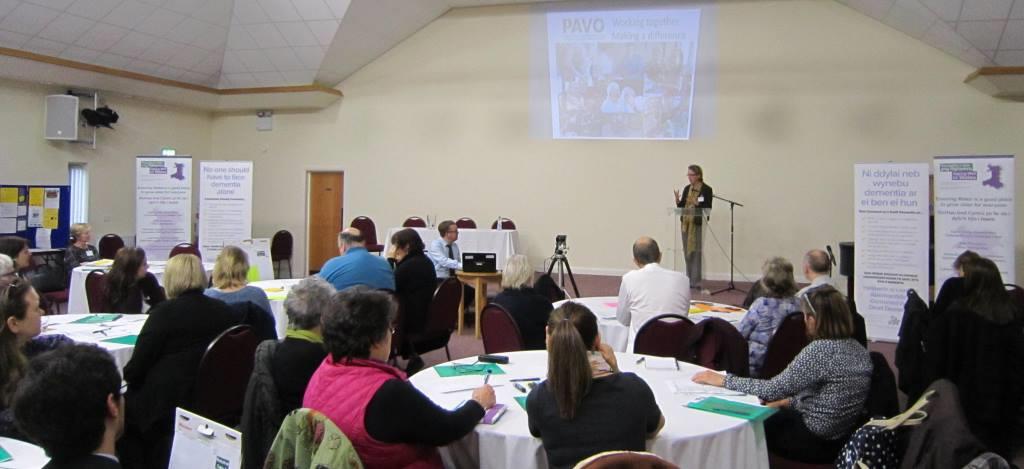
Last Thursday I attended a Dementia Supportive Communities network event in Brecon organised by Ageing Well in Wales and Brecon and Hay Dementia Supportive Community with support from Alzheimer's Society, Powys Association of Voluntary Organisations, Powys County Council and Powys teaching Health Board. The event was extremely well-attended, with representatives from the statutory, voluntary and private sectors.

The aim of the event was "to build and develop Dementia Supportive Communities across Powys by:
  • Sharing examples of practical ways to support people with a dementia.
  • Identifying best practice and sources of information.
  • Exploring ways of working together in the future."
It was an absolutely packed day, and all I can do here is focus on some highlights, whilst giving links to further information where appropriate.

The day was introduced by Gweneira Raw-Rees (below left), the Project Lead for Ageing Well in Wales, which has the challenging remit of "ensuring Wales is a good place to grow old for everyone". Gweneira explained that one of AWW's roles is to share good practice through events. "The formula is simple. To try to inspire people to take action."  

Our facilitator for the day was Trish Richardson (below right) of Brecon and Hay Dementia Supportive Community. Trish explained the concept behind dementia friendly communities (interchangeable with dementia supportive communities), emphasising that "it is about enabling people with dementia, working with them as opposed to doing for them."


First up, and certainly the highlight of the day for me, was a performance from Re-Live Theatre Company, working alongside people with dementia. The company is passionate about the role creativity plays in removing stigma, and aims to put the real stories and experiences of people with dementia out there. The short performance was made by two members of the company alongside real people (not actors) sharing their real experiences. These included features around the importance of singing for some, and the humiliation of being bid for as a 68 year old male in "not too bad condition.... not too challenging... no immediate family... if you know what I mean...." Number NL2810 was then sold to the highest bidder for £500 - securing his place at an Elderly Infirm Unit.

And Jill Grey read her powerful poem with support from other members of the group.


They meet in the appointed room.
Laptops, briefcases, suits.
Meet bi-monthly,
Promptly, religiously,
Unless, of course, it's cancelled
And nothing happens.

They bring their minutes
Their memos
Their own agendas,
Protect their kingdoms
Cover their backsides
And nothing happens.


They have a bright idea.
It's brilliant, workable
Inexpensive.
Then it's - 'Maternity Leave',
Or - 'Change of Post'
And nothing happens.

'Care in the Community' means
'Keep them at home'.
Poorly trained care-workers; different each day
With eyes on the clock, pens on the paperwork
And minimum pay.
Promises of improvement
But nothing happens.


A brand new ward! An Assessment Ward!
Retitled - 'Assessment and Continuing Care'.
Queues grow deeper, waiting lists longer.
Does it really matter?
The outcomes are the same.
So nothing happens.

They close a ward; its soul has flown.
A dementia ward now filled with ghosts.
In general wards they cannot sleep.
"Those damned dementia patients!
Why can't they just shut up!"
But nothing happens.

Tories blame the Socialists.
Socialists the Tories.
Lib Dem, UKIP, Plaid add their two-penneth too.
Oh where is the one who can wield Excaliber or hold aloft good Merlin's Wand?
A bold magician who would override us all
And make it happen!

L-R: Gloria Jones Powell (Chair, PAVO Board), Joy Garfitt (Head of Adult Social Care, PCC),
Rhiannon Jones (Executive Director of Nursing, PtHB)
How to follow that? Well, that was the task of the next three speakers. They all made comprehensive presentations from their individual organisations' perspectives about work being done to encourage dementia supportive activities across Powys. All three acknowledged that there is still a lot to be done, but the ambition is clearly there. Again, I can only give a flavour here due to lack of space, but there is a link to the presentations at the end of the post.

Rhiannon Jones, Executive Director of Nursing, Powys teaching Health Board
Rhiannon clarified that dementia currently falls into the mental health strategy for Powys - Hearts & Minds. Her role as Chair of the steering group overseeing the Joint Dementia Action Plan is to work more with people in contact with services, and the community, to get it right.

Joy Garfitt, Head of Adult Social Care, Powys County Council
Joy spoke of the journey currently being travelled to make the council a person-centred organisation. "It is about support, not necessarily services. It is not about fitting people into a box." She explained that from April 2016 the new Social Services & Wellbeing (Wales) Act will change everything.

Gloria Jones Powell, Chair of Trustees, Powys Association of Voluntary Organisations
After introducing the audience to PAVO's general role in supporting the Third Sector, Gloria highlighted three very relevant services - Powys Befrienders and the Third Sector Brokers are hosted by PAVO, whilst the new role for Powys of a Dementia Supportive Communities Coordinator is managed by Alzheimer's Society.


In one of the breaks I managed to catch up briefly with Karen Rodenburg (above), who has recently taken on this role. Karen is based in Newtown and covers Montgomeryshire & Radnorshire. Her colleague in South Powys is Ian Thomas, who is based in Talgarth.


A couple of really interesting workshops later ("Experiencing dementia - how does it feel?" with Re-Live Theatre Company, and "Setting up voluntary and community-led dementia friendly initiatives" with Brecon & Hay Dementia Supportive Community) and it was time to hear PtHB's Dementia Lead - Harold Proctor - speak.

After a little bit of history relating to person-centred care, Harold described how practically we can help people with dementia who are in a hospital environment. He touched on everything from the Butterfly Scheme, to colour and tonal contrast in the physical environment, with references to liaison nurses, specialised training, digital technology and dementia pathways along the way.


Rachael Beech, PAVO's Powys Befrienders' Coordinator, was the final keynote speaker of the day. Her topic: Establishing a Powys Dementia Network. She put into words what I had been thinking increasingly throughout the day - there is a lot going on around dementia in Powys. How do we pull it all together? Care homes. Memory clinics. Singing groups. Hospitals. Memory cafes. Carers' respite. Neighbours' support.... Who is doing what, where and when? PAVO has already started work on a mapping and gapping project, and now proposes initiating a dementia alliance, forum or network - Rachael asked people to suggest names. She also posed the questions - who would be invited? How often would it meet? Would a virtual network be an option?

The new network could be facilitated by PAVO, and would be aimed at people using services and their carers in the first instance. The idea is to launch it next April after further dementia events have been held and information gathered. What do you think? Would you find a dementia network useful? Have you got a good idea for a name? Let us know in the comments section below.

All told everyone seemed to find this dementia networking event extremely valuable. A similar event is planned in North Powys for the New Year. Watch this space for further updates. Here's hoping they manage to book Re-Live Theatre Company for another inspiring session.
_________

Dementia Supportive Community Coordinators in Powys
Montgomeryshire & Radnorshire: 
Karen Rodenburg, email: karen.rodenburg@alzheimers.org.uk
South Powys: 
Ian Thomas, email: ian.thomas@alzheimers.org.uk

Presentations from the day can be found on the Powys Mental Health website 
under the Powys Mental Health dementia blog section.

Jill Grey has written a book which is available online - 
After the Rehearsal - Living with Dementia, a Carer's Story