Showing posts with label brecon dementia friendly community. Show all posts

Thursday, 28 July 2016

Memory boxes – connecting with the past


I recently found out about an innovative new dementia-friendly project in Brecon called the Memory Box Loan Scheme, which is run by Brecknock Museum & Art Gallery and funded by the Heritage Lottery Fund.

“This new service is aimed at those working with, or caring for, older people. Each box has a particular theme and is made up of a range of objects from the 1950s, 60s and 70s. The idea behind the boxes is that they can be used to stimulate memory and start conversation. They can be especially useful for talking about the past with a person with a dementia”.


Martine Woodcock, Education Officer at Brecknock Museum & Art Gallery, told me more:

The project was initially set up by our Volunteer Co-ordinator, Emily Tilling, who has since left Brecknock Museum. The project is now co-ordinated by myself and one of our curatorial assistants, Jacqueline Morgan. Emily spent a lot of time setting up the project and worked with a group of our Museum volunteers who were very interested in taking the project further. They were dedicated in their enthusiasm by either donating personal items or frequently visiting charity shops so that we could build up our collection. Local charity shops have been very generous in supporting the project when they hear what we are using the items for.

The service came about as one of the targets on our HLF Activity Plan was to run reminiscence sessions with older people. As we were about to start this we were invited to a Dementia Friendly session by Rhiannon Davies who is one of the Co-Chairs of Brecon Area Dementia Friendly Community. She delivered a fascinating and informative session and we decided that if we started up a Memory Box Loan Service then that would be of great benefit to elderly people whether they had dementia or not.


We have about 12 themed boxes altogether (Leisure, Sewing & Knitting, Men in the 50s & 60s, Transport & Holidays, Childhood, Women’s Fashion, Household, Photography, World War II, Cooking & Baking, and Shopping) and information has been circulated to care homes and day centres. The boxes don’t have an excessive amount in them and we try to put them in relevant containers such as a vanity case for ‘Women’s Fashion’ and a knitting bag for the ‘Sewing and Knitting’. 

We have opted for group rather than individual use at the moment, but that doesn’t mean that that won’t change in the future. The loan service has been very popular with boxes going out most weeks. We usually let organisations have them for about a fortnight so that other groups don’t have to wait too long.

We don’t facilitate the sessions ourselves. We are just the box providers. We send out a feedback form with the boxes so we know where we could improve the contents/service and we also send out discussion prompts and some item information sheets as we appreciate that those facilitating the session may not have come across the things in the boxes before. A prompt from the Sewing & Knitting box might be: “Did you use the phrase ‘make do and mend’? Did you wear darned or patched clothes? What were scraps of material or old clothes used for (rag rugs, cleaning cloths)?” The box contents include knitting needles, thimbles, tape measures, patterns, crochet and knitting samples, cotton reels, velvet, ribbon and an old knitting pattern magazine!

Rhiannon, and the other Brecon Area Dementia Friendly Community Co-chair, Joan Brown, are also very keen to involve the young people of Brecon in raising Dementia Awareness. Joan has been working alongside local Primary Schools. Year 6 pupils regularly visit care home residents and have used some of our boxes at sessions as well as devising their own.


So, as you can see, it really has taken off in Brecon! We are very proud that we can be a part of maybe bringing a little bit of pleasure for someone experiencing dementia. We are of course prepared for the fact that some objects may jolt unhappy memories too.

We have promoted the service well with the assistance of Brecon Dementia Friendly Community. We recently attended the ‘Ageing Creatively’ day as part of Gwanwyn (a festival each May celebrating creativity in older age) which was held at Theatr Brycheiniog where we displayed boxes. We did the same as part of ‘Dementia Awareness Week’ at The Guild Hall, Brecon. I have also done a talk to a group of Alzheimer’s Befrienders about how simple it can be to put a box together.

Rhiannon Davies, of Brecon Dementia Friendly Community (a familiar face on this blog) has used some of these memory boxes several times at the weekly Tea & Chat and Music & Memories sessions, as well as in care home settings. I spoke to her to find out more:

The volunteer co-ordinator at the museum was full of energy and ideas. Staff there could see what was possible and made it happen. Dr Anja Pinhorn, a consultant at the Brecon Memorial War Hospital, has also borrowed memory boxes to take on to the general ward. They have a lot of long-stay patients with physical illnesses, some of whom have dementia. It is really important to keep them interested and stimulated, and this is an excellent way of doing that. I hear that they are going to make “conversation boxes” in Ystradgynlais Hospital for use on the general ward.


At Brecon Dementia Friendly Community we are starting a new activity in the Autumn on the hospital wards – introducing creative activities and supporting the nursing staff with ideas to generate conversations so that people do not become institutionalised. The memory boxes have been used very successfully so far as they have items in them that can trigger memories and conversations. It can, otherwise, sometimes be difficult to start a conversation with a patient.

In one of the care homes I went into with the boxes a vanity case containing fashion items was used. It had things for ladies, including a suspender belt, stockings, lipstick and a powder pack. It was just fantastic! People actually wanted to pick up and handle the items and had a lot of fun. We don’t use some of these things any more but they take people back to the time when they were used often, and can trigger all sorts of memories such as taking people back to an age when they were much younger and getting ready to go to a dance.

The boxes are a very powerful way of stimulating memories and keeping people connected. There is then a collective connection which is lovely and enhances relationships between the staff and the patient or resident. After you have built this relationship you can achieve trust and it makes things much easier for people.


Many thanks to Martine and Rhiannon for telling us about this wonderful scheme. Perhaps you could use their ideas and develop something similar in your community?

The Brecon memory boxes are available to borrow free of charge. However, it is a collection-only service. To book a memory box or for further information call 01874 624121 or email brecknock.museum@powys.gov.uk

Wednesday, 11 May 2016

Linda's experience since being diagnosed with dementia

There is a bit of a dementia theme on the blog at the moment which works well as Dementia Awareness Week starts in just a few days.

Last week I wrote about the Dementia Supportive Communities Event in the North, and this week we focus on young-onset dementia with a look at the South of the county.  

Bethan Morris, who is a Dementia Support Worker with Alzheimer's Society for Gwent and South Powys, recently contacted our Information Service to find out more about activities in the county. 

As a result she was able to put me in touch with Linda, who was diagnosed with young-onset dementia, dementia which affects people under the age of 65. Linda kindly agreed to tell us about her diagnosis, and what has happened since.

I knew I had problems with my memory whilst I was at work and didn’t think much about it and used to say I am having a "dementia day" and could someone help me? Little did I know that I was suffering from dementia. I did ask my doctor on several occasions about my memory loss and was told it was my age - it's normal as people get older, or I was depressed and given anti-depression tablets. 

It wasn’t until I saw a different doctor after I had retired from work at the age of 60 that they thought there was a problem with my speech and memory and I was given a memory test. From there I was referred to a memory clinic at the hospital. I was given a memory test at the hospital and then saw the consultant and was told I had a form of Alzheimer’s but he would like a second opinion. I went home and looked at the diagnosis on the internet and felt the diagnosis wasn’t me as I did not fit the criteria. After a MRI scan I was given the second diagnosis of vascular dementia.

At the first visit the consultant asked me if he could inform the Alzheimer’s Society to come and visit me and to give me advice and information and describe the way they could help me. 
I was visited by Anne from the Society who talked about what the Alzheimer’s Society could offer me and the help that was on offer, she also told me about all the activities the Society provided like a singing group, art group and a monthly memory cafe. At that time I did not want to speak to anybody about my illness as I couldn’t think quick enough to answer questions and I didn’t want to feel silly or be judged, and anyway I couldn’t sing or draw. But after time I felt like I would like to go along to a memory cafe to see what it was like. The first time I was extremely nervous and frightened but I was made to feel very welcomed and from here the Society has changed my life for the better.

From the memory cafe I made friends and was asked to join the singing group. I said no I couldn’t sing but was told that didn’t matter as it was fun and I would enjoy it so I said I will give it one go and if I didn’t like it I wouldn’t go again. After going for the first time I am still going and we have just had our fifth anniversary. I love it. Our choir mistress is extremely funny and we have a marvellous time and come away feeling uplifted. We now have gigs all over Wales and have even sung at the Millennium Centre. I was also asked to join the art group, my art has really improved, I am unable to copy other work as I have a very shaky hand but I do my own thing and love it. Mine is more modern art but it doesn’t matter if you cannot draw as there are always ways around it.

I now sit on a Service User Review Panel, we either overview a new/old document or have a live speaker who would like our opinion on new projects etc. Age Cymru has been commissioned to ask people across Wales about their experience of living with dementia and wanted our views. We have been asked how they could improve the Memory Walk etc.

About five years ago there was a forum for Younger People Living with Dementia and we were asked what we wanted from the community. The joint opinion was that we wanted our own permanent unit for people living with dementia. Somebody on the panel asked ‘Was this just a paper exercise’.

About two years later, however, this idea became reality because the Seren group took on the project in Blackwood and they asked the SURP if we wanted to be involved once the plans had been drawn up. We sat every month to discuss how the project was coming on, we chose all the interior, even the name of the unit. There is an outbuilding we called the ‘CWTCH’ where meetings could be held, we could have parties, our own kitchen to make drinks and even a hairdressers and a chiropodist room. We named the building ‘Cwmgelli Lodge’, this is now opened and we have our SURP meeting there and there are now permanent residents living there.

Having dementia changes your life and sometimes it is difficult but the Alzheimer’s Society helped me to change it for the better. I have become more confident, have a feeling of self worth being able to change people’s perception of dementia, I can emphathise with others, listen to others and offer my support and encouragement.

I attend the monthly memory cafe, singing group, art groups, SURPS' meeting, attend interviews, talk at workshops and conferences, and became an Ambassador for the Alzheimer’s Society. My husband attends a carers' meeting group to discuss any issues and sometimes there are speakers - at least he has a point of contact should it be required.

I now have a befriender Chris and she takes me out every week for two hours. I am always asked where I would like to go, sometimes we go on girlie shopping trips, or go for walks to the wetlands, parks or reservoir, to museums or just go to places of interest but we always end up for a coffee and a chat and this gives my husband time for himself.

I have learned to change small things for the better to improve my life. I make lots of sticky notes and place them around the home to remind me of things I might have forgotten like my purse, my phone, my keys etc. I make lists for when I go shopping and I have a note to remind me ‘have I got my list’. We have changed the cooker to an induction cooker so that it will switch itself off if something is burning, my iron turns itself off if not being used, my shower is set at a certain temperature so I only have to turn one handle, my calendar has become like a bible to me as I write everything on it so I know what it going on every day, and I keep a notepad and pen in my bag so that I can write information down as I normally forget dates.

I am an Ambassador for the Society because I like to help others and I like to give back to the Society as they have given me a quality of life that I thought I would never have.

I look forward and not back, concentrate on the things I can do and forget about the things I cannot do, try new things and if I don’t enjoy it I don’t do it again and can say I have given it a go but it isn’t for me.

You can live well with dementia.


Many thanks to Linda for telling us her story.

The Alzheimer's Society office for Young People with Dementia where Bethan Morris is based is in Pontypool. Staff provide information on all aspects of dementia, including support on caring for a person with dementia and providing emotional support to Younger People with Dementia (YPwD) and their family members. A Younger Person with Dementia is someone diagnosed at the age of 65 and under. This service is available across Gwent and South Powys. Also available: one to one support service for younger people with dementia, offering social support within the community. Home visits can be arranged, please contact Bethan Morris by ringing 01495 768744 or email: bethan.morris@alzheimers.org.uk

Dementia Awareness Week is from 15 - 21 May 2016. Brecon Dementia Friendly Community has organised a number of additional events to coincide with the week, you can find out more here. If you know of any other events or activities then do let us know in the comments section below.

Thursday, 5 May 2016

Dementia Supportive Communities event - the North

Karen Rodenburg, Dementia Friendly Communities Coordinator, North Powys
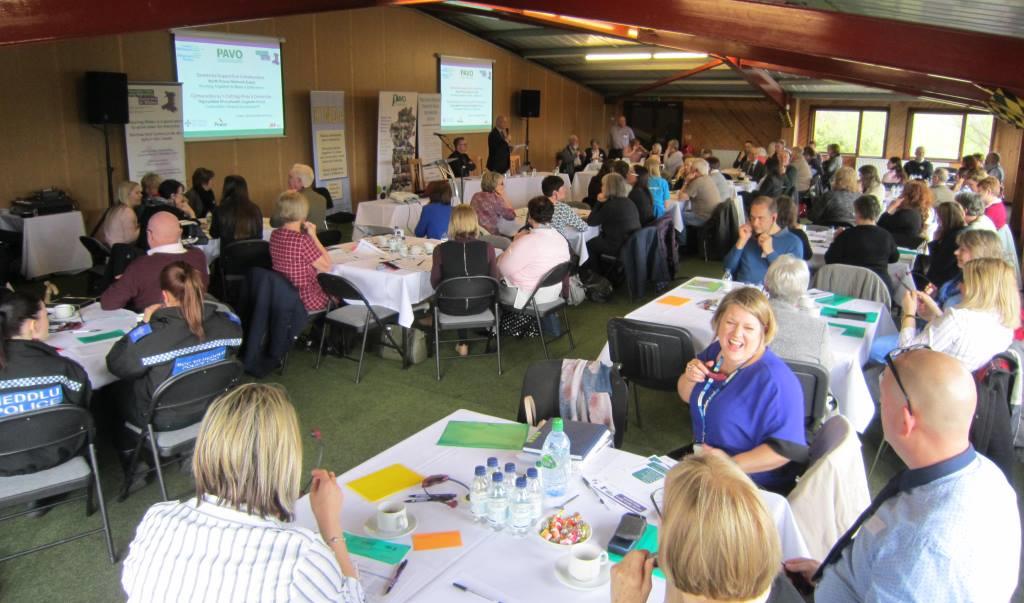
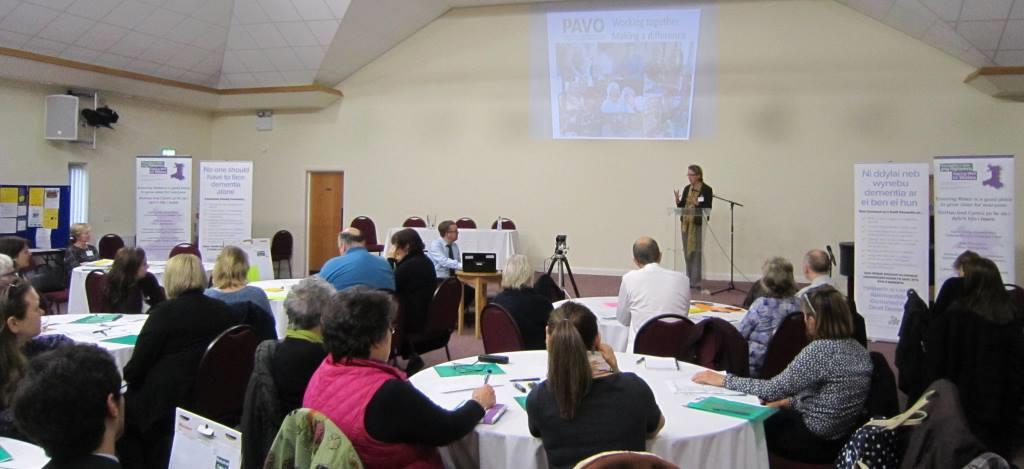
In November last year I attended an excellent Dementia Supportive Communities event in Brecon, South Powys. Last week it was the turn of the North. Thanks to the hard work of Ageing Well in Wales, Alzheimer’s Society, and Powys Association of Voluntary Organisations we had the opportunity to find out more about some truly inspiring initiatives already taking place. And by the end of the day people were asking not just – what has been done already, but what can we, what can I do, to make my bit of Powys a more dementia supportive (or friendly) community? The seed has been sown!

Read on to find out how the day - “Working Together to Make a Difference” - unfolded.


Carl Cooper, Chief Executive Officer at PAVO, set the context for the day, explaining that the new Social Services and Wellbeing (Wales) Act requires us to work with people and communities to address matters that are important to them, and dementia is very much part of that agenda as it touches the lives of so many people. Whilst much is already happening, Carl asked if the voluntary sector could work alongside the public and private sectors in a more effective and efficient way.

Steve Huxton of Ageing Well in Wales, and Carl Cooper, CEO at PAVO
Next up was Councillor Dawn Bailey, the Powys County Council Dementia Champion. Partnership working was also one of Dawn’s key messages. After touching on the history of the Dementia Supportive Community, and the need to treat everyone as an individual with specific needs, she outlined the council’s plans. These include moving to a creative approach, providing more community based services, and ensuring these are the best services possible given the reduced resources available. Dawn said that this will require culture change, both within staff and general populations, where everyone gets involved. What we need is a grassroots approach from the bottom up. The council’s aim for Powys to become a DFC will be formalized in the Dementia Mission statement soon to be adopted.

Councillor Dawn Bailey, PCC Dementia Champion
Steve Huxton, Network Coordinator of Ageing Well in Wales, followed by telling us that 45,000 people in Wales live with dementia and under half have received a formal diagnosis. People of all ages will be affected, directly or indirectly, through the experience of family and friends. He went on to outline what we mean by a Dementia Supportive Community:
  • It listens to people’s needs. 
  • It is patient and understanding. 
  • It engages with businesses and local organisations. 
  • It makes changes with people, rather than providing services for them. 
The concept has benefits to all of us, not just people with dementia, and has blossomed into a social movement throughout Wales.


Karen Rodenburg, Dementia Friendly Communities Coordinator in North Powys,
had literally just started when I attended the event in the South. Since then she has been extremely busy helping to set up DSCs across the North.

Karen explained that through this initiative we can help people to live well in their own homes and play an active role in their communities. Her presentation included local updates, case studies around partnership working, and outlined the mechanics of how to go about taking those first small steps to setting up a DSC in the first place. The roadmap (above) provides a snapshot of some of the key actions a community can then take to “empower people with dementia to have high aspirations, confidence and know they can contribute.”


Heather Wenban, Project Development Officer in Dementia Care at Powys Teaching Health Board then spoke on “Creating dementia friendly hospitals.” She touched on everything from the Butterfly Scheme, to colour and tonal contrast in the physical environment, with references to liaison nurses, specialised training, digital technology and dementia pathways along the way.


Dr Shirley Evans, Senior Research Fellow at the Association for Dementia Studies at the University of Worcester, described a research project on dementia friendly meeting places. The initiative, developed by the University of Amsterdam, brought health, social care and voluntary organisations together to create a community based club in an ordinary life setting. The pilot was so successful that it is now being replicated throughout several European countries, with Droitwich Spa hosting the first club in the UK. A second, more rural example, has just opened in Leominster. It will be particularly interesting to observe how this develops as it could more readily be applied to a Powys setting.


Rhiannon Davies, Co-chair of Brecon Dementia Friendly Community, followed, talking us through the history, starting in 2012, of the first DSC in Wales. The inspirational work that is being carried out in Brecon is now a model to other communities across Wales, as we found out during Dementia Awareness Week 2015. Rhiannon said that the most important thing that they had learnt in Brecon was the importance of action. No matter how inspired or committed people are, it is “how you walk the talk that counts”. She added that BDFC is open to sharing resources and experiences in supporting other DSCs to develop and grow.

Julia Llewellyn Roberts from KINDA with Carla Rosenthal (PAVO Participation Officer, mental health team)
There followed updates from some of the more recently developed DSCs in Powys. Each had its own quite individual origins and story depending particularly on who had initiated that all important “action” that Rhiannon had spoken about.

Julia Llewellyn Roberts – KINDA (Knighton Initiative for Dementia Action)

Julia had been inspired after hearing that Liverpool planned to become a DSC and in 2014 pulled together some key local organisations from which the steering group grew. KINDA now has alliances with the Royal Voluntary Service, Community Support, Men’s Sheds, primary schools and the Carer’s Trust
.


Nic Williams – LOUDA (Llandrindod Opens up to Dementia Awareness)

Nic, who is a Wellbeing Coordinator at Mid Powys Mind, was inspired at one of Rhiannon’s Dementia Friend sessions. She is currently fundraising whilst promoting the concept to cafes and hotels in the town, and has already involved the town council and Vanessa Garwood of Alzheimer’s Society.


Robert Robinson – Dementia Friendly Welshpool

As the Town Council Clerk in Welshpool, Robert was originally approached by Karen Rodenburg to consider how the town might become dementia friendly. In the short-term the new steering group is being chaired by the town council, which also provides support including secretariat, banking account, insurance, a website and use of a building. Karen has provided dementia friendly sessions for all the councilors and many of the staff too.


Councillor Kath Roberts-Jones & Councillor Stephen Hayes, PCC Portfolio Holder Health & Social Care
Workshops followed the presentations, and on our tables we all looked at how we could work to make our own communities more dementia friendly, taking into account potential barriers whilst suggesting areas of help and support. What impressed upon me was the sheer number of links we had just on our table of five people, into the third, statutory and private sectors, and also each of us into our own communities. We all agreed that as a first step it was important that we find out about becoming a Dementia Friend, and encourage colleagues, family and friends to do the same.

Freda Lacey, Senior Officer Health & Social Care at PAVO, also asked us to consider the potential value of a Powys-wide Dementia Forum or Network. There followed a lively discussion about the purpose, membership and location of such a network. No decisions have yet been made, but the feedback has been gathered, and Carl explained that in partnership with Powys County Council, Powys Teaching Health Board and other agencies all the comments will be taken on board. So, watch this space for further updates!

What do you think? Would you like to see a Powys-wide Dementia Network? And how would it work best for you? Are you setting up a Dementia Supportive Community in your area? Let us know in the comments box below.


A dementia sensory box - for stimulating conversation and reminiscing

Small changes help make a dementia friendly community – 
an Alzheimer’s Society video we watched during the day.

The event was supported by Powys Teaching Health Board, 
Powys County Council and the Joseph Rowntree Foundation.

Tuesday, 1 December 2015

Re-Live Theatre @ Dementia Supportive Communities event


Last Thursday I attended a Dementia Supportive Communities network event in Brecon organised by Ageing Well in Wales and Brecon and Hay Dementia Supportive Community with support from Alzheimer's Society, Powys Association of Voluntary Organisations, Powys County Council and Powys teaching Health Board. The event was extremely well-attended, with representatives from the statutory, voluntary and private sectors.

The aim of the event was "to build and develop Dementia Supportive Communities across Powys by:
  • Sharing examples of practical ways to support people with a dementia.
  • Identifying best practice and sources of information.
  • Exploring ways of working together in the future."
It was an absolutely packed day, and all I can do here is focus on some highlights, whilst giving links to further information where appropriate.

The day was introduced by Gweneira Raw-Rees (below left), the Project Lead for Ageing Well in Wales, which has the challenging remit of "ensuring Wales is a good place to grow old for everyone". Gweneira explained that one of AWW's roles is to share good practice through events. "The formula is simple. To try to inspire people to take action."  

Our facilitator for the day was Trish Richardson (below right) of Brecon and Hay Dementia Supportive Community. Trish explained the concept behind dementia friendly communities (interchangeable with dementia supportive communities), emphasising that "it is about enabling people with dementia, working with them as opposed to doing for them."


First up, and certainly the highlight of the day for me, was a performance from Re-Live Theatre Company, working alongside people with dementia. The company is passionate about the role creativity plays in removing stigma, and aims to put the real stories and experiences of people with dementia out there. The short performance was made by two members of the company alongside real people (not actors) sharing their real experiences. These included features around the importance of singing for some, and the humiliation of being bid for as a 68 year old male in "not too bad condition.... not too challenging... no immediate family... if you know what I mean...." Number NL2810 was then sold to the highest bidder for £500 - securing his place at an Elderly Infirm Unit.

And Jill Grey read her powerful poem with support from other members of the group.


They meet in the appointed room.
Laptops, briefcases, suits.
Meet bi-monthly,
Promptly, religiously,
Unless, of course, it's cancelled
And nothing happens.

They bring their minutes
Their memos
Their own agendas,
Protect their kingdoms
Cover their backsides
And nothing happens.


They have a bright idea.
It's brilliant, workable
Inexpensive.
Then it's - 'Maternity Leave',
Or - 'Change of Post'
And nothing happens.

'Care in the Community' means
'Keep them at home'.
Poorly trained care-workers; different each day
With eyes on the clock, pens on the paperwork
And minimum pay.
Promises of improvement
But nothing happens.


A brand new ward! An Assessment Ward!
Retitled - 'Assessment and Continuing Care'.
Queues grow deeper, waiting lists longer.
Does it really matter?
The outcomes are the same.
So nothing happens.

They close a ward; its soul has flown.
A dementia ward now filled with ghosts.
In general wards they cannot sleep.
"Those damned dementia patients!
Why can't they just shut up!"
But nothing happens.

Tories blame the Socialists.
Socialists the Tories.
Lib Dem, UKIP, Plaid add their two-penneth too.
Oh where is the one who can wield Excaliber or hold aloft good Merlin's Wand?
A bold magician who would override us all
And make it happen!

L-R: Gloria Jones Powell (Chair, PAVO Board), Joy Garfitt (Head of Adult Social Care, PCC),
Rhiannon Jones (Executive Director of Nursing, PtHB)
How to follow that? Well, that was the task of the next three speakers. They all made comprehensive presentations from their individual organisations' perspectives about work being done to encourage dementia supportive activities across Powys. All three acknowledged that there is still a lot to be done, but the ambition is clearly there. Again, I can only give a flavour here due to lack of space, but there is a link to the presentations at the end of the post.

Rhiannon Jones, Executive Director of Nursing, Powys teaching Health Board
Rhiannon clarified that dementia currently falls into the mental health strategy for Powys - Hearts & Minds. Her role as Chair of the steering group overseeing the Joint Dementia Action Plan is to work more with people in contact with services, and the community, to get it right.

Joy Garfitt, Head of Adult Social Care, Powys County Council
Joy spoke of the journey currently being travelled to make the council a person-centred organisation. "It is about support, not necessarily services. It is not about fitting people into a box." She explained that from April 2016 the new Social Services & Wellbeing (Wales) Act will change everything.

Gloria Jones Powell, Chair of Trustees, Powys Association of Voluntary Organisations
After introducing the audience to PAVO's general role in supporting the Third Sector, Gloria highlighted three very relevant services - Powys Befrienders and the Third Sector Brokers are hosted by PAVO, whilst the new role for Powys of a Dementia Supportive Communities Coordinator is managed by Alzheimer's Society.


In one of the breaks I managed to catch up briefly with Karen Rodenburg (above), who has recently taken on this role. Karen is based in Newtown and covers Montgomeryshire & Radnorshire. Her colleague in South Powys is Ian Thomas, who is based in Talgarth.


A couple of really interesting workshops later ("Experiencing dementia - how does it feel?" with Re-Live Theatre Company, and "Setting up voluntary and community-led dementia friendly initiatives" with Brecon & Hay Dementia Supportive Community) and it was time to hear PtHB's Dementia Lead - Harold Proctor - speak.

After a little bit of history relating to person-centred care, Harold described how practically we can help people with dementia who are in a hospital environment. He touched on everything from the Butterfly Scheme, to colour and tonal contrast in the physical environment, with references to liaison nurses, specialised training, digital technology and dementia pathways along the way.


Rachael Beech, PAVO's Powys Befrienders' Coordinator, was the final keynote speaker of the day. Her topic: Establishing a Powys Dementia Network. She put into words what I had been thinking increasingly throughout the day - there is a lot going on around dementia in Powys. How do we pull it all together? Care homes. Memory clinics. Singing groups. Hospitals. Memory cafes. Carers' respite. Neighbours' support.... Who is doing what, where and when? PAVO has already started work on a mapping and gapping project, and now proposes initiating a dementia alliance, forum or network - Rachael asked people to suggest names. She also posed the questions - who would be invited? How often would it meet? Would a virtual network be an option?

The new network could be facilitated by PAVO, and would be aimed at people using services and their carers in the first instance. The idea is to launch it next April after further dementia events have been held and information gathered. What do you think? Would you find a dementia network useful? Have you got a good idea for a name? Let us know in the comments section below.

All told everyone seemed to find this dementia networking event extremely valuable. A similar event is planned in North Powys for the New Year. Watch this space for further updates. Here's hoping they manage to book Re-Live Theatre Company for another inspiring session.
_________

Dementia Supportive Community Coordinators in Powys
Montgomeryshire & Radnorshire: 
Karen Rodenburg, email: karen.rodenburg@alzheimers.org.uk
South Powys: 
Ian Thomas, email: ian.thomas@alzheimers.org.uk

Presentations from the day can be found on the Powys Mental Health website 
under the Powys Mental Health dementia blog section.

Jill Grey has written a book which is available online - 
After the Rehearsal - Living with Dementia, a Carer's Story

Tuesday, 19 May 2015

Dementia Awareness Week 2015


Last week I attended an event in Llandrindod Wells organised by my colleague Jane Cooke to update the Wellness & Recovery Learning Centres (the Mind centres and Ponthafren) about dementia services in Powys. As this week is Dementia Awareness Week it seemed appropriate to share some of the information, so here is what I found out (in brief, but check out the links) from some of the people speaking at the event.


Rhiannon Davies – Brecon Dementia Friendly Community

Rhiannon gave up her full-time job to set up Brecon Dementia Friendly Community as a volunteer two years ago – and the inspirational work that is being carried out in Brecon is now a model to other communities across Wales.

She explained that a dementia friendly community (DFC) is a community that has a high level of understanding and awareness of dementia and the issues that it brings to people living with the disease. “Most people with dementia just want to get on with as normal a life as possible. They don’t want to be boxed. It is about having independence and choice, and just getting on with everyday activities such as going shopping, attending clubs and being part of the community like everyone else”.

Rhiannon is passionate about giving a voice to people with dementia – “in the past things were done for people to fit in with our systems. We need to create services that people actually want and need.” She has held numerous Dementia Friends sessions for groups and organisations in which she informs, inspires and engages those living in the local area. These help break down the stigma and fear still attached to the disease. Becoming a DFC is about commitment to social change – what is good for people with dementia – “being caring, compassionate, patient and understanding – is also good for the community as a whole.”


Jacky Baldini – Alzheimer’s Society

Jacky is the Operations Manager for North Wales – a massive patch stretching all the way from Holyhead to Brecon. Alzheimer’s provides support to people with dementia and their carers – information provision is a large part of their work, and the charity has a very useful website. (North Powys and South Powys pages).

There are Dementia Support Workers in Newtown and Talgarth – helping people and those close to them to understand their diagnosis. A Project Information Officer was recruited with Welsh Government funding late last year to further develop DFCs across the county.

Alzheimer's also has advocates (currently there is a vacancy in Newtown) who will support people with dementia to say what they want, secure their rights and obtain the services they need.


Harold Proctor – Powys teaching Health Board

Harold is the Dementia Lead at PtHB, and gave us an overview of NHS dementia services in the county, including the following areas:
  • Community hospitals operate the Butterfly Scheme which reaches out to people with dementia.
  • Caring well in Care Homes – where the use of antipsychotics is being reduced. Staff are trained to look at alternative techniques if faced with challenging behaviour.
  • Memory Assessment Services across Powys.
  • Specialist services in Community Mental Health Teams (CMHTs).
  • In-patient assessment units (we wrote about Newtown’s Fan Gorau here).
  • Commissioning of complementary services, for example: Memory Cafes and Clinics, CrISP (Carer Information & Support Programme) training, information signposting and the Wellness & Learning Recovery Centres. 
Harold said that a rainbow of services was required as people need different things at different times. There is also a requirement from Welsh Government that 50% of front-line staff are trained in dementia awareness in the next year.


Rachael Beech – Powys Befrienders


Rachael is another of my PAVO colleagues. She is the co-ordinator of the Powys Befrienders project to improve the independence of people over 50, to maintain their social networks and remain in their own homes for as long as they are able. Some of the project’s clients have dementia, and can be lonely and/or isolated. More detail about the project is coming up in a separate blog post soon - watch this space!

Jacky updates everyone on the Alzheimer's Society's work in Powys
I want to finish off with a story Rhiannon told me recently – it was passed on to her by someone who had just attended one of her Dementia Friends’ sessions.

“We were driving back to Brecon at about 9.45pm in the pitch dark when we saw in the headlights an elderly woman on the verge. She seemed to be just standing there, looking a bit unsteady. Cars were swerving to avoid her as the verge was narrow and she was stumbling a bit. I went to talk to her – I wasn’t sure if her car had broken down further up the road or if she was a tramp or had maybe been drinking. Anyway, it quickly became obvious that she was very confused – she told me she was staying in a holiday chalet and that someone was coming in and stealing her things so she just had to get out. She’d been walking all day but couldn’t remember where she started or where she was heading. She said all the bright lights (car headlights) on the road were confusing her. She was peeling a satsuma while she was wandering.

She had a bag of photos that she was happy for me to look at – I was hoping to find something that might give a clue as to where she had come from. We persuaded her to get into the car as it was so dangerous, and took her to Brecon police station. They were very good and took her inside and took our details down. When she was in the car she said that the woman who was stealing from her was sending in her little dog to take things and also pulling her belongings out on wires. It was obvious that she had dementia of some sort. The police said that they thought she couldn’t have come far as they’d have had reports of her either missing, or from drivers telling them that she was on the road. They were really grateful we’d brought her in – the young PC kept saying what a terrible call it would have been if she’d been knocked over.

So, I just wanted to tell you how valuable the awareness session was – perhaps if I hadn’t attended it I wouldn’t have thought to stop for her – and if I had, maybe I wouldn’t have realised what she was suffering from. I also think that I might have struggled to persuade her to get into the car if I hadn’t remembered the ‘distraction’ advice you’d given and to keep her talking and pleasantly distracted while we were driving there.

Anyway, if you ever have any doubts about the value of the Dementia Friends sessions, I hope this helps you realise the excellent work you’re doing, we felt we did the best thing we could under the circumstances and got her somewhere safe.”

A celebratory concert is being held in Brecon on Saturday May 23 to celebrate Brecon being officially recognised by the Alzheimer's Society as 'working towards becoming dementia-friendly' – the first community in Wales to achieve this accolade. You can find out about more events taking place across Powys during Dementia Awareness Week on our website.

Small changes help make a dementia friendly community – an Alzheimer’s Society video.