Tuesday, 31 May 2016

Stepping Stones @ Brecon & District Mind


This week's guest blog post is from the team leading on an innovative new project at Brecon & District Mind. Neil Hurst is the Project Officer, and Clare Searle the Project Administrator.

First they tell us all about the Stepping Stones Project, and then we find out more about them and why they decided to get involved with this work. So, over to Neil and Clare.

Brecon and District Mind has received funding from the People's Health Trust to run a project called Stepping Stones.

What is Stepping Stones you may ask, well the project offers a pathway of activities aimed at assisting people to overcome their barriers to employment and, as part of that pathway, the support to stay in employment moving forward. Or you may already be in employment and need a little external support. This project is open to the wider community as well as Mind members. We offer group training sessions to include; team building, CV writing, interview skills, and confidence building. We are always open to other training initiative ideas that you may have. In addition, there are also 1:1 sessions that are held on an individual basis in a confidential setting.

Why not come along to one of our informal and friendly sessions in Brecon, Crickhowell and Hay-on-Wye and see what support we can offer? Dates are posted on the Brecon & District Mind Facebook page and on flyers dotted around.


What brought you to this job?

Neil… Having worked for the past five years for Communities 1st within Blaenau Gwent running social enterprises focusing on employment and training for 16 – 30 year olds, I found myself transferring my employment to one of the enterprises on a reduced hours contract. This led me to make a conscious choice to find additional work – and gave me the opportunity to look at options closer to home in Brecon. The Stepping Stones project post was an excellent opportunity to undertake some really meaningful employment back in the communities I now call home and in a field which I enjoy working in.

Clare… Having moved from Exeter, Devon to Wales during which I had a career break for 3 years to be an almost stay at home mummy, I was looking for a part time role to get me back into work. The Stepping Stones project jumped out at me as the perfect job to do this.

Being from Kent, Neil considers Clare to be a ‘southern Softie’, and whilst Neil is from Yorkshire he seems to have lost his flat cap and whippet.

What were you doing previously?


Neil… The previous five years to this, and still on-going three days a week, I run initiatives in Blaenau Gwent offering volunteering, paid work tasters, paid transitional employment and apprenticeships for 16 – 30 year olds at the most extreme margins of society. Prior to that I ran other social enterprise initiatives including for the Prince’s Trust and in my deepest darkest past I was an accountant and logistics manager in the private sector working for Senior Engineering.

Clare… Since leaving school some !!!!!! years ago! I have worked in Secretarial / Project Assistant roles, mainly in London and then more recently in Exeter, Devon. Always varied roles from making the coffee and walking it down the road to an outsourced meeting room (I kid you not!) to organising large charity events.

Neil has honed his skills over 25 years and has almost attained the skills to make a decent cup of tea, whilst Clare has passed this role from her previous jobs on to Neil.

What is it about this work that enthuses and inspires you? Why is it really important?

Neil… I was inspired to apply for the Stepping Stones Co-ordinator role as I could see the real impact the project has in a small community like Brecon and our surrounding outreach centres. Whilst we are running a project that has set targets and goals – I am more enthused by the impact the project has in terms of people’s lives and the journey that the project can take people on. Fortunately the project goals allow me to maintain that enthusiasm through people’s personal stories and challenges.

Clare… The Stepping Stones project is such an amazing project to be involved in. Mental health is not an illness that is often discussed and many do not know how to approach this illness, particularly with regards to employment, so how great is it to have this facility to provide instant support and the tools needed to help you to find and get back into work. The project is also there to provide support during employment.

Two months in and we are beginning to see the impact of the project on people’s lives… We already have our Brecon and Crickhowell sessions running with Hay starting in early June.

What do you like to do in your spare time?

Neil… Spare time seems like a luxury at the moment, especially at this time of year with so much to do around the garden. I volunteer and am on the Board of Smart Money Cymru (Credit Union) and until last year was a member of the Mid Wales area committee for the Co-operative Group. Leisure again seems like a real luxury sometimes but until recently I was a keen footballer. However the years have crept up on my decrepit body and I have been forced to play golf whenever I can in Cradoc – well I turn up and drive the buggy anyway which is a real source of amusement to my colleague Clare.

Clare… Spare time, what spare time!!! Having a 3 year old doesn’t leave me much spare time, but I do love to paint and walk the dog, we are so blessed to live in such a beautiful area.


To book an appointment with us, or let us know you are coming, call the Mind office on 01874 611529 and ask for the Stepping Stones team, or email clare@breconmind.org.uk 

If we are not in the office we will get back to you as soon as possible. We look forward to hearing from you.


Monday, 23 May 2016

The Art of Health in Wales

Artwork by Susie Freeman 

Earlier this month I attended a symposium at Celf O Gwmpas (setting for our team’s recent comedy workshop) which explored policy and practice in arts and health. 
The aim of the day was “to move the Arts Health & Wellbeing sector forward and explore opportunities for advocacy, collaboration and networking”. One of the highlights of the event for me was a showcase describing innovative practice already happening across Wales. 

In our team we have previously worked very successfully on projects incorporating art when collaborating with people in contact with mental health services, most notably the DIY Futures Project, resulting in the book it’s the inside that matters. So, Jane and I were very keen to find out about a potential national network which encouraged further collaborative work between the art and health sectors.

In brief, here's how the day panned out...


Our facilitators for the day (photo below) were Angie Rogers, Development Coordinator at engage Cymru and Prue Thimbleby, Arts in Health Coordinator at Abertawe Bro Morgannwg Health Board. 


Engage originally carried out some pilot projects in North Wales a couple of years ago, and with funding from the Arts Council of Wales “Sharing Together” pot were able to set up the All Wales Arts Health & Wellbeing Network. This network has “now attracted over 30 members from across Wales representing arts organisations, health boards, academics and artists”. Prue said that whilst recognising we have regional diversity it was important to ensure that the Network’s voice is heard at a high level.


Tim Joss, Founder and Chief Executive of Aesop (Arts Enterprise with a Social Purpose) and Co-Founder of the Arts Impact Fund

Social and cultural entrepreneur Tim set the scene for the day, sketching the bigger picture of where health and the arts meet with an image of Barbara Hepworth’s hospital art as a backdrop. Using case studies from England and Africa he explored the widespread benefits of using various art practices to disseminate health messages and also change patients’ lives for the better.

The Raw Sounds project in South London provides recording studio sessions for young people accessing mental health services, and was praised for “reaching the person rather than the illness.” And financially savings could be measured at about £500 per night – the cost of a mental health bed in the area. Nevertheless, despite the evidence provided by such obvious successes, Tim had struggled for 40 years trying to bring art into the public health service, often due to the attitudes of some working in the health sector.

There followed a series of short presentations showcasing the examples of good practice from across Wales.


Dementia & Imagination: Dr Teri Howson & Dr Catrin Hedd, Bangor University

This research project looked at arts groups set up for people with dementia and their carers in communities, in care homes and in hospitals in different parts of the UK. The partnership working element was found to be key to their success (partners included major contemporary art galleries such as The Baltic on Tyne & Wear). And innovation was also vital – two cartoon characters, Doris and Ivor, were spotted on Bangor Pier telling passers-by what the arts can do for them.

“People always say they can’t do art, but they very quickly get absorbed and forget they said that.” The hope now is that health commissioners will recognise the value of art to people with dementia and continue to provide the groups through mainstream services.


Caban Sgriblio: Arts Alive Wales – Justine Wheatley

Llandrindod Wells High School provided the focus for this project, which aimed to improve the resilience, confidence and wellbeing of those children taking part through creative writing and film.

Emma Beynon ran the sessions where children played with writing and then spoke to camera with original poetry and free writing. “I love seeing pupils synthesizing the world in their own terms…. It is the most exciting thing I do.”


Live Music Now: A Choir in Every Care Home – Douglas Noble

Thirty organisations from divergent perspectives including adult social care were brought together for this project’s working group. The aim was to explore how music and singing can feature regularly in care homes across the country. Research has already shown singing to be beneficial for psychological and social wellbeing, and part of what makes us feel connected to our community.

In England an online toolkit is now available to share the learning and best practice already captured. And at the other end of the generational scale children now participate in Sing Up – a drive to bring singing into all primary schools.


Betsi Cadwaladr University Health Board: Creative Well – Andrea Davies

Andrea presented the BCUHB Arts in Health & Wellbeing Programme, which focuses on five key areas: 1. Working with older people and chronic conditions, 2. Improving mental health and wellbeing for all ages, 3. Transforming healthcare environments, 4. Integrating the arts into education, training, professional development and staff wellbeing, and 5. Capitalising on creative therapists' and artists' abilities to act as catalysts for innovation. She described a vast range of arts activities which had been pursued. The work started with putting artists in hospitals. The challenge was to convey the benefits across such a huge health board area (all of North Wales).

We found out about the staff choir, the painted hoardings around Glan Clwyd Hospital during its redevelopment, the artist residency at Llangollen Health Centre, and the creation of an arts studio on a mental health hospital ward. “I was known as the person who can get teenagers out of bed!” Andrea said. There is now a pathway through to community arts projects once a patient has been discharged.

Andrea’s top tip: “It is really important to plan with staff. Get the right people together to shape and tailor a project”.


Your Medicine, Your Health – Alison Warner, Cwm Taf University Health Board & Nancy Evans

Bring together Alison – who works in Medicines Management, and Nancy – a freelance artist and here we had the perfect combination to deliver a public health message to a wider audience. Nancy worked with school children to design colourful posters to educate people about correct medicine use and disposal. Additional benefits included the increased sense of achievement and pride of the children involved, particularly as the artwork is due to be exhibited this June at the Pierhead Gallery in Cardiff.

As a legacy for the project a teaching pack is now being developed so that others can deliver the exercise which has already been picked up in many more schools across South Wales.


Jane Cooke from our team catching up with Fiona Edwards, Property Manager, Arts in Health, Abertawe Bro Morgannwg Health Board. After lunch we welcomed the next keynote speaker.


Professor John Wyn Owen, Chair Health Protection Committee, Welsh Government & Council Member of Health Action Partnership International

John’s career achievements across the public, private and charity sectors both in the UK and internationally could fill an entire separate blog post. In 1985 he was the first Director of the NHS in Wales, and has championed the value of meaningfully connecting with the arts in health care provision throughout.

Some of John’s proposals to encourage a cultural shift where people matter more than structures, and where art is at the heart of healthcare planning, included:

  • Pushing to include the humanities in the medical curriculum.
  • A programme for health leaders and executives along the lines of American models.
  • Engaging with key figures in the new Welsh Government and Public Health Wales.
  • Building on the statutory obligations of the Wellbeing of Future Generations Act.
  • Working more closely with the Welsh universities.


Sally Lewis, Portfolio Manager (Education & Participation) Arts Council of Wales

Sally updated the Network members about a recent inquiry into arts and health as part of the All Party Parliamentary Group at the House of Lords. The purpose of the inquiry is to:

  • To inform a vision to support practitioners, to stimulate progress and to influence decision makers.
  • To raise awareness of the arts in health and wellbeing with MPs and the health profession.
  • Supporting academics in the field.
The final report will be launched in 2017. Sally said that it is important, meanwhile, to establish the value of the arts-related work in health by sharing the growing evidence base from Wales and further afield. The Wellbeing of Future Generations Act will be a major driver in the future, which led us nicely into the final presentation for the day.


Rhodri Thomas, Cynnal Cymru Sustain Wales – Introduction to the Wellbeing of Future Generations (Wales) Act 2015

Rhodri started by saying that “art is part of the fabric of everyday life.” In the Stone Age people lived their life in balance with nature. “We want to keep what we have but do it in a more mindful way.” For more information on the Act his recommended reading is the Essentials guide.

In brief the Act is about improving the social, economic, environmental and cultural wellbeing of Wales. The challenges of poverty, the global economy, an ageing population, health inequalities, climate change, pressures on natural resources and a rising demand for quality public services, mean that things will have to be done very differently in future. But collaboration is key.

44 public bodies across Wales now have to pursue the 7 wellbeing goals in the Act which could potentially change Wales. One of these is: “A Wales of vibrant culture and thriving Welsh language,” whilst another is “A healthier Wales.” Rhodri acknowledged that it is a massive challenge.

We rounded off the day with workshops looking at ideas to sustain and grow the arts and health sector in Wales. Perhaps the most refreshing part of the whole experience was the creative approach brought to the table by representatives from so many different sectors, the arts – practitioners and administrators, academics and the voluntary sector. Jane and I look forward to watching the next steps as the Network grows and develops.


To find out more, or to join the All Wales Arts Health & Wellbeing Network, contact Angela Rogers by emailing cymru@engage.org

Use the comments box below to tell us more about your experiences as an artist, art organisation, health board employee or someone in contact with health services, who has experience of a collaborative approach in arts and health.

Wednesday, 11 May 2016

Linda's experience since being diagnosed with dementia

There is a bit of a dementia theme on the blog at the moment which works well as Dementia Awareness Week starts in just a few days.

Last week I wrote about the Dementia Supportive Communities Event in the North, and this week we focus on young-onset dementia with a look at the South of the county.  

Bethan Morris, who is a Dementia Support Worker with Alzheimer's Society for Gwent and South Powys, recently contacted our Information Service to find out more about activities in the county. 

As a result she was able to put me in touch with Linda, who was diagnosed with young-onset dementia, dementia which affects people under the age of 65. Linda kindly agreed to tell us about her diagnosis, and what has happened since.

I knew I had problems with my memory whilst I was at work and didn’t think much about it and used to say I am having a "dementia day" and could someone help me? Little did I know that I was suffering from dementia. I did ask my doctor on several occasions about my memory loss and was told it was my age - it's normal as people get older, or I was depressed and given anti-depression tablets. 

It wasn’t until I saw a different doctor after I had retired from work at the age of 60 that they thought there was a problem with my speech and memory and I was given a memory test. From there I was referred to a memory clinic at the hospital. I was given a memory test at the hospital and then saw the consultant and was told I had a form of Alzheimer’s but he would like a second opinion. I went home and looked at the diagnosis on the internet and felt the diagnosis wasn’t me as I did not fit the criteria. After a MRI scan I was given the second diagnosis of vascular dementia.

At the first visit the consultant asked me if he could inform the Alzheimer’s Society to come and visit me and to give me advice and information and describe the way they could help me. 
I was visited by Anne from the Society who talked about what the Alzheimer’s Society could offer me and the help that was on offer, she also told me about all the activities the Society provided like a singing group, art group and a monthly memory cafe. At that time I did not want to speak to anybody about my illness as I couldn’t think quick enough to answer questions and I didn’t want to feel silly or be judged, and anyway I couldn’t sing or draw. But after time I felt like I would like to go along to a memory cafe to see what it was like. The first time I was extremely nervous and frightened but I was made to feel very welcomed and from here the Society has changed my life for the better.

From the memory cafe I made friends and was asked to join the singing group. I said no I couldn’t sing but was told that didn’t matter as it was fun and I would enjoy it so I said I will give it one go and if I didn’t like it I wouldn’t go again. After going for the first time I am still going and we have just had our fifth anniversary. I love it. Our choir mistress is extremely funny and we have a marvellous time and come away feeling uplifted. We now have gigs all over Wales and have even sung at the Millennium Centre. I was also asked to join the art group, my art has really improved, I am unable to copy other work as I have a very shaky hand but I do my own thing and love it. Mine is more modern art but it doesn’t matter if you cannot draw as there are always ways around it.

I now sit on a Service User Review Panel, we either overview a new/old document or have a live speaker who would like our opinion on new projects etc. Age Cymru has been commissioned to ask people across Wales about their experience of living with dementia and wanted our views. We have been asked how they could improve the Memory Walk etc.

About five years ago there was a forum for Younger People Living with Dementia and we were asked what we wanted from the community. The joint opinion was that we wanted our own permanent unit for people living with dementia. Somebody on the panel asked ‘Was this just a paper exercise’.

About two years later, however, this idea became reality because the Seren group took on the project in Blackwood and they asked the SURP if we wanted to be involved once the plans had been drawn up. We sat every month to discuss how the project was coming on, we chose all the interior, even the name of the unit. There is an outbuilding we called the ‘CWTCH’ where meetings could be held, we could have parties, our own kitchen to make drinks and even a hairdressers and a chiropodist room. We named the building ‘Cwmgelli Lodge’, this is now opened and we have our SURP meeting there and there are now permanent residents living there.

Having dementia changes your life and sometimes it is difficult but the Alzheimer’s Society helped me to change it for the better. I have become more confident, have a feeling of self worth being able to change people’s perception of dementia, I can emphathise with others, listen to others and offer my support and encouragement.

I attend the monthly memory cafe, singing group, art groups, SURPS' meeting, attend interviews, talk at workshops and conferences, and became an Ambassador for the Alzheimer’s Society. My husband attends a carers' meeting group to discuss any issues and sometimes there are speakers - at least he has a point of contact should it be required.

I now have a befriender Chris and she takes me out every week for two hours. I am always asked where I would like to go, sometimes we go on girlie shopping trips, or go for walks to the wetlands, parks or reservoir, to museums or just go to places of interest but we always end up for a coffee and a chat and this gives my husband time for himself.

I have learned to change small things for the better to improve my life. I make lots of sticky notes and place them around the home to remind me of things I might have forgotten like my purse, my phone, my keys etc. I make lists for when I go shopping and I have a note to remind me ‘have I got my list’. We have changed the cooker to an induction cooker so that it will switch itself off if something is burning, my iron turns itself off if not being used, my shower is set at a certain temperature so I only have to turn one handle, my calendar has become like a bible to me as I write everything on it so I know what it going on every day, and I keep a notepad and pen in my bag so that I can write information down as I normally forget dates.

I am an Ambassador for the Society because I like to help others and I like to give back to the Society as they have given me a quality of life that I thought I would never have.

I look forward and not back, concentrate on the things I can do and forget about the things I cannot do, try new things and if I don’t enjoy it I don’t do it again and can say I have given it a go but it isn’t for me.

You can live well with dementia.


Many thanks to Linda for telling us her story.

The Alzheimer's Society office for Young People with Dementia where Bethan Morris is based is in Pontypool. Staff provide information on all aspects of dementia, including support on caring for a person with dementia and providing emotional support to Younger People with Dementia (YPwD) and their family members. A Younger Person with Dementia is someone diagnosed at the age of 65 and under. This service is available across Gwent and South Powys. Also available: one to one support service for younger people with dementia, offering social support within the community. Home visits can be arranged, please contact Bethan Morris by ringing 01495 768744 or email: bethan.morris@alzheimers.org.uk

Dementia Awareness Week is from 15 - 21 May 2016. Brecon Dementia Friendly Community has organised a number of additional events to coincide with the week, you can find out more here. If you know of any other events or activities then do let us know in the comments section below.

Thursday, 5 May 2016

Dementia Supportive Communities event - the North

Karen Rodenburg, Dementia Friendly Communities Coordinator, North Powys
In November last year I attended an excellent Dementia Supportive Communities event in Brecon, South Powys. Last week it was the turn of the North. Thanks to the hard work of Ageing Well in Wales, Alzheimer’s Society, and Powys Association of Voluntary Organisations we had the opportunity to find out more about some truly inspiring initiatives already taking place. And by the end of the day people were asking not just – what has been done already, but what can we, what can I do, to make my bit of Powys a more dementia supportive (or friendly) community? The seed has been sown!

Read on to find out how the day - “Working Together to Make a Difference” - unfolded.


Carl Cooper, Chief Executive Officer at PAVO, set the context for the day, explaining that the new Social Services and Wellbeing (Wales) Act requires us to work with people and communities to address matters that are important to them, and dementia is very much part of that agenda as it touches the lives of so many people. Whilst much is already happening, Carl asked if the voluntary sector could work alongside the public and private sectors in a more effective and efficient way.

Steve Huxton of Ageing Well in Wales, and Carl Cooper, CEO at PAVO
Next up was Councillor Dawn Bailey, the Powys County Council Dementia Champion. Partnership working was also one of Dawn’s key messages. After touching on the history of the Dementia Supportive Community, and the need to treat everyone as an individual with specific needs, she outlined the council’s plans. These include moving to a creative approach, providing more community based services, and ensuring these are the best services possible given the reduced resources available. Dawn said that this will require culture change, both within staff and general populations, where everyone gets involved. What we need is a grassroots approach from the bottom up. The council’s aim for Powys to become a DFC will be formalized in the Dementia Mission statement soon to be adopted.

Councillor Dawn Bailey, PCC Dementia Champion
Steve Huxton, Network Coordinator of Ageing Well in Wales, followed by telling us that 45,000 people in Wales live with dementia and under half have received a formal diagnosis. People of all ages will be affected, directly or indirectly, through the experience of family and friends. He went on to outline what we mean by a Dementia Supportive Community:
  • It listens to people’s needs. 
  • It is patient and understanding. 
  • It engages with businesses and local organisations. 
  • It makes changes with people, rather than providing services for them. 
The concept has benefits to all of us, not just people with dementia, and has blossomed into a social movement throughout Wales.


Karen Rodenburg, Dementia Friendly Communities Coordinator in North Powys,
had literally just started when I attended the event in the South. Since then she has been extremely busy helping to set up DSCs across the North.

Karen explained that through this initiative we can help people to live well in their own homes and play an active role in their communities. Her presentation included local updates, case studies around partnership working, and outlined the mechanics of how to go about taking those first small steps to setting up a DSC in the first place. The roadmap (above) provides a snapshot of some of the key actions a community can then take to “empower people with dementia to have high aspirations, confidence and know they can contribute.”


Heather Wenban, Project Development Officer in Dementia Care at Powys Teaching Health Board then spoke on “Creating dementia friendly hospitals.” She touched on everything from the Butterfly Scheme, to colour and tonal contrast in the physical environment, with references to liaison nurses, specialised training, digital technology and dementia pathways along the way.


Dr Shirley Evans, Senior Research Fellow at the Association for Dementia Studies at the University of Worcester, described a research project on dementia friendly meeting places. The initiative, developed by the University of Amsterdam, brought health, social care and voluntary organisations together to create a community based club in an ordinary life setting. The pilot was so successful that it is now being replicated throughout several European countries, with Droitwich Spa hosting the first club in the UK. A second, more rural example, has just opened in Leominster. It will be particularly interesting to observe how this develops as it could more readily be applied to a Powys setting.


Rhiannon Davies, Co-chair of Brecon Dementia Friendly Community, followed, talking us through the history, starting in 2012, of the first DSC in Wales. The inspirational work that is being carried out in Brecon is now a model to other communities across Wales, as we found out during Dementia Awareness Week 2015. Rhiannon said that the most important thing that they had learnt in Brecon was the importance of action. No matter how inspired or committed people are, it is “how you walk the talk that counts”. She added that BDFC is open to sharing resources and experiences in supporting other DSCs to develop and grow.

Julia Llewellyn Roberts from KINDA with Carla Rosenthal (PAVO Participation Officer, mental health team)
There followed updates from some of the more recently developed DSCs in Powys. Each had its own quite individual origins and story depending particularly on who had initiated that all important “action” that Rhiannon had spoken about.

Julia Llewellyn Roberts – KINDA (Knighton Initiative for Dementia Action)

Julia had been inspired after hearing that Liverpool planned to become a DSC and in 2014 pulled together some key local organisations from which the steering group grew. KINDA now has alliances with the Royal Voluntary Service, Community Support, Men’s Sheds, primary schools and the Carer’s Trust
.


Nic Williams – LOUDA (Llandrindod Opens up to Dementia Awareness)

Nic, who is a Wellbeing Coordinator at Mid Powys Mind, was inspired at one of Rhiannon’s Dementia Friend sessions. She is currently fundraising whilst promoting the concept to cafes and hotels in the town, and has already involved the town council and Vanessa Garwood of Alzheimer’s Society.


Robert Robinson – Dementia Friendly Welshpool

As the Town Council Clerk in Welshpool, Robert was originally approached by Karen Rodenburg to consider how the town might become dementia friendly. In the short-term the new steering group is being chaired by the town council, which also provides support including secretariat, banking account, insurance, a website and use of a building. Karen has provided dementia friendly sessions for all the councilors and many of the staff too.


Councillor Kath Roberts-Jones & Councillor Stephen Hayes, PCC Portfolio Holder Health & Social Care
Workshops followed the presentations, and on our tables we all looked at how we could work to make our own communities more dementia friendly, taking into account potential barriers whilst suggesting areas of help and support. What impressed upon me was the sheer number of links we had just on our table of five people, into the third, statutory and private sectors, and also each of us into our own communities. We all agreed that as a first step it was important that we find out about becoming a Dementia Friend, and encourage colleagues, family and friends to do the same.

Freda Lacey, Senior Officer Health & Social Care at PAVO, also asked us to consider the potential value of a Powys-wide Dementia Forum or Network. There followed a lively discussion about the purpose, membership and location of such a network. No decisions have yet been made, but the feedback has been gathered, and Carl explained that in partnership with Powys County Council, Powys Teaching Health Board and other agencies all the comments will be taken on board. So, watch this space for further updates!

What do you think? Would you like to see a Powys-wide Dementia Network? And how would it work best for you? Are you setting up a Dementia Supportive Community in your area? Let us know in the comments box below.


A dementia sensory box - for stimulating conversation and reminiscing

Small changes help make a dementia friendly community – 
an Alzheimer’s Society video we watched during the day.

The event was supported by Powys Teaching Health Board, 
Powys County Council and the Joseph Rowntree Foundation.

Monday, 25 April 2016

The latest on MasterMind - computerised CBT in Powys

Powys Teaching Health Board staff at a MasterMind seminar in Odense, Denmark in October 2015.
Front row far right: Dr Wasi Mohamad, PTHB Clinical Director & Consultant Psychiatrist who is the Clinical Lead for MasterMind; next to him: Becka Williams Project Administration Assistant. Back row second from right: Harold Proctor Dementia Lead for PTHB and the MasterMind Project Executive.
Back in August 2014 our friends at Powys Teaching Health Board wrote on Introducing MasterMind - computerised CBT in Powys. 

The MasterMind project is currently being piloted across Europe, including Powys. Some individuals with a diagnosis of low to moderate depression have been able to access the computerised Cognitive Behavioural Therapy course in their own homes. We decided now was a good time for an update and Becka Williams, who works with the team overseeing this project, gives us the latest news.


MasterMind – where are we?

We have just begun the final year of the MasterMind project with the project due close in February 2017.

We went ‘live’ with the online CBT programme in March 2015 and have had 216 referrals since. We have implemented this service into the Local Primary Mental Health Support Service teams (LPMHSS), Pain Management and Occupational Health and in recent weeks have started engaging with the GP practices in Powys to encourage GP direct referrals.

A bit about the programme…

Powys staff opted for Beating the Blues as their software of choice which was developed by our service provider Ultrasis with ownership transferring to 365 Health & Wellbeing.

What does Beating the Blues consist of?

Beating the Blues consists of eight, approximately 1-2 hour sessions recommended to be completed weekly. The programme is interactive. During sessions you can watch video clips, complete exercises and learn CBT techniques that can help with depression and anxiety. Each week tasks will be given to be completed during the time between sessions.

How will it help?

Beating the Blues will help to pinpoint and change unhelpful ways of thinking that can affect how you feel, whilst teaching you more effective ways of solving problems.

How many sessions need to be completed?

It is important to complete as many sessions as possible. When completing the first couple of sessions it may be hard to see how it is relevant to your situation, however the programme is designed to build up your knowledge and skills over the weeks, if you stop too early, you will not get the full benefit of the treatment. The advice is to complete all eight sessions.

Where can the course be completed?

The course can be completed in your home or in a community site such as a library. To do it at home you need a PC or laptop with either speakers or earphones, along with access to a printer as there will also be a need to print material most weeks. Beating the Blues does not run on iPads, Tablets or Smart Phones at present. When doing it at home it is important to set aside enough time to complete your session at roughly the same time each week and ensure you have sufficient privacy to do so. You do not have to complete all sessions from the same location, you may want to complete some from home and some form one of the community sites. 


Feedback from participants

“The sessions were brilliant.”

“The programme was good in many aspects.”

“
Most techniques I knew but Beating the Blues helped me put them into action.”

The Mastermind seminar in Denmark, October 2015

Collaborative Care through Videoconferencing (cCVC)

The second part of the MasterMind project is the collaboration of care through videoconferencing (VC) which we are currently implementing. In the initial stages we will be implementing this in the Crisis Resolution Home Treatment Teams (CRHTT) and the Community Mental Healthcare Teams (CMHT). In short, a member of these teams will meet with the patient and together they will have an appointment with the Consultant Psychiatrist through the use of Videoconferencing. The VC software that has been rolled out across the Health Board is Skype for Business.

Our EU Partners

Throughout the project, there have been a number of meetings and events taking place across Europe to get together with our European MasterMind partners to discuss the project, the pros and cons and generally share thoughts and ideas. The project has been a great opportunity for networking, building working relationships and shared learning. 


Many thanks to Becka for the update. Have you had experience of Beating the Blues or other computerised CBT sessions? Let us know what you think in the comments box below.

You can find out more about the MasterMind Project on the project website, and also join the debate on Twitter.

Thursday, 14 April 2016

Five Ways to Wellbeing in the workplace


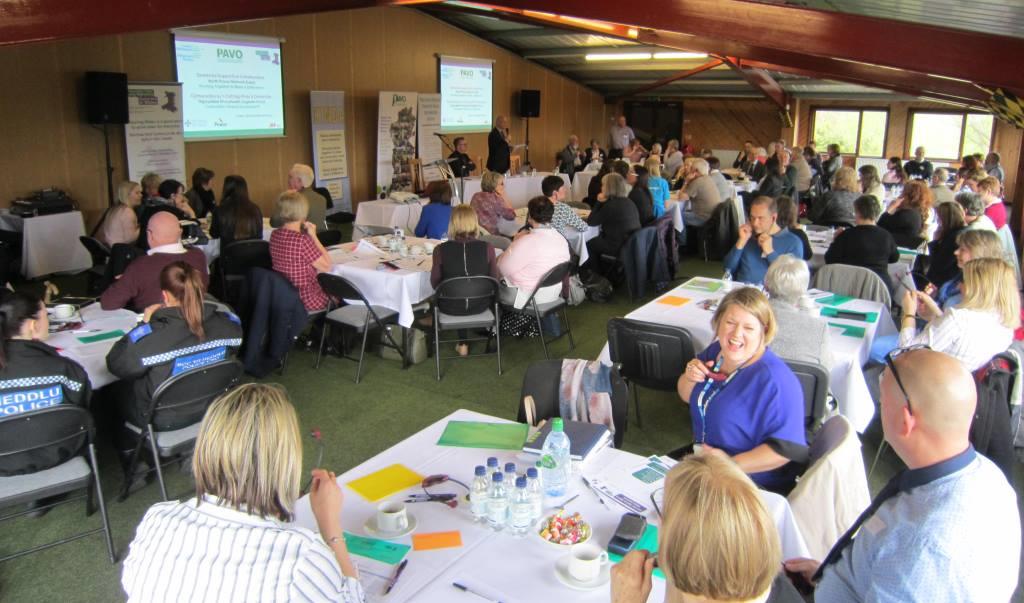
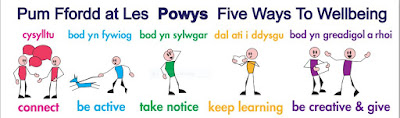
At the PAVO staff development day on Tuesday our team manager Jane Cooke, and former mental health team colleague Freda Lacey (now with the health & social care team), ran a session on Five Ways to Wellbeing in the workplace. They asked each of us to look at how the Five Ways – Connect, Be Active, Take Notice, Keep Learning and Give/Be Creative play a part in our personal and our work lives. They were also keen to find out how PAVO, as an employer, could support our wellbeing at work, and asked us to make suggestions which would later be considered by the senior managers.

PAVO staff development day 12 April 2016
Our team originally wrote about the Five Ways last June in a joint blog post - which is where you can find out about the origins of the Five Ways (a resource created by the New Economics Foundation) and how being active in the five areas can lead to happier and healthier lives. The Powys Public Health team is understandably keen to promote the approach far and wide. So anyway, it was really interesting to reflect and consider if anything had changed for us since last June, and also to hear what our colleagues thought about an approach which can, apparently, add another 7.5 years to the average lifespan!


First – take notice!

Jane started by asking each of us to spend a couple of moments considering how we felt – right then. Bored? Excited? Full? Empty? Happy? Sad? Lively? Tired? She invited us to go outside, close our eyes, and listen. To tune in to our other senses. Luckily the weather was on our side! We felt the sun on our faces, the breeze in our hair. We heard lambs bleating and robins singing. It was wonderful! When we were called back in to the conference room a few minutes later people were reluctant – they wanted to stay out there and enjoy the beautiful day, the fresh air, the green Powys countryside which is on our office doorstep. We acknowledged that most of us don’t do that at lunchtimes, even. We know it’s nice. Yet we don’t do it during our work day.

Connecting with colleagues
Giving & connecting

Then Jane invited us to have a conversation about something really nice we’d given to someone else. On my table a colleague said: “The gift I enjoy giving is time. It is crucial for my aged parents. I take time to sit with them and talk about things that happened 50 years ago.”

Jane explained that giving and connecting are very similar. We leave three quarters of ourselves behind when we come to work and very rarely say how we’re really feeling. Yet, if we open up as human beings in the workplace that actually helps our work. It changes the energy of the workplace. “It’s not magic. Really.”

Be active

Another colleague told me that the ideal number of steps we should take each day is 5,000. He does over 2,000 a day even when in the office, but does go out for lunch rather than sit at his desk. 


Freda dug a bit deeper. What does “being active” mean to people? Interpretations included – physically active, mentally active, busy, making things happen, the new, variety… Freda said that clearly the interpretation was very subjective. One person climbed 5 flights of stairs several times a day to their home, another went to exercise classes whilst yet another walked a dog. The Five Ways can be completely different for everyone – but that is absolutely fine. It was also pointed out that it is about a sense of achievement – it doesn’t matter what anyone else thinks if you feel you’ve achieved something.

1000 steps so far today!
The barriers

We 
then looked  at some of the barriers to doing things we know are good for us. A long list soon filled up a flipchart page – time, too busy, not valuing ourselves and our wellbeing, not prioritising, habit, physical limitations, apathy, guilt (a sense of being too selfish)....  the pressures were described as sometimes different for men and women.

Some good ideas

We discussed how we could use the Five Ways to change the way we work. Here are just a few of our ideas:

  • Standing meetings… or acquire some standing desks for the offices.
  • More visual ways of working – which supports creativity in the workplace.
  • Cycling to work scheme.
  • Frontline staff connecting with the PAVO trustees more regularly.
  • Using computers to tell us when to take a break.
  • Reactivating the book share scheme.
  • A lunchtime walk around Plas Dolerw park in Newtown or Llandrindod Wells lake.
  • An outdoor workplace, and a team-building day creating it!
Some of the ideas depend on organisational involvement, but many of the suggestions really just require a group of enthusiastic colleagues to get together and start! Carl Cooper, Chief Executive Officer (left in top photo), rounded off the session by promising to look at all the suggestions and agreeing to support the ethos of the Five Ways by encouraging the opportunities and culture for these things to happen.

Keep learning


Right now it’s time for me to Keep Learning. I have my staff appraisal next Tuesday, and there’s an empty box on the form titled Training & Development Plan for the coming year… But first, I just want to catch up on what Jane wrote about why we like the Five Ways to Wellbeing… in particular: “the things that make us feel good, that are enriching and fulfilling, are not always the same as the “big sell” – do more and do it faster, buy more stuff, buy it faster, chuck it away faster… so what does that mean for the way that we work together as part of PAVO?”


Have you used the Five Ways to Wellbeing to help promote a healthy workplace? Let us know what you think in the comments box below. We always love to Connect with our readers!

Wednesday, 6 April 2016

Cuppa with a Copper


Leanne Morris is a Police Community Support Officer (PCSO) for Dyfed-Powys Police based with the Brecon Neighbourhood Policing Team. Along with other PCSOs, Leanne supports the NPT by “engaging with the community and providing a highly-visible and reassuring presence.” In November 2015 Leanne attended the first of our PAVO mental health team’s Stand-up! for emotional health and wellbeing partnership meetings which took place in Brecon. 


My colleague Anne Woods, who is funded for three years by Comic Relief to develop this participation work across Powys, set up the meeting at Brecon & District Mind. It was the first of several planned for Brecon, and people who have been in contact with mental health services, and people close to them, are encouraged to attend and meet up with NHS staff, the local mental health advocate and third sector representatives. Local police PCSOs are also invited and generally made very welcome.

And so it was that Leanne attended that first meeting in Brecon, where there were cuppas and cakes… Anne takes up the story:

“As a result of the Comic Relief funded participation work, a spin off project has started to improve relationships between the local police service and people who experience mental ill-health. Regular opportunities have been created to have a ‘Cuppa with a Copper’ at Brecon & District Mind recovery and well-being centre, to improve relationships between police officers and the community they serve.

When Leanne attended that first Brecon Stand up! Meeting it quickly became apparent that the presence of someone in police uniform had an effect on some people there, and a discussion followed about their experiences of coming into contact with the police. Some people recounted negative experiences or negative feelings towards the police as a result. When someone is experiencing extreme emotional distress, frequently it is the police who are the first service they come into contact with."


Some of the issues which arose at the Brecon meeting have been discussed in publications such as The Police Federation of England and Wales publication "Police." In an article entitled Forum to focus on mental health issues in custody, Kevin Huish, the 2013 mental health lead on mental health wrote: "It’s widely acknowledged by all experts that police custody is the last place a person suffering a mental health crisis should be. Being confronted by officers in uniform with all their kit further exacerbates that breakdown." In Powys, a multi-agency approach is now working to improve the police response to those with mental health needs. However, sometimes, even when the crisis is over, and perhaps some time well in the future, just being in a room with someone in police uniform can trigger distressing feelings for an individual.


Back to Anne and the Cuppa with a Copper initiative.... 


"After the group meeting Leanne approached me to suggest that we find ways to foster better relationships. I followed up by organising a meeting with Val Walker, the manager of Brecon & District Mind, and we developed a proposal to put to the members. As a result, and with the members’ full support, the police now hold a monthly drop-in session to have ‘a Cuppa with a Copper’.

These sessions are informal and provide an opportunity for people to raise issues or seek advice but also simply to get to know each other, whether they wear a uniform or not. By timetabling and advertising the sessions, it gives people the opportunity to stay away if they feel interacting with the police would trigger difficult feelings or memories. Fortunately, however, the drop-ins have been well attended. There is also now talk of the police helping out with some of Brecon & District Mind’s outdoor volunteering projects alongside members.

This spin-off is transforming a negative situation into a positive one. The Comic Relief funded work has revealed tensions in the local community, an opportunity to take practical steps to address them has been followed up, and the initiative is improving the lives of people in the Brecon area.”


PCSO Leanne Morris told us what she thought about the new opportunity to meet up with members of Brecon & District Mind:

"The aim of setting up the Cuppa with a Copper meetings is to build relationships between the police and the people attending the Mind centre in Brecon who have experienced issues with mental health. I wanted to show the human face behind the uniform so that if anything comes up in future people feel happy to approach and speak to us on the street.

I worked for 10 years in the field of substance misuse, and with dual diagnosis clients - people who self-medicate with alcohol. I also spent 2 years at the Royal Glamorgan Hospital working with people with alcohol related problems, including assessing people on a mental health ward. So I can appreciate why people feel the way they do, why they can have varied and negative views of the police.

The meetings are running really well. I've been asked back anyway, so that's a good sign! And one of the Brecon Mind members wants to write a piece for the organisation's newsletter.

Some people only come into contact with the police when they are in crisis - which is obviously not ideal. I want people to meet us at different times to chat. Even if they are just offloading - that can really help."

Thanks to Anne and Leanne for the update, and watch this space for details of the next Cuppa with a Copper meeting in Brecon.

Find out more about Brecon & District Mind activities.


Do you care about adult mental health provision in the NHS in Powys and think it could be better or should be run differently? 

The next Stand up! for emotional health and well being meeting takes place in Newtown on Tuesday 3 May. Contact Anne Woods on anne.woods@pavo.org.uk or tel: 01597 822191 if you want to find out more.