 |
| Clare Clark & Owen Hughes from the Pain & Fatigue Management Service |
On November 10 I attended the Powys Research, Therapies and Health Sciences Conference, where I found out how staff at the Pain & Fatigue Management Centre in Bronllys near Brecon deliver condition management groups by Skype. The team at Bronllys provide help to people who want to live life more fully but are hindered in doing so by symptoms of long term health conditions – these could be conditions relating to physical or mental health or both.
This session was delivered by Owen Hughes, Head of Pain & Fatigue Management, and Clare Clark, Advanced Practitioner – Occupational Therapist – both based in the Pain & Fatigue Management Service in the Centre of Long Term Condition Management. Owen and Clare explained that there is currently a Skype group running from Bronllys, and through their presentation they explored the benefits of working in this way and what to consider when setting up a new Skype group.
Owen started the session by asking why it is important that we consider using software applications such as Skype to have video appointments and group support sessions over the internet. At this point his presentation featured a photograph of a famous actress from the silent movie era – but not a single person in the room recognised her because she had refused to switch to the “talkies” once they came along. (And I’ve forgotten exactly who she was already, though Owen did tell us her name!) The moral from that story being – we must move with the times or be left behind forever…. Owen said “technology is everywhere, and homes are getting smarter.” He asked us to imagine what people’s homes would look like in ten years’ time.
 |
| Eleanor Boardman - the forgotten silent movies star...? |
Clare picked up here to detail other issues which affect both patients and the team when trying to engage over a period of time. As we know people living in Powys often have to travel huge distances to see medical professionals even within the county. They may already be anxious and even on a good day people experiencing mental distress may not be ready to take on the long journey, perhaps by public transport, to make an appointment.
Other people may find it inconvenient to take a whole day from work to attend a session every 6 weeks, but would be able to free up an hour in a private room to make the Skype call. The issue of time is a factor for the staff too, who may otherwise have to spend many hours behind the wheel of their cars when they could be talking to more patients. They simply do not have the capacity to deliver all their sessions face-to-face, and Skype has proved an additional extra tool by which they can offer support to people.

- Peer support still works when Skype is used – there is a lot of interaction between the participants on the group sessions.
- It can be hard to manage group dynamics online – there is no social filter – so if some people are being derogatory this needs to be managed. Now there is a working agreement and boundaries are set at the start.
- It is important for participants to have a trial one-to-one session at the beginning during a coaching period with a telehealth facilitator, particularly if they are not familiar with the technology.
- The maximum number for a group session is probably 8. There were 4 in this group.
- It should not be forced on people. Generally they self-select.
- It can be effective for quite complex issues, not just mild anxiety or conditions.
- It is a transferable skill as it teaches people how to communicate online. It increases their social connectedness.

What people said
"I thought it would encourage isolation – but it made me feel less isolated. If I’m working with levels of anxiety, being at home can be a good place to start".
"I felt it improved my confidence so I was able to go out and socialise".
"I would never have been able to attend a face-to-face session today, but was able to log into the PC and join in".
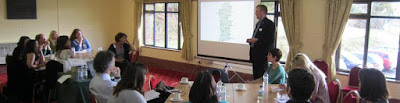
Then on 22 November I went along to a public session run by the Mid Wales Healthcare Collaborative in Newtown. The MWHC covers North Powys, Ceredigion and South Gwynedd, an area served by three health boards including PTHB, and works with providers and communities “to plan and deliver safe, sustainable, high quality and accessible health and social care services for the population of Mid Wales”. One of its twelve priorities this year (2016 – 17) is to look at Telehealth, Telemedicine and Telecare:
“There should be a coordinated effort by all three Health Boards to identify the opportunities for much greater use of telehealth capacity and a determined drive to hasten its implementation”.
“A 6 month project will be undertaken to ensure that the telemedicine equipment in Mid Wales is working, sited in the best place and that staff are trained to use it”.
At the Newtown session I met Adrian Thomas, Director of Therapies and Health Sciences at Betsi Cadwaladr University Health Board and lead on telehealth for the MWHC, and Emma Pritchard - the Telehealth Project Manager. They described some recent telehealth work developed as a result of this priority which focussed on a teledermatology service in North Ceredigion. We also spoke about other options that could be developed in future, taking into account feedback from the Mastermind Beating the Blues pilot and other initiatives such as those running at the Pain & Fatigue Management Centre. It was emphasized on the table where I was contributing that the telehealth option would not work for everybody - personal choice was key - but it should be offered as an option as it may be preferable for some.
Pages 32 – 38 of the 2016 report “A review of telehealth, telecare and telemedicine in Wales” give some details of recent initiatives in Wales which have used telehealth, including a Veterans’ mental health project in South Wales and the Powys Mastermind project. There are also links to further published research evidence around computerised CBT including that relevant to autism, eating disorders, and veterans.
"I thought it would encourage isolation – but it made me feel less isolated. If I’m working with levels of anxiety, being at home can be a good place to start".
"I felt it improved my confidence so I was able to go out and socialise".
"I would never have been able to attend a face-to-face session today, but was able to log into the PC and join in".

“There should be a coordinated effort by all three Health Boards to identify the opportunities for much greater use of telehealth capacity and a determined drive to hasten its implementation”.
“A 6 month project will be undertaken to ensure that the telemedicine equipment in Mid Wales is working, sited in the best place and that staff are trained to use it”.
At the Newtown session I met Adrian Thomas, Director of Therapies and Health Sciences at Betsi Cadwaladr University Health Board and lead on telehealth for the MWHC, and Emma Pritchard - the Telehealth Project Manager. They described some recent telehealth work developed as a result of this priority which focussed on a teledermatology service in North Ceredigion. We also spoke about other options that could be developed in future, taking into account feedback from the Mastermind Beating the Blues pilot and other initiatives such as those running at the Pain & Fatigue Management Centre. It was emphasized on the table where I was contributing that the telehealth option would not work for everybody - personal choice was key - but it should be offered as an option as it may be preferable for some.
Pages 32 – 38 of the 2016 report “A review of telehealth, telecare and telemedicine in Wales” give some details of recent initiatives in Wales which have used telehealth, including a Veterans’ mental health project in South Wales and the Powys Mastermind project. There are also links to further published research evidence around computerised CBT including that relevant to autism, eating disorders, and veterans.

If you are in contact with mental health services, or have been in the past, have you tried the telehealth option? What was your experience? If not, would you like to try it, particularly if it meant you were able to receive support sooner? Let us know in the comments box below.


