Wednesday, 18 November 2015

Young Adult Peer Support workshop @ PAVO AGM

L-R: Julia Gorman (YAPS co-ordinator), Robin Green (YAPS Assistant Co-ordinator)
 - both with Ponthafren Association, and Sarah Harmon
Just last week I joined colleagues to help at our annual PAVO AGM which took place at the Royal Welsh Showground near Builth Wells. In the Chair's invitation to the AGM, Gloria Jones Powell wrote: "Welsh Government's White Paper, Reforming Local Government: Power to Local People, states that we need to be: 'Putting people at the centre and involving service users in prioritising, commissioning, designing, delivering and accessing services'. Unlike the usual approach to consultation and engagement, the projects within PAVO's One Powys - Connecting Voices portfolio invite commissioners, service providers and others to listen to what's important to them".


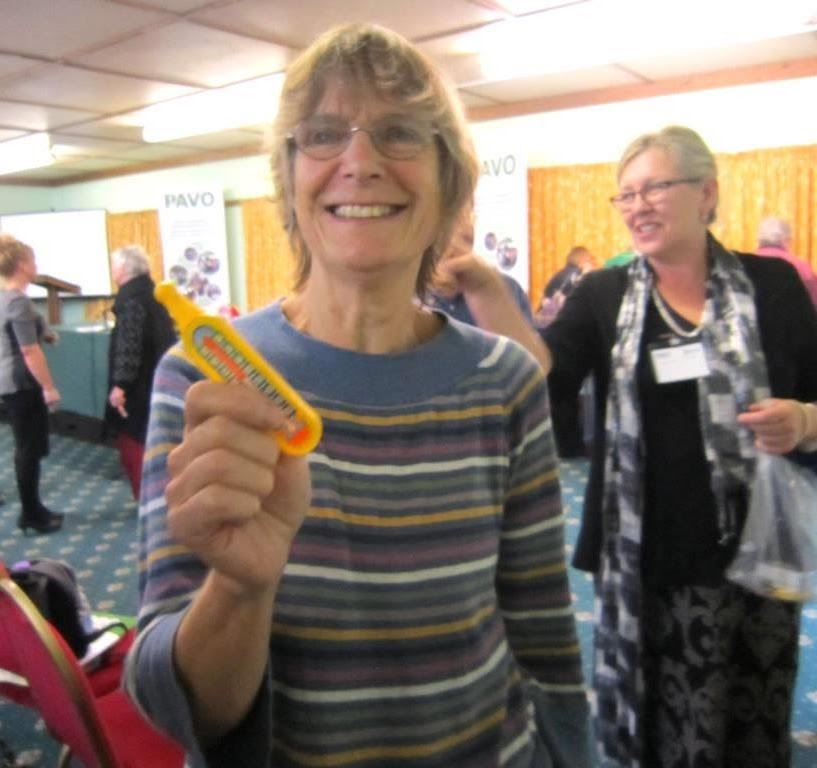
The Young Adult Peer Support (YAPS) project, which is one of the One Powys - Connecting Voices projects funded by the Big Lottery Fund, held a workshop at the AGM. It was attended by representatives from Powys teaching Health Board, Powys County Council, and numerous voluntary organisations and individuals, all of whom had an interest in mental health. My role was to support the project facilitators on the day, and so it was I joined Julia Gorman, Robin Green, and Sarah Harmon - one of the young people involved with the project - to capture feedback about mental health services from those attending. 

The YAPS project is delivered by Ponthafren Association, and offers peer support mentoring to young people (16-25 years old) who experience mental health issues, by helping to give them a voice of their own in the development of services. A project volunteer wrote about her experience for us last year, and we featured the project video "I don't let mental health define me" earlier this year.


The YAPS team had devised an intriguing game to carry out for the first half of their workshop. They had raided all the Ponthafren board games for dice! The aim of the game was to try and access mental health services as young people would do in the real world if they were experiencing mental distress. Starting at home, a simple throw of the dice would see the workshop participants on their way to the various services on offer in Powys. How hard could it be!

Martin Nosworthy, PAVO trustee, at the start of the YAPS game
Depending on the throw of the dice participants would be directed to one of various stages around the main hall at the AGM venue. They might be sent to College, a Friend's house, the GP, Ponthafren Association, the Police, or Child & Adolescent Mental Health Services (CAMHS) for example. On the way to their next "station" in the game, they had to negotiate chairs, tables, and numerous other players of the game, all competing to reach their own stage and win the support they so very much needed.


Those lucky enough to reach College/University then had to throw again. 1 = too anxious to go - return home, 2 = bad day - get a Crisis Card, 3 - 5 = good day = go to friends, 6 = pass an exam - take a chocolate and go home. 


The Crisis Card was particularly bad news. It stated: Stop taking your medication, lose a chocolate and go to the GP...


The pile of sweets did go down slowly, but most people, whilst glad to pick up an occasional reward, were starting to feel increasingly frustrated about how often that they had to return home....


Many participants made it to the GP surgery, including Kate van den Ende, one of the reps on the Mental Health National Forum, (who wrote for us very recently about Dual Diagnosis).


However, over at Child & Adolescent Mental Health Services there were very few arrivals...


And at the Police Station whatever the throw of the dice, the news was not good. 1 - 2 = get fined, go home and return a chocolate. 3 - 6 = cautioned, and go home.

After 30 minutes the game was stopped and we gathered the participants together to get their feedback. Everyone expressed frustration at not being able to access the support they needed. They kept "getting caught" or "having to return home". Their frustration escalated significantly when they learnt that one dice roll was equivalent to one whole day! They said that the situation was totally unpredictable and completely out of their control!

Only two players of the game acquired the elusive Mentor Card and were less likely to be trapped at home. They quickly realised that they: 
  • Would no longer be sent home.
  • Had increased confidence.
  • Felt more comfortable. 
  • Could do things and get results. 
As Robin explained: "That is what peer support does. This is what YAPS does."

It was a brilliant game. And both a brilliant and fun way to convey to people the increasing frustrations of a young person trying to access services and being passed from one to another without ever getting to the root of their problem.

Barbara Perkins (centre), PAVO One Powys Connecting Voices Officer
with Sarah and Robin
The workshop continued for another half an hour with an animated discussion around the value of the YAPS Project and the many barriers to young people accessing relevant services in Powys. Watch this space for further updates as the One Powys - Connecting Voices Project continues to make a difference to the way in which public services are planned and delivered. Over at YAPS they are listening hard and looking to suggest some very innovative solutions.

The YAPS Project runs its own blog called VOX. Check it out here.

Thursday, 12 November 2015

Dual diagnosis - changing times

Dual diagnosis - co-occurrence of a mental health problem with a substance misuse problem.

This week’s post is from our guest author Kate van den Ende. 

Kate is one of three representatives on the National Mental Health Forum in Powys. There are ten such networks across Wales, feeding in to the National Partnership Board – where those using services, carers, professional groups, the statutory and voluntary sector and government departments across Wales meet three times a year to oversee the delivery and implementation of "Together for Mental Health – A Strategy for Mental Health and Wellbeing in Wales".


The bad news

If you live with a mental health problem, you are more likely than the rest of the population to have to manage a problem with substance misuse as well......and vice versa.

The most commonly used 'substance' is alcohol, but, in the world of addiction, the understanding is that, at different times, we use different 'substances' to support us, to self-medicate - a horrible term used by professionals! So alcohol can be interchanged with food, drugs, relationships and/or gambling as the 'substance of choice' at different stages of our lives, depending on which is available or which fills the need at that time.

The double whammy of co-occurrence used to be considered a rarity but, as any of us could have told the professionals, statistics show that it is more like the norm..... and if you have a severe and enduring mental illness like schizophrenia or bipolar disorder, your chances of having to cope with both is considerably increased again.

Assuming that co-occurrence was a rarity meant that the two sides to the problem tended to be treated separately, as if they were symptoms of two completely different, unrelated conditions. People were shunted between the separate services and, surprise, surprise, they fell through the gaps!

Our experience was just that.

An appointment would be made to see the mental health team or psychiatrist. Nervousness and self doubt resulted in large quantities of vodka. The professionals refused to see a drunk patient. An appointment was made to see the drug and alcohol service. Nervousness and self doubt resulted in large quantities of vodka and a failure to attend the appointment. This in turn fed into the 'I'm rubbish, just see how rubbish I am....I can't get help even when it's offered.' Vodka again, with pills this time. A&E admission and a couple of days to check liver function before discharge either directly home to exhausted and lost carers or mental health ward, with or without Section. Medication, escapes to buy vodka, discharge to the even more exhausted and despairing carers.

An appointment would then be made to see the mental health team....vodka.....no change in mental distress......appointment with drugs and alcohol service....vodka......further reason to beat herself up.....vodka and pills.....A&E.....Section.....revolving doors, escalation of the problems.....further desperation for carers....

And so we went on, for 18 months, with the reliance on vodka and the self harming reaching ever higher, dangerous levels. Neither service looking beyond their particular remit. Nobody was looking at the whole distressed person, with all her complexity of problems.

The good news 


Changes are being made to the way help and treatment are offered to people battling with co-occurrence. Indeed, changes are being required by the Welsh Government. If you talk to service providers in Powys, they will tell you that they have already started on a new, joined-up approach. Drug and Alcohol services are provided in Powys by Kaleidoscope and CAIS. They have started to work out ways of joining forces with the local mental health services, to deliver 'seamless' provision.

But the new legislation demands far far more. Seamless delivery is just a start.

It includes:

"It must not be left to the service user to navigate between substance misuse, mental health and other related support services themselves." They and their family will have a nominated, responsible key worker to help them find their way.

There must be "absolute clarity on which agency is leading and coordinating care."

An integrated approach, with clear treatment protocols and care pathways will provide "holistic, person-centred care."

To deliver these improved services, the Welsh Government recognises that:

Professionals on both sides will need considerable training "to overcome institutional and cultural assumptions."

So, from December this year, when Powys teaching Health Board resumes complete control over, and responsibility for, the commissioning and delivery of services to those in mental distress in this area, they have been offered a fine example of the kind of services we want, whether or not we have a co-occurring substance misuse problem.

Integrated, holistic, person-centred and individually tailored to our needs, delivered by teams of well trained professionals who work together and who listen!

That’s the kind of support we need to recover control over our lives.

Thursday, 5 November 2015

Bev Clarke - award-winning volunteer counsellor Ystradgynlais Mind

Bev receiving her Outstanding Contribution Award from the
High Sheriff of Powys, Lieutenant Colonel Mike Lewis DL
Bev Clarke has been volunteering at Ystradgynlais Mind for the past 4 years as a Level 6 counsellor / supervisor, enabling the mental health charity to provide a free counselling service to the community. She volunteers 3 days a week. She has enabled the recruitment of 7 further student counsellors, who benefit from her supervision and guidance. Her input both into clients and students is life changing.

In October 2015 Bev was winner of an Outstanding Contribution Award at the Powys Volunteer of the Year Awards. Her nominator said: “Bev has experienced her own difficulties throughout her life and she demonstrates you can overcome anything and give so much to the community despite those difficulties. She inspires all at Ystradgynlais and is loved and respected.”

Carol Stephens, Chief Executive at Ystradgynlais Mind, said: “We are thrilled about Bev's award, it is so well deserved. She's a diamond.”

We talked to Bev to find out more about her invaluable contribution at Ystradgynlais Mind.


What originally motivated you to start volunteering at Ystradgynlais Mind?


I graduated from the University of South Wales at Pontypridd in 2009 (Bachelor of Science (BSc) Hons, Systemic Counselling) and was looking for a counselling placement. I needed 450 hours of supervised counselling for my accreditation. I have 1050 now, 800 of these from counselling sessions at Ystradgynlais Mind.

I first came over to Ystradgynlais looking for plants and saw that there was a Mind centre here. I set up my own counselling practice in Port Talbot with a friend from university and volunteered my services to Ystrad Mind. Carol interviewed me and it went really well. She said – can you start next Wednesday?!

I have bipolar and Carol said “we’re looking for people like you”. It’s been a wonderful experience. I didn’t have to hide my mental health issues, it was like the start of a new beginning.

Carol and I share the same vision – which is to do the best for our clients and also to provide good packages for our student counsellors.

Tell us more about your role as a counsellor at Ystradgynlais Mind

A lot of men come to us for counselling which is unusual. It stands out at about 55%. They have moderate issues as they almost leave it too late to seek help. Women are not afraid to access the service, so their issues are often mild to moderate.

Most of our clients are middle-aged – in their 40s and 50s, with various issues. Often they might be waiting for treatment from the statutory mental health teams so they seek support from the voluntary sector instead. They usually have about 7 – 8 one hour counselling sessions, weekly or fortnightly depending on the complexity of the issues.

How does counselling make people’s lives better?

It is a forum where people can be heard. They take their issues away from their families and share them with someone else who is prepared to listen. They have more clarity with the help of a counsellor and so see things that they couldn’t before.

Who is eligible to receive the counselling service, and for how long can they access support?

The service is available to people 17 +. They can self-refer – some people walk in off the street - or they are referred by the GPs in the Abertawe Bro Morgannwg University Health Board cluster area.

If your role didn’t exist, what would happen to people who needed support with their mental health in Ystradgynlais and district?

I’ve seen mental health care decrease unbelievably in the past 4 – 5 years. There is no help there for people. Mental health isn’t a “sexy” health condition, so there is no investment or focus as with other ailments. It feels as if mental health is the poor relation. This is really obvious when working in the Third Sector.

Tell us more about your work supporting 7 student counsellors

I provide support for them, which includes 1½ hour supervision once a month where we’ll talk about the issues that have been raised with clients and signposting options for people. I also make sure that the counsellors are safe, and don’t take home any issues that could impact on their lives.

We source new student counsellors when we need them from the universities. The students are supposed to complete 100 hours of supervised counselling here, but some have already done 300. We give them an excellent level of support, their insurance is covered and they enjoy the experience here so they stay.

I believe you also provide counselling for GP patients in a neighbouring health board?

Our counselling services have now been taken on by GPs in the Ponterdawe and Neath Valley area so it has been well worth it.

Tell us some of the hardest things about being a volunteer counsellor

Watching how hard it is for those working and volunteering in the Third Sector to apply for grants and funding just to make ends meet. I’m here 2 – 3 days a week, but Carol is here for 5. I know how hard she works and how little she takes. I’ve got a bigger picture as a volunteer.

What is the most rewarding aspect of volunteering at Ystradgynlais Mind?

To see how the clients improve. And most of them give back – for example they give talks on their own mental health which is so enlightening for the student counsellors. It’s great the way that they find it good to say what they’ve been through. Clients also feedback to counsellors in supervision sessions.

What was it like winning the Outstanding Contribution Award at the Powys Volunteer of the Awards ceremony?

Well, at the end when I knew it was me who had won – my first thought was – don’t fall down the steps! There were fifty to get down!

I’m so proud of myself. My daughter was with me and she said – “you’ve set the bar even higher now!” To hear the words Carol had written when she put me forward for the award was wonderful.

The narrative of my own mental health issues was a guilty secret for so many years, it is almost a relief to talk about it now.

It was just a wonderful experience.

What would you say to encourage other people to volunteer to support people experiencing mental distress?

Don’t be afraid. We seek help from a psychiatrist in the same way as someone who is diabetic would go to a medical ward. It’s not like “One Flew over the Cuckoo’s Nest”. We’re working with wonderful people who just have unfortunate mental health issues.

I have enjoyed every minute that I’ve given to Ystradgynlais Mind.


Many thanks to Bev for telling us about her role at Ystradgynlais Mind. You can contact the charity by emailing info@minditv.org.uk or ringing 01597 824411, or visit the Ystradgynlais Mind website.

You can read more about the Powys Volunteer of the Year Awards on the PAVO website.
Outstanding Contribution category: These awards are in recognition of the outstanding contribution and commitment made to voluntary activity. The volunteering undertaken is selfless, a response to local need coming out of the community and is carried out willingly.

The Judges’ Panel was made up of PAVO trustees - Gloria Jones Powell, Ian Charlesworth and Keith Rollinson. The panel felt that Bev stood out because of:

  • Her willingness to support others achieve their goals.
  • She has overcome huge personal adversity in order to help others.
  • Her unyielding commitment to the organisation she volunteers for.
  • The difference she has made to the organisation on many levels.
  • The difference she has made to the local community.
Claire Sterry, County Development Officer for PAVO, who helped organised the 2015 awards, said: “Bev is truly inspiring, it was an honour to meet her - she is a very special lady, and so unassuming!”

Thursday, 29 October 2015

Spirituality and Recovery in Mental Health

Last Monday Tim Teeling, the Pembrokeshire Mental Health Development Officer at West Wales Action for Mental Health, travelled up to Mid Wales to join us for our regular monthly team meeting. We had invited him to talk to us about an innovative project he set up for WWAMH on Spirituality and Recovery in Mental Health. 

Our team had made a trip down to Carmarthen and WWAMH HQ earlier this year to find out more about the organisation’s work generally. 

We discovered TONIC for surfing, watched the Recovery Wall Project and heard a veteran’s story, but the day just raced by – they have so much exciting stuff going on down there! And we ran right out of time to pick up more than a passing hint at Tim’s work. 

It was enough to whet our appetite to find out more, however, and so here is a taste of what we enjoyed on Monday.

Beginnings

Tim was originally inspired to set up the Spirituality project for WWAMH about four years ago when he became aware that whilst much had been written on the topic, very little was available about how to work with spirituality as part of an individual’s recovery. Tim did not want to set up a project that looked at faiths in particular, but rather at “how my feelings and thoughts can help me recover from mental health problems. Instead of seeing our beliefs as signs of illness, we explore them as strengths in recovery.”

Whilst the statutory mental health sector concentrates on reducing symptoms such as hallucinations, the spiritual approach focuses on hope and optimism. There is a shift away from problems to look at a person’s strengths.

What the project does

Three monthly groups, which are open to individuals and their carers, run in Aberaeron, Haverfordwest and Llanelli. After initially experimenting with standalone groups, Tim now works closely with pre-existing organisations such as Mind which has proved more successful.

At the start of each meeting Tim introduces a theme, such as joy, courage, or forgiveness, and following a brief introduction participants then discuss. Revealing our attitudes to our own spirituality could potentially be awkward in a group setting, but ground rules such as “respect for each other” and “no preaching allowed” ensure confidence and enthusiasm to talk. The project is non-denominational and a belief in God is not necessary.

Knowing our own Minds – the starting point

In 1997 the Mental Health Foundation carried out a survey which revealed that 50% of people in contact with mental health services relied on spiritual and religious feelings to help their recovery. This is not that surprising as 60 – 70% of people believed in “something”, even though church attendance was down to 5%. Tim has worked in mental health for 27 years now and is always aware of the importance of spirituality or the non-material aspects of life for many people, particularly in relation to recovery. “It gives a meaning and purpose to life, an optimism, and a much-needed connection to others and the outside world.”


Tim Teeling meets our mental health team
L:R Jackie Newey (Info Service), Jane Cooke (Senior Officer), Anne Woods (Participation Officer)

Spirituality and themes in spiritual therapy

One of the criticisms that people in contact with mental health services sometimes make is that those delivering these services don’t understand them or what makes them tick. “The big question is – what is the most important thing for you in your life? What brings hope and purpose into your life?” The values of peace, compassion and happiness – the sense of the inner self, and the search for a meaning and purpose in life, these themes are rarely explored in any depth. Even more radical, perhaps, is the possibility that problems could be viewed as opportunities for growth.

Spiritual practices and assets

Engaging with our spiritual side does not necessarily mean (although it might – it so much depends on the individual) praying, reading scripture or taking part in a particular faith’s rituals. It could be as simple as enjoying nature, cooking, or helping others. “One guy just loves fishing down by the river. That is his spiritual practice – standing in the river and listening to the birds – not how many fish he catches”.

Once they engage with their spiritual side people start to realise that life is “not just about me – I am part of a greater whole. It gives the courage and grounding that people need, and hope in the face of distress”.

Spirituality and religion

The difference between spirituality and religion is a subject often discussed. Tim said that spirituality is usually something we do on our own and covers beliefs and practices found outside organised religion. Religion, meanwhile, whilst intrinsically spiritual, tends to be organised and communal.

Research

There is a wealth of research in the area, and evidence shows a statistically significant relationship between those who engage in spiritual practices and greater life satisfaction, including: an increase in hope and optimism, a sense of purpose and well meaning, increased self esteem, less depression, fewer suicides, less substance abuse, and less psychosis and psychotic tendencies.

Of course, negative experiences are also possible – people may feel persecuted by spirits or punished by an intolerant deity, and it would be unwise to suggest someone cut out all their medication in favour of prayer, for example.

Mental health assessments and spirituality

A particularly interesting part of Tim’s talk related to the way in which mental health nurses struggle to explore an individual’s spiritual life with them, in care and treatment planning for example. The Mental Health (Wales) Measure 2010 acknowledges the importance of spirituality in its Code of Practice:

“Spirituality can play an important role in helping people live with, or recover from, mental health problems. Spirituality is often seen as a broader concept than simply religion”.

But for the nurses it is often an awkward area to discuss. Where do they start? What questions can they ask? They may be fearful about stepping on sensibilities, but actually exploring spiritual issues with someone can be therapeutic in itself. In Tim’s workshops he looks at ways this can be done, using practical exercises and prompting questions such as:
  • Are you spiritual and religious in any way?
  • What do you really value in your life?
  • What keeps you going when things get tough?
  • Has being ill affected your thoughts about the future?
Once a conversation has been started, and if an individual is keen to pursue the subject, further questions can be asked about specific scenarios. Nurses could find out more about someone’s experience of talking to GPs, psychiatrists and nurses about their spirituality. And ask if they are worried about any conflicts between their beliefs and their care. At his sessions Tim talks through the specific skills which aid such conversations. These include attentive listening, suspending your own judgment, and accepting that spiritual pain may not be solved as a problem, but as a question to be lived.

So far Tim has met with two groups of nurses in Pembrokeshire – a Community Mental Health Team and staff on an inpatient ward. He has a third session coming up soon. It sounded to the rest of us as if his session on spirituality would be invaluable for all those working in the field of mental health!

Tim ended his talk by reminding us that “our health services are very much involved in symptom relief. Recovery is about living with hope, even with our problems.”

Thanks so much to Tim for telling us about the Spirituality and Recovery Project run by WWAMH in West Wales. What are your thoughts on spirituality and mental health? We’d love to hear from you. Let us know in the comments box below.

You can watch a video in which Tim talks about the project at the 2014 Annual International Think Tank Conference.

If you are interested in finding out more about the project please contact Tim Teeling by emailing tim@wwamh.org.uk

Read about other research on spirituality and mental health:

Taken seriously: Somerset spirituality Project 2002

The impact of spirituality on mental health 2006

Thursday, 22 October 2015

Harts and Craft - Diane's story


Diane Hart, volunteer and member at Ponthafren Association, a mental health charity in North Powys, writes our guest blog post this week. 

Hi! My name is Diane and I have been a member of Ponthafren for five years now.

When I first attended I was in a very bad place in my head, I couldn't see the point in anything. It has only been recently that I have been able to see a future. My Community Psychiatric Nurse thought it would give me something to do and a reason to carry on.

For a very, very long time I was very shy. At first I just hid behind the laptop, which as a member I had use of, and I only spoke to people when I was spoken to. I still hide behind it sometimes but it is more of a safety blanket rather than a protective shield.

Slowly over time I joined in some art and craft classes which gave me a reason to attend Ponthafren. Back then they were not accredited so the number of people who attended didn't matter, which was a good thing because there were not many who were interested in learning how to make felt, or silk painting. Gradually I joined in other classes like sugar craft where I learnt to make edible flowers. The classes eventually became accredited and I now have three certificates for sugar craft.


Around that time I also joined an adult literacy class. Not that I had a problem reading or writing, but the tutor said he would help with interview skills and confidence building. Well, it did some good because my tutor asked me to give a ten minute talk to the other members on how my art and craft classes were helping me, which I did, and this became the first of many.

Because of my talk a very special lady, who became my friend, saw me and asked me to join the committee of Powys Mental Health Alliance. I did this for a couple of years before other commitments and ill health stopped me from carrying on.

Then, because of changes going on at Welshpool Ponthafren, classes stopped for a while and I found things very hard to cope with. I was having a bad time when someone from Newtown Ponthafren called me and asked if would I like to join a class they had there. I thought they said Arts and Crafts, but what they actually said was Art and Design. I was told that if they couldn't get the numbers up the class would have to stop. I knew how important classes were to me and I felt for the people in the group so I immediately said yes. 


Needless to say I had a very big shock when I realised my mistake. I was not only nervous attending a new place and meeting new people but to find out the course I had agreed to was a Level Two BTEC in Art and Design and they were already six weeks into it. I thought it wouldn't be too much of a problem as there were only a few weeks left. The other courses I attended only lasted ten weeks. I was reassured that I would be OK - I had an advantage over the other girls as I had a painting portfolio under my belt so I could use this as part of my work. I told my teacher at the time that I knew nothing about art but again I was reassured and I decided to stay.

Perhaps if I had known then it was going to take 18 months I might have thought differently. I am glad I didn't know as it was a challenge but one I am pleased I met.

After a few weeks the teacher left and the new lady did things differently which at the time I found difficult but over time I warmed to her. Esther Thorpe opened my eyes to appreciate art. Even if I didn't like the style, I learnt to understand and appreciate it. With Esther's encouragement I have experimented in different techniques of painting and drawing. Recently I have dabbled in sculpture which I not only found therapeutic but I found I wasn't bad at it. So, over the last couple of years, I have mounted up thirty four certificates so far.

Apart from the BTEC the others were ten week courses of card making, calligraphy, pottery, sculpture, painting, drawing, paper flower making, and jewellery making with recycled paper. I also attended computer classes to refresh my skill and learn new skills like digital photography and playing with my pictures on the computer.

A couple of years ago I also started my own class where I teach others arts and crafts in Welshpool Ponthafren, putting to good use what I have learnt. 

I have also had the pleasure of working with an artist painting a mural celebrating 60 years since the last commercial steam train went through Welshpool. This is up for posterity and although not many know I had a big hand in it my friends know and I now have the confidence to point it out to people at the side of Welshpool Library.

Last year I attended a 4 day course which, apart from my BTEC, was one of the hardest courses I attended. It was not that the work was hard but I wasn't sure of myself. However, now I am a volunteer support worker at Welshpool Ponthafren and I know it was the right thing to do, for not only is it giving me the confidence to socialise I am attending more courses to help me become a better support worker.

I am still attending classes teaching and volunteering and I am now the chair person of a small volunteer group called Meeting Point Montgomeryshire. Last month I also joined a creative writing and poetry group. I have already had some of my work published, so who knows what the future holds. I am also helping to make things for the Welshpool Carnival next year. This is not connected to Ponthafren but through Ponthafren I met people who asked me to get involved with outside interests. In a way though it has everything to do with them because it was through them and other agencies that I feel able to do what I do. Even though some days all I want to do is crawl up in my bed and stay there having responsibilities and reasons to get out of bed has been a literal life saver.

Throughout July this year I did probably the hardest thing I have ever done and that was to go to shops in Newtown and Welshpool canvassing for money for charity. I had pledged to shave my hair all off to raise money and in doing so I raised £700.00.

I still have bad days but, as my CPN says, we all have blips and if we can see them as that they don't seem so dreadful. All I know is, five years ago I wouldn't have dreamt of being able to write what I have written, never mind see myself doing what I have done, for I saw no future for myself.

So I would like to say a big thanks to Ponthafren for all the help they have given me over the years and a big thanks for not seeing my visual and physical disability as a problem to becoming a volunteer.

And to you reading this - I hope it helps you to see a more positive future, for if I can do it so can you. I think life can be like climbing a mountain. It looks impossible but if you only look at one step at a time before you know it you have reached the summit. Don't worry if you slip a few times. I did many times. It’s not the slipping that matters, it's the getting up that counts.

Blessed be - Diane.

Many thanks to Diane for sharing her story with us. If you would like to tell us your story, then please get in touch.


Photos of Diane's art and craftwork courtesy of Diane Hart.

Thursday, 8 October 2015

World Mental Health Day 2015


Saturday 10 October 2015 is World Mental Health Day, which is organised by the Mental Health Foundation in partnership with the World Federation of Mental Health and the World Health Organisation. This year’s theme is Dignity in Mental Health. The MHF states:

“We believe that effectively supporting people experiencing mental health problems is on target to become one of the greatest public health challenges of our time. Stigmatising and discriminatory treatment can be particularly distressing when a person is experiencing a health crisis.

We all have mental health, and by failing to treat people with mental health problems with dignity we make it more difficult to ensure that everyone takes steps to safeguard their wellbeing and to seek help, as it can lead to self-stigma, low confidence, low self-esteem, withdrawal and social isolation.”


The World Federation for Mental Health has published a collection of papers under the heading "Dignity in Mental Health" from "expert authors who show that dignity in the mental health context can have many meanings and can be applied to every aspect of care." There are contributions from all around the world - including for the UK - Professor Mike Pringle CBE on "Mental Health for All: Mental and physical health parity - the role of General Practice".

The definition of dignity, according to one of those handy online dictionaries, is: “being worthy of honour or respect”. In our day-to-day lives we all expect to be treated with dignity, and it follows on from that – so we would too if in contact with any services we seek in relation to our mental health.

But provision of mental health services is complex and linked in to the laws of the land. Staff are often desperately firefighting due to cuts and increased paperwork, sometimes they barely have time to even talk to their patients…. The very fact that this theme has been chosen for World Mental Health Day 2015 suggests that there are issues around being treated with dignity whilst distressed.


Mental Health Foundation Tea & Talk initiative
for World Mental Health Day
What does it feel like, not being treated with dignity? It might feel that:

I am not being listened to

My colleague Jane Cooke says: “I think the fundamental thing for me is the quality of listening - and acknowledging that I am saying what I am saying - I think my dignity is affected when people reply with something like “So it’s about…” and then telling me what I said. It means that I am not heard - I’ve been put into a box.”

I have been labelled

Perhaps I have been told I have a specific diagnosis or disorder. I might not agree, but I might need the diagnosis to access further support or other services. I have to compromise to make a step towards recovery. In North Powys young people are fighting back against being labelled – those involved in the Young Adult Peer Support project at Ponthafren Association made a video called – “I don’t let mental health define me” in which young people challenge stigma with the powerful message: “Everyone has mental health.”

I am just a number, an entry on a list, without individuality or identity

It is all-too-common anywhere in Wales, not just in Powys, to be on a waiting list for psychological or talking therapies if support of this kind is considered appropriate. People in this situation can feel isolated, forgotten, and helpless. They don’t know where to turn. But just communicating with people can be helpful, as Jane found out at an event she helped organise earlier this year specifically to look at issues relating to the waiting lists.

I might lose my freedom

I no longer have control over my life – perhaps I am forced to take medication against my wishes or engage in activities which don’t interest me. Ultimately I may lose my freedom if I am detained under the Mental Health Act. Derek Turner and Jan Rogers wrote about the value of Advance Statements for crisis planning recently, whereby people are able to make their wishes clear in a written statement which could be referred to in times of mental health crisis. In this way someone experiencing mental distress in a public place could be supported with dignity rather than arrested and perhaps “bundled into a police van.”

I am not valued – by family, friends or staff with whom I come into contact… My self-esteem has hit rock bottom…

On Maple Ward at the Longley Centre, Sheffield Health & Social Care NHS Foundation Trust has developed ‘Dignity Steps’ which translate the views of people using the service into actions for improvement. It’s a lot like the approach taken by Powys Patients Council here, where mental health inpatients meet with experienced volunteers to talk about improvements they would like to see on Felindre Ward at Bronllys Hospital in South Powys. Rhydian Parry, who is a rep on the National Mental Health Partnership Board, wrote about his experience of volunteering on Powys Patients’ Council.

Together for Mental Health is the Welsh Government strategy for improving mental health and a vision for mental health services across Wales. Objective 13 of the national outcomes states:

“Service user experience is improved, and safety, protection and dignity are ensured and embedded in sustainable services.”

The ambition is there, but what is the reality actually like? Identifying the problem, in some ways, is easy. Much harder is thinking of solutions… but there are lots of ideas on the Social Care Institute for Excellence website – take a look and see what you think.

If you have been in contact with mental health services, do you feel you were treated with dignity? If yes, great, tell us about it and we can spread the news of some good practice! If not… why do you think this was so, and what could be done to improve things?


Brecon & District Mind is hosting a Mental Health Awareness Morning to mark World Mental Health Day this Saturday 10 October, 10am - 2pm at Brecon Guildhall. Tea and coffee available. All welcome.

Thursday, 1 October 2015

More Harm Than Good

A couple of weeks ago our guest blogger, Anne Watmough, went along to this London conference - More Harm Than Good: Confronting the Psychiatric Medication Epidemic, organised by the Council for Evidence Based Psychiatry (CEP). The CEP website reports: "Global leaders in the critical psychiatry movement met for a one-day conference to address an urgent public health issue: the iatrogenic harm caused by the over-prescription of psychiatric medications." Anne kindly sent in a review of her experience of the day - read on.

I set out on Thursday the day before the conference at 9 o'clock in the morning and boarded the bus direct to London. My journey took five and a half hours. But I didn't mind as the coach was very comfortable.

I arrived at my small hotel to find my room cosy and spotlessly clean. I had a nice meal that evening at a Moroccan restaurant on King Street.

The next morning I rose early and went out to have a full English breakfast at a nice cafe. Where the chips were delicious. I allowed myself to eat this food because I was a traveller.

Then I took a taxi to Whiteland College, part of Roehampton University, over Hampstead Bridge.

I arrived to an empty auditorium - one of the very first people to get there. Then two women came to sit down beside me. These remarkable women both had sons like myself affected by psychiatry and psychiatric medications.

Amy, a most young looking natural blonde lady despite all of the transgressions her life has held, explained she was prescribed psychiatric medications whilst she was pregnant with her son. He was born handicapped and she has had his lifetime to regret what happened to her when she was most vulnerable and carrying him inside her.

She has devoted her life to caring for him.

The second woman I met was Jemima and she explained how she was fighting for her son who had had a bicycle accident when young. He was left disabled and in a wheelchair. She felt that when he was prescribed psychiatric medication his disabilities were made worse. How horrendous for a woman whose son was disabled for her to watch him become more disabled due to side effects of medication that is supposed to keep him healthy.

I listened to the wonderful speaker Peter Gotzsche and how he is fighting for the rights and care of people like myself. To keep us free!

There were several speakers who were educated renowned men.

But one of the speakers who most impressed me was the renowned American journalist Robert Whitaker. He wrote "Mad in America" and "Anatomy of an Epidemic". He has researched and investigated psychiatry and psychiatric medications. And the drug industry. He has a website - Mad in America - and his work is also on this along with that of other people. The epidemic of labelling and drugging is rife in America and also in Europe. More and more people suffering from normal emotional problems are sent to their GPs who go on to prescribe medications like anti-depresssants or refer them to a bio-psychiatrist. These medications do more harm then good. This award-winning journalist can be found also on YouTube.

The main speaker, and a man I totally am devoted to, was Dr. Peter Breggin. He came through from America on Skype. He couldn't attend because his wife Ginger was unwell and he felt he had to be by her side. He gave his talk and as I expected the audience gave him a rapturous applause.

Then he was up for some questions. I was the first to put up my hand to speak. The sound effects were an issue on that day and at first he couldn't hear me but I managed to speak loud enough and clear enough so my question could get through.

First, and this is the first time I ever had a chance to speak to him, I wanted to tell him I have read his books. "Toxic Psychiatry", "Your Drug May be Your Problem", "Withdrawing off Psychiatric Medications" are just a few of his wonderful writings. I have his latest book in front of me -  "Guilt, Shame and Anxiety" - which I think is his best book yet. My favourite being "The Psychology of Freedom" which he wrote in 1980 when my son was born. Which makes it 35 years old. Somehow my question got through to him despite the sound situation. And he answered me giving me hope about my own current brain damage.

Dr. Breggin has been a psychiatrist working in New York for 61 years. He started at the young age of 18 at Harvard University and went on to train. He never prescribes medication or sends off his patients to be incarcerated. He has never had a suicide on his books.

Which in my opinion makes the man incredibly remarkable.

After the joy of speaking to Dr. Peter the conference went on with the panel and people asking questions.

I am afraid my anger got the better of me on that day although I passionately expressed myself and did keep it in check. It is recorded on YouTube under the title of this article.

My son I feel has been damaged by psychiatric medications. And that they stirred in him mania which he may not have suffered from if given talking therapy which was suited to what ailed him emotionally at the time he was in crisis.

I have been in therapy these past two years and I feel I will never have another psychotic episode.

I became aware at the conference of the wonderful Sandra Breakspeare and her dream of starting up a farm called Chy-Sawel in St. Ives, Cornwall. Chy-Sawel is Cornish for ‘House of Health giving.' Sandra's son is incarcerated as we speak and has been in an institution over these past ten years. Which without a doubt makes this remarkable woman even more amazing.

This is an alternative to medication and is the way forward and will help millions. Anyone interested can find details online. Please do all you can to promote this.

I am also aware of Open Dialogue Therapy which is curing, with a 86% result, people who are suffering from first diagnosed psychosis. This is the way forward also. This nursing approach by psychiatrists and psychologists and trained nurses has been working in Lapland, Finland these past 20 years. It is slowly being introduced to the NHS in this country. Sandra is embodying this into her farm. Which is a non-profit making charity.

Open Dialogue UK is holding a conference next February in London. Anyone who wishes to attend can find details online.

I would say that not only has my therapy been a way forward to recovery for myself but attending this conference has also been life changing.

Simply Google Dr. Peter R Breggin psychiatrist, Robert Whitaker American journalist psychiatry, Open Dialogue Therapy Lapland Finland and Chy Sawel. And you will find these people.


Anne Watmough


Many thanks to Anne for telling us about this interesting day. If you want to find out more, you can watch videos of the event on the CEP YouTube channel.

Some names have been changed to protect the privacy of individuals.