Showing posts with label Montgomeryshire Wildlife Trust. Show all posts

Thursday, 23 June 2022

Wild Skills Wild Spaces – natural ways to wellbeing


Wild Skills Wild Spaces is an innovative partnership project using ecotherapy sessions in the wilds of North Powys to help people struggling with their mental health. Delivered by Montgomeryshire Wildlife Trust, in partnership with Powys Teaching Health Board (PTHB), it is funded by the Welsh Government until 2023.

In 2021 the project attracted national acclaim with a prestigious NHS Forest 2021 Award for Engaging People with Nature.

Montgomeryshire Wildlife Trust's Head of Health and Wellbeing, Carla Kenyon, tells us more about this award-winning project where people are learning new skills, meeting new people and improving both physical and mental wellbeing while making a positive change for wildlife within their communities.


What inspired the Wild Skills Wild Spaces project?

I have an overwhelming passion to connect more people to nature and wildlife so that it is protected and cared for in the future. I also wanted to reach out to people who may not normally connect with nature by offering a health and wellbeing project as I know how nature is so important in helping people. I looked to see what other Wildlife Trusts are doing and visited the amazing My Place project being run by Lancashire Wildlife Trust. It is fantastic and that is what inspired me to bring that concept to Montgomeryshire.

Carla joins a Wild Skills Wild Spaces activity

The benefits of Nature and green spaces on mental health are well documented. What is WSWS’s take?

We often get participants saying we changed their life. Those four words are powerful and that is what drives us. Not only that though, they learn about their environment and wildlife. When they turn around, and point out things in nature to us, then that makes you smile.

The whole connection to and appreciation of life - whether it is human, animal, insect or plant life - is so important. We have had participants go from being hospitalised two or three times a year to no hospitalisation since joining the scheme and actually volunteering in their own time to bird survey or help in other areas. It is so powerful, that non judgemental setting mixed with a great team, and being outdoors really clearly works.

Tell us a bit about the team – characters and strengths

The team is made up of two males and two females who have been trained in delivering to people, who may have complex needs, outdoors. As such they can call themselves Outdoor Psychologically Aware Practitioners. They come from a range of backgrounds including forest school, wildlife trust conservation, National Trust and Mencap the learning disability charity.

I have been very lucky with the team as they just gel and connect with people so well. Mark, who is supported by Jo, runs the youth sessions and just naturally connects with kids. He is very funny and has the ability to be seen as an equal with the children. It is definitely a gift and not something everyone has. He just gives out an energy that is magnetic for the youth we work with.

Jo is warm and gentle and the mothering type figure some kids need. Fran, the project manager, has an amazing skill set from being forest school trained and a passion for nature and wildlife that is her life. Eurig joined us from North Wales Wildlife Trust and has lots of experience of delivering engagement sessions outdoors; his knowledge is second to none. There is nothing Eurig doesn’t know about wildlife and plants.


Who is the project aimed at and how are people referred?

The project is aimed at anyone who needs hope basically. People are referred through primary care - GP / community connectors / secondary care / schools / statutory and we are now open to self-referral.

What does MWT’s version of ecotherapy look like?

Ecotherapy is a word thrown about and applied to any wellbeing activity taking place outdoors but that is not what it is. That is a wellbeing session. Ecotherapy requires trained staff and a programme in place based on the Five Ways to Wellbeing. It requires structure and a thought through plan of activity delivered by trained staff.

Which Wild Skills have proved the most popular and why?

The green wood work proves popular - working with tools that people may have never used before and making things they can take home for wildlife in their gardens or to place on our reserves such as bird boxes or feeders. Also cooking is always popular - foraging within the surroundings for ingredients to make nettle crisps for example. But it is always done with care and people are educated where to cut the nettle so that it grows back for the wildlife.


What is it about these particular Wild Spaces in Montgomeryshire that can impact positively on wellbeing?

As a wildlife trust we are lucky that we have urban reserves that can be accessed on foot. That is a major positive as access is a problem where we live. We can see the fields but can’t access them. However, our urban community reserves can be accessed and are in walking distance of Welshpool and Newtown. This has a huge impact as it means people who may not have known they exist now know and can access them on a weekend or outside the session. They might take family or friends and educate them with what they may have learnt. That gives empowerment and a sense of ownership to people.

What happens once participants have completed the 12 week programme?

They can continue with us by joining a Friends of Group for one of the nature reserves or mentor on another programme.

Wildlife conservation is the MWT’s first priority. How does a project like WSWS fit into the trust’s aims and objectives?

It allows us to diversify and spread the conservation message to a new target market of people. People and youth, who may have nothing to do with wildlife or access nature, are through this scheme educated about the local surroundings and nature.  And they then go home and educate others, so that passion builds.  As David Attenborough says “No one will protect what they don’t care about, and no one will care about what they have never experienced!"  This is so true! We could do an event with neon flashing signs and the same ole people would attend it and most of those people are already converted to care about their environment. How do we educate others, or find a new target market of people? Through a project like WSWS!

Hopefully then we are spreading the message wider and getting people to care thus leaving the legacy in safe hands.

Also with the participant support we are able to carry out activities under the programme that will increase biodiversity and enhance the reserves.


Why is the project being evaluated by a research team at Cardiff Metropolitan University?

They are evaluating it to produce standards and a framework to help influence social policy in Welsh Government. So it can hopefully be used and adopted by other outdoor third sector organisations across Wales.

What else do you do at MWT to encourage the therapeutic use of green spaces?

We use social media and other forms of communication to help encourage people out in nature. Currently the 30 Days Wild campaign run by the Wildlife Trusts is being promoted. It encourages people to do something connected with nature every day for the month of June.

Other than national campaigns like this we will have other people engagement activities on offer throughout the year depending on project funding and the projects that are currently being implemented, for example wildlife walks.

What have been the main challenges of the project?

The NHS actually referring in if I am honest. Getting referrers to take the time to refer people to the project. Also the time it takes to offer a pick up facility, in hindsight we need an 8 seater driver as part of this project. So in the future we would definitely factor this in to any future funding although that will be challenging as the funding is very scarce. SO, as always, funding is a challenge. We have a proven fantastic offering and to continue this after June 2023 is challenging as we need funding to do so.


Tell us about some of the most rewarding work WSWS has done so far

Working with children from local secondary schools. The demand is huge and the number of children needing help with anxiety and other issues is increasing. Helping and delivering to these children, and seeing the difference it is making to them, pulls on your heart strings. For it to end would be devasting for all. Seeing the children have a safe environment and thrive in a group they feel comfortable enough to make friends in, talk and take part and get enthusiastic about nature is so rewarding.

We have also made improvements to the reserves themselves and put up over a hundred bird boxes which were made by some of the participants. There are too many things to list. But just seeing people connect to nature and care like David A said is what ticks the box as they say! That legacy for us is so important.

Everyone needs a boost to their mental wellbeing from time to time. With your wildlife trust hat on what can you recommend?

Keep it simple, it doesn’t have to be strenuous or complicated. It could be just going outside your front door and being mindful, for example, noticing the clouds, the insects, watching ants, birds…. anything.

It doesn’t need money or financial investment it can just be very simple. Put an apple outside and watch it being eaten, hang it on a tree and watch the birds peck at it. Or just simply visit one of our reserves, if only for 5 minutes, just go for a quick walk around it. That may be enough for some people and will instantly boost mood.

You can even just look out of the window for 5 minutes a day and notice if you see any wildlife in that space of time. Do it again the next day at the same time and see if you spot anything different or the same.

Key words – keep it simple!


Many thanks to Carla for telling us more about this award-winning project. If you want to find out more about Wild Skills Wild Spaces, you can contact her by emailing: Carla@montwt.co.uk


Tuesday, 8 March 2022

NHS Forest – growing forests for health


We recently found out about an amazing project called NHS Forest which aims to improve the health and wellbeing of patients, staff and communities by increasing access to green space on or near to NHS land.

As trees are known to have a positive impact on mental health we wondered if anything was happening in Powys and how we might encourage projects in Mid Wales.

We recently spoke to Miriam Dobson at the Centre for Sustainable Healthcare, which coordinates NHS Forest, to find out more about the initiative.


What is your role with NHS Forest?

I coordinate the NHS Forest network and our tree planting scheme. On a day to day level, this takes the form of advising healthcare sites on how to use greenspace and nature connection to benefit staff, patients and the wider community; how to improve the ecological quality of NHS sites to help support biodiversity and improve their environmental impact; and coordinating our tree donation scheme – in the 2022/23 tree planting season, we are planting over 12,000 trees at nearly eighty sites across the UK!

How did NHS Forest come about?

The NHS Forest began in 2009 as a tree planting campaign, launched by the “Campaign for Greener Healthcare”, which is now known as the Centre for Sustainable Healthcare and is the independent charity that runs the NHS Forest. By 2013, 100 sites had joined the NHS Forest – we now have around 250! Over the course of its history the NHS Forest has expanded from being a tree planting campaign to a nationwide good practice network for any NHS site looking to improve and increase its use of greenspace in healthcare – from tree planting to dementia gardens, to wildflower planting, and so much more.

How does NHS Forest work in brief?

Any NHS site – from hospitals to GP surgeries to ambulance stations – can join the NHS Forest network by visiting our website. We provide advice, guidance and inspiration on all forms of greenspace development in healthcare – whether for environmental benefit, staff wellbeing, use in patient care – or all of the above! 

We collate the latest evidence and resources on green spaces and health to provide an easy to use resource database on our website to help educate people on the benefits of green spaces. If a site has a project in the pipeline or plans to develop a green space, and wants to chat through or hear about other hospitals that have done similar projects, they can get in touch and we can advise and connect them with others in the network. 

copyright Claire Blakey all rights reserved

We also still offer our flagship tree donation scheme where sites can work with us to develop tree planting plans and receive free saplings for planting in the tree planting season which runs from November to March every year. 

We also do other work on green spaces, particularly with our Nature Recovery Rangers, who are full-time members of staff embedded at hospitals to conduct a programme of environmental work to green hospital grounds, improve support for biodiversity, and run activities for staff and patients on nature connection and spending time outdoors. 

We also run an annual conference and awards scheme and produce a bimonthly newsletter full of the latest inspirational news on green space work across the NHS, and a course on Green Space for Health to help people learn about the links between nature and health and begin developing their own projects.

How can people – patients, staff & communities – use their NHS Forest?

The variety of ways that people use their NHS Forest trees, or indeed the wider network, is seemingly endless! 

We have sites who have planted coppice woodlands for use in therapeutic woodworking classes, whilst providing habitats for wildlife and creating a beautiful walkway amongst the coppice willow woodland. Another site has used the NHS Forest tree donation scheme to replace damaged or dying trees in a native woodland in the Cairngorms that is adjacent to their site and has a beautiful walkway and benches where staff and the community can take time out and relax. We have also planted orchards for fruit provision, and standard trees to provide shade in open spaces. Another site has worked with the local council to plant trees along a river bank in a nearby green space, which will help with drainage and flood prevention as well as beautifying this area that is enjoyed by staff, patients and the wider community.

What is the Centre for Sustainable Healthcare?

The Centre for Sustainable Healthcare is an independent charity and think tank offering strategic input and consultancy on sustainable healthcare research and practice to national and local programmes. We work across the health system, from carbon footprinting, to sustainable surgical practice, to Green Plans and our expansive green space programme, of which the NHS Forest is part.

The benefits of trees and green spaces on mental health are well documented. What feedback have you had about NHS Forest projects?

Our projects bring a huge spectrum of benefits to staff, patients, the wider community and the environment. We have had a wide range of positive feedback, from the hospitals where our Rangers are placed talking about a whole shift in culture towards focusing on the outdoors and nature connection in daily activities such as having meetings outdoors. 

One of our NHS Forest sites also recently wrote the following feedback: “We have been working alongside the NHS Forest for 8 years. A partnership working approach has enabled the service to transform the once scrub land into a beautiful tranquil green space that benefits the local environment and the people who access the space. Without the NHS Forest support this would not have been possible. The service has benefited in excess of 2,000 people over the last 8 years and we hope to increase this in 2022 by introducing a lovely outdoor woodland area connected to the growing space for more community involvement and therapeutic value.”

Wild Skills, Wild Spaces project in North Powys

Tell us about any NHS Forest projects in Powys

In 2021, a project in Powys won the NHS Forest award for engaging people with nature. This was Wild Skills, Wild Spaces – run by Montgomeryshire Wildlife Trust in partnership with Powys Teaching Health Board and Cardiff Met University. The project engages adults and young people in ecotherapy to empower people who would not typically engage with outdoor activities or prescribed therapeutic interventions. They provide free, inclusive and accessible sessions at local nature reserves, including bushcraft, food growing, and other outdoor activities. Over 50 people are currently engaged in the project. 

How can we encourage more NHS Forests in Powys?

By spreading the word and inviting people to join the network!

Tell us about a particularly inspirational NHS Forest

“Come Grow With Me” is the name of the community garden at Highbury Hospital in Nottingham, which immediately demonstrates the welcoming nature of the garden. Highbury Hospital offers Adult Mental Health Services (amongst others) in the city and set up the community garden in 2016 originally.

Food growing is at the heart of the Highbury project. Each hospital ward has its own designated raised bed, and all the participants have access to the communal shed, greenhouse and fruit trees. Other garden features include a no-mow zone and a wildflower meadow. The sensory planting area and herb circles ensure that rich aromas float around the spaces, while a garden wall screening the nearby road creates an enclosed sanctuary. Picnic benches occupy a central area, while more private seating is provided in relatively secluded corners of the garden. 

Every year the garden participates in the community arts festival, on one occasion turning the whole space into a gallery with artwork all the way around. It’s an inspirational example of using green space for therapeutic healthcare but also for celebration, community and the arts.


What are the main challenges of the role?

Keeping up with the incredible demand for trees and green space advice takes up most of my time, and it’s always disappointing if we run out of trees to match demand for the year! However, that’s just more reason to try harder to get more trees sponsored, and make more connections throughout the environmental sector, to ensure that we can provide as many saplings to as many NHS sites as are in need of them, whilst providing high quality bespoke advice to anybody who needs help in developing their green space ideas.

Tell us about some of the most rewarding work you have done at NHS Forest so far

It’s been fantastic coordinating our tree planting for the current season. A long summer and autumn of working with nearly eighty sites around the UK developing plans from planting seven to one thousand trees – so much variety! We’re planting around 12,000 trees this season which is the largest number that’s ever been planted by the NHS Forest in a single season! And now we’re into the tree planting season, it’s been so rewarding to see them be planted and hear about the wonderful projects that everyone’s been doing with volunteers in the local community. Seeing the photos and hearing about the joy the trees have brought people already is fantastic and really rewarding.

When you are not working for the Centre for Sustainable Healthcare, how do you enjoy spending your time?

I like to practice what I preach – so you can usually find me outside. I live on the edge of the Peak District National Park where I enjoy going climbing, fell running, swimming and cycling!


If you want to find out more about the NHS Forest initiative, you can contact Miriam by emailing: miriam.dobson@sustainablehealthcare.org.uk

Thursday, 8 September 2016

Second Chances, New Horizons

Matt Clark (second from left), retiring Reserve Warden, Montgomeryshire Wildlife Trust

This week's guest post was first published in the latest edition of the Montgomeryshire Wildlife Trust News. Many thanks to the local wildlife charity for allowing us to republish here.

Volunteers are vital to the Trust’s work – we simply couldn’t do it without them! We are also grateful for the opportunity to make a real difference to people’s lives, as this letter from retiring reserve warden Matt Clark shows:

In February 2012 I had just been released from HMP Altcourse after serving 9 months for what I still class as a despicable crime of fraud and forgery. On returning home I was unable to go out without my parents for I lived in fear of retribution. I was diagnosed with manic depression and, as in prison, I was under the care of a mental health team due to attempts to take my own life.

In March 2012 the Montgomeryshire Volunteer Bureau suggested I try a visit to the Nurtured by Nature project at Severn Farm Pond. I went along in the first week of April and lasted all of 6 minutes. It was just too much for me - all those eyes looking at me and judging me, as I thought. But the following week I went again and stayed for the whole session. I started to attend unaccompanied and quickly realised that I wasn’t being judged at all, that one’s past can be left at the door. I was able to go there and share my interest in wildlife, under the leadership and later friendship of Mel. I was able to find my feet and in August of that year I was able to go to Tesco on my own to buy a paper - a huge achievement.


I worked at the pond for 3 years every Wednesday without fail. Whilst there I have learnt more about myself, have a better tolerance of people and have learnt how to build bug hotels, bird boxes, adapt habitats for the benefit of wildlife and learnt about wild flowers. My general knowledge has increased widely and I have built up the courage to join many other wildlife groups and Trusts. Over the time I spent at the project I was able to express myself, to tell my story and not be judged. Through the project I have met a chap from a completely different walk of life who has turned out to be a dear friend, something I would never have done before.

Prison strips you of everything - self-belief, self-respect and freedom. The project gave it all back to me as well as a sense of belonging. I was fortunate to be made warden of Severn Farm Pond which was a huge honour. To be given that chance in life to give something back was truly excellent. As a result of the self-confidence I have gained from the project I now run my own business, have been signed off by the mental health team and am starting a new adventure in my life.


If anyone gets an opportunity to join or work with MWT or at Severn Farm Pond then do it. It will change your life for the better, I guarantee it. As I have said before, Mel* and the project changed my life. The sessions at the reserve mean so much to the people that attend them. I’m sure I’m not the first and I won’t be the last to pass through the Nurtured by Nature project and be so much better for it.


Many thanks for Matt for sharing his story with a wider audience. Have you volunteered in conservation work? How has it impacted on your mental health? Tell us more in the comment box below.

*Mel Chandler is the MWT Community Partnerships Officer. She works with local community, voluntary and statutory agencies to develop outreach projects, such as Nurtured by Nature, which promote and connect people and the natural world. You can contact Mel to find out more by emailing mel@montwt.co.uk or ringing 01938 555654.

Tuesday, 14 June 2016

30 Days Wild 2016


A couple of months ago I decided to sign up to the Wildlife Trusts' 30 Days Wild Challenge which asks: "This June can you do something wild every day for a month?" 


The idea is that many of us are so busy with our every day lives that we often forget to connect with nature. And yet nature is around us all the time, whether we live in the town or the countryside there are trees, birds, wildflowers (sometimes called weeds!), creepy-crawlies and other creatures.
It is a well-established fact that being outdoors and close to nature is good for our mental and physical wellbeing. Rather ironic then that on 1 June, Day 1 of the challenge, I found myself indoors looking at fish and other amazing sea creatures! The lumpsuckers at Anglesey Sea Zoo, the lobsters, jelly and star fish, conga eels and sea anenomes had our family party completely hooked on going wild straight at the off! The challenge was well and truly on!


I found out about the challenge originally a couple of months ago when browsing my copy of Natural World, the magazine of the Wildlife Trusts. Receiving this and a local roundup of news is one of the benefits of being a member of the Montgomeryshire Wildlife Trust which I have enjoyed for many years.

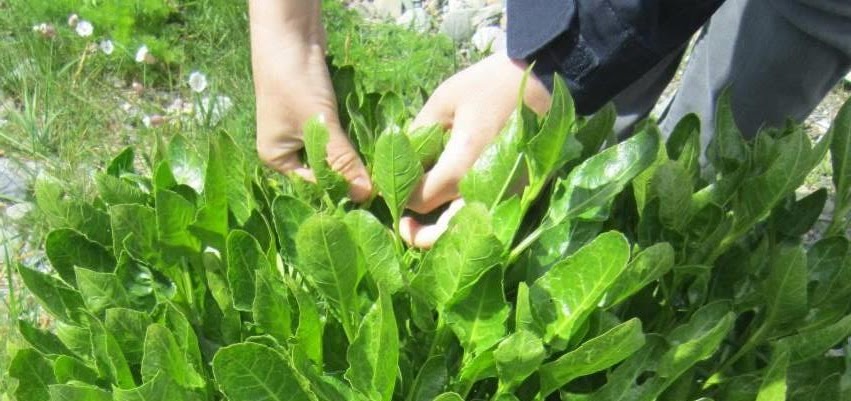
Just by chance, on the afternoon of Day 1, we spotted some clumps of sea spinach or sea beet (a distant relative of cultivated Swiss chard) on the beach by the Menai Strait. We picked some of the vivid green leaves and my niece Andrea later cooked up a delicious "Foraged spinach and filo pastry bake"!


Day 2. The first week started during half-term and we were on holiday with family at Trearddur Bay on Holyhead Island. What better place to start the challenge!

We spent the whole day on a virtually deserted beach on the north-west coast of Anglesey, flying kites, jumping off the dunes, rock pooling and paddling in the sea. Gabriel (11) and Daisy (8) then helped create this massive beach sculpture of a mermaid. Pebbles for the scales, seaweed for the hair, limpet shells for decency and even an old glove for a hand!


Before heading off on our holiday I had printed some of the 30 Days Wild random acts of wildness cards. Over breakfast we browsed these for ideas: not that we were short of inspiration on Anglesey. But great for Day 14 as I type this in the office and it pours down!

So, Day 3: time for a walk. The Isle of Anglesey Coastal Path beckoned. This long distance footpath covers much of the island's coast, and is one of my all-time favourites. Our short stretch along Holyhead Island took us up and down rocky outcrops overlooking the Irish Sea smothered in wild flowers such as sea thrift. Happy days!


Day 4 and sadly our week's stay on Anglesey was at an end. It was another baking day so we called in at Betws y Coed on the return home and dipped our feet in the River Llugwy before making footprints on the rocks.

I signed up for the challenge online, and as I type so have 27,386 people! Part of the fun comes from posting photographs of activities on social media and seeing what exciting and creative things other people have been up to. We used the hashtag #30DaysWild on Twitter to spread word of our involvement.

Luckily Day 5 was a Sunday! Chance to catch up at home before returning to work. And we were greeted on our arrival by the cheerful sight of 5 baby pied flycatchers in one of our bird boxes. The birdcam was a Christmas present three years ago and this is the first time any bird has nested in it. How did they know I'd signed up to 30 Days Wild?

Left: Daddy pied flycatcher pops in to check out the youngsters - probably just a couple of days old and snuggled up tight to keep warm.


I'll be honest - fitting in the challenge around work days is harder, but definitely not impossible. Day 6: back to the busy PAVO Mental Health Information Service... in my breaks I wondered what to choose for the day's challenge.

It was a lovely evening at home and I picked just a few wild flowers from the many in my garden - greater stitchwort, red clover and common vetch - to press under a pile of heavy books. Later I might use them to make cards for friends.

Day 7: the end of week one - we'd made it! I'd stayed in touch with Andrea and family who live in the South of England and they too were still really enjoying the challenge (still are on Day 14 where James Carter's poem "The Tree" is inspiring them).

At lunchtime on Day 7 I went for a walk on a short section of our local long distance walk - the Severn Way. Our office is just a few hundred yards away from the river in Newtown. I found some sycamore seeds (blown off early?) and just played, even when the rain poured down I was still sheltered by the leaf canopy.

That was a week ago now! And the challenge rolls on. We're having fun, being creative, and learning so much stuff - it's brilliant. If you've taken the 30 Days Wild challenge, tell us all about it in the comments section below.